

Outdoor play is a core learning environment
Outdoor play supports movement, confidence, cooperation, curiosity and connection with the natural world. It also creates space for science, mathematics, storytelling and large-scale construction. A strong programme combines meaningful challenge with active supervision, safe equipment, weather-responsive decisions and ways for energetic, quiet and differently mobile children to participate.
Outside should not be treated only as a break from learning indoors. Wind changes a fabric structure, a slope changes speed and a garden insect invites close observation. The scale and conditions create questions that cannot be reproduced exactly at a table.
Parents assessing outdoor provision should look beyond the number of fixed structures. The quality of access, interaction, adaptable materials and supervision shapes what children can actually do.
Movement builds confidence and judgement
Running, climbing, carrying, balancing and changing direction support coordination and body awareness. Children learn what different surfaces and speeds feel like. Adults supervise, maintain safe boundaries and help children judge manageable challenges. The aim is not to remove every uncertainty, nor to expose children to hazards they cannot understand.
Large spaces change collaboration
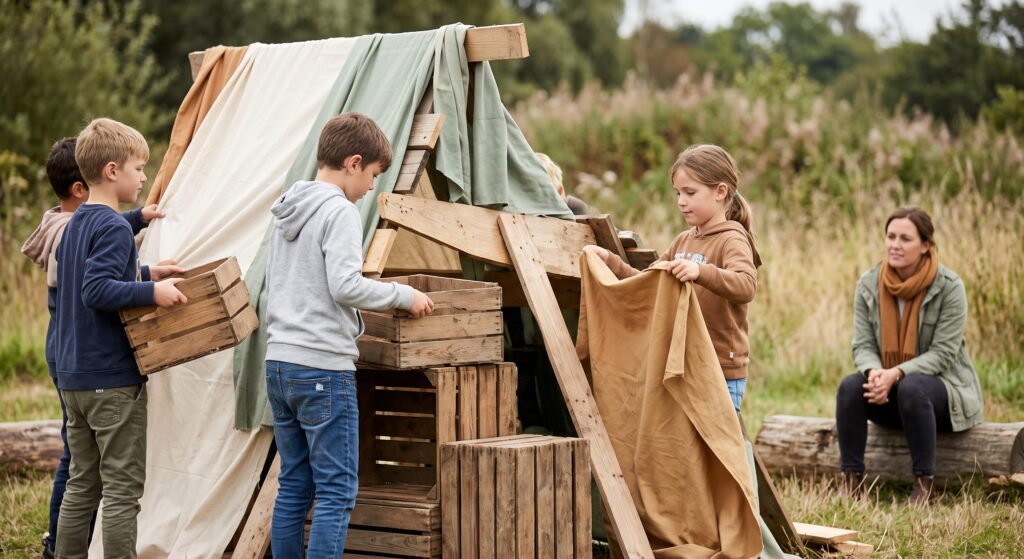
Outdoors, children can build at a larger scale, transport heavier loose parts and develop games that involve distance. They must communicate about pathways, shared equipment and changing rules. Teachers can make participation visible and intervene when speed, noise or confident leadership pushes others out.
Outdoor learning is wider than physical development
- Science through weather, plants, insects, water and materials
- Mathematics through distance, capacity, pattern and measurement
- Language through plans, rules, stories and negotiation
- Creativity through movement, sound and large-scale design
- Responsibility through caring for equipment and living things
Weather provides real information
Rain changes soil, wind reveals force and sunshine changes shade. Centres make decisions according to conditions, safety and children’s wellbeing rather than promising identical access in every circumstance. Families should ask what clothing is needed, how wet items are managed and how sun protection fits current procedures.
Challenge and hazard are not the same
Balancing on a suitable structure may be challenging because the child must assess and adjust. Broken equipment or an unseen poisonous plant is a hazard requiring adult action. Ministry guidance requires safe premises, equipment and playground surfacing. Teachers inspect, position themselves and respond while allowing age-appropriate physical problem-solving.
Active supervision is more than being nearby
Adults consider where children are, what they are doing and how the situation may change. They scan, listen, move and engage. A fixed blind spot, crowded zone or transition between spaces can alter risk quickly. Parents can ask how the environment supports lines of sight and how staff communicate when children use several areas.
Quiet participation belongs outdoors too
Not every child wants to run or climb. Gardens, books, drawing, small-world play and sheltered observation can create calmer possibilities. A child with sensory or mobility needs may require adapted surfaces, positioning, equipment or time. Inclusion is not achieved simply by opening a door.
Indoor ideas can travel outside
A block design may become a full-size hut. A story may inspire a map or movement game. Measurements taken outdoors can be drawn or compared inside. When teachers help ideas cross environments, children can represent the same thinking in different scales and materials.
Nature should be encountered respectfully
Children can notice living things, seasonal change and the consequences of their actions. Adults model gentle handling and decide when observation is more appropriate than collecting. Concepts such as kaitiakitanga can be explored through repeated care and relationship with place, not reduced to a slogan.
Outdoor equipment needs more than visual appeal
Fixed structures and surfacing must be safe and maintained. Loose resources also need appropriate size, condition and storage. Families can ask how equipment is checked and how the team adapts the space as children’s abilities and group patterns change. A photograph cannot show these everyday systems.
A practical observation route for parents
- Notice what children can initiate, move and combine.
- Watch teacher positioning and interaction across the area.
- Look for both energetic and quieter possibilities.
- Ask how challenge, weather and clothing are managed.
- Consider whether different ages and abilities can participate meaningfully.
Review the programme across time
One visit may coincide with rain, maintenance or a particular group interest. Ask for examples of how outdoor ideas have developed and how the centre reviews which children use the space. Learning stories and direct conversations can add context, while current operational details should always be confirmed with the relevant centre.
Access between spaces affects independence
Current centre-based guidance expects outdoor activity space to connect with the indoor area so children can access it safely and easily. In daily practice, doors, steps, storage and adult positioning influence whether movement is genuinely workable. A child may need help with footwear, mobility equipment or carrying an idea across the threshold. Ask how access is organised rather than assuming that adjacent rooms automatically create a connected programme.
Outdoor learning needs resources that can change
Fixed equipment supports valuable movement, but loose parts, water, sand, tools, art materials and natural objects can make the environment responsive to current interests. Selection must remain age appropriate and safe. Teachers review whether resources invite cooperation, create congestion or exclude a group, then adapt the setup rather than leaving it unchanged for appearance.
Outdoor play in early childhood: FAQs
Should children go outdoors every day?
Ask the centre how it makes safe, weather-responsive decisions and what clothing or sun-protection arrangements currently apply.
Is climbing too risky for preschool children?
Suitable challenge can support judgement and confidence when equipment, environment and supervision are appropriate. Hazards still require adult management.
What if my child prefers quiet activities?
Look for calmer outdoor choices and ask how teachers support participation without forcing high-energy play.
How can I assess supervision on a tour?
Observe positioning, movement, lines of sight, engagement and how adults respond as activities and locations change.
Contact Childsplay Unlimited
Visit the outdoor learning environments at Childsplay Unlimited. Call Mt Roskill on 09 627 9041 or Kingsland on 09 846 8908 to arrange a tour and confirm current routines, clothing guidance and outdoor practices.