

Play is a serious way of learning
Play-based learning gives children meaningful opportunities to explore ideas, relationships, movement, language and materials. Children influence the direction, while kaiako prepare environments, observe closely and extend learning with thoughtful responses. It is neither unstructured free time nor a disguised worksheet: it is an active partnership between curiosity, teaching and reflection.
A child arranging stones, rebuilding a tower or negotiating a pretend café may look as though they are simply having fun. Fun matters, but much more can be happening. The child may be comparing size, testing balance, recalling a family experience, using new words, managing frustration and coordinating a shared plan.
In Aotearoa New Zealand, Te Whāriki positions play as an important part of early childhood experience. Understanding what makes play educational helps parents look beyond colourful equipment and ask how children’s ideas are noticed, challenged and revisited.
Play-based learning starts with active participation
Children learn differently when they can handle a material, make a choice and see the result. Pouring water reveals capacity and flow. Moving a plank changes a pathway. Giving a doll a blanket turns memory and empathy into action. The learning is not limited to a correct answer because children can repeat, modify and connect the experience to another idea.
Child choice and adult teaching work together
A common misunderstanding is that play-based learning requires adults to stand back at all times. Kaiako may choose useful resources, model a technique, introduce a word, help children enter a group or ask a question that opens another possibility. The skill lies in responding without taking ownership of the play. Sometimes the strongest decision is to wait and observe.
What kaiako may be noticing
- The working theory a child appears to be testing
- Language, movement or social strategies being practised
- Who can enter the play and who remains on the edge
- Whether a new material would deepen or distract from the idea
- When safety guidance or practical help is needed
One experience can connect many areas of learning
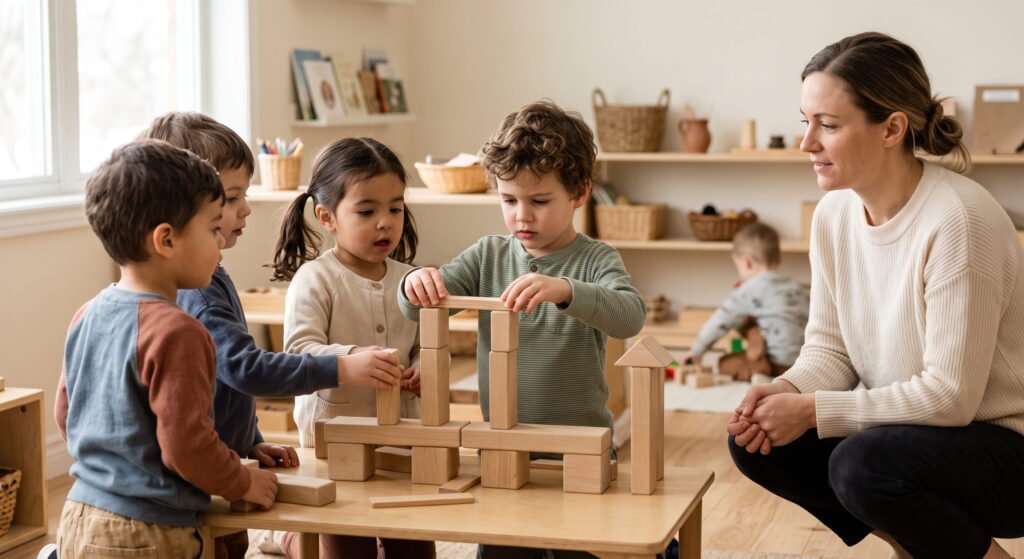
Building a bridge may involve measurement, spatial thinking, storytelling, cooperation and persistence. Dramatic play can combine vocabulary, cultural knowledge, counting and emotional understanding. This is one reason early learning does not need to divide every experience into school subjects. Children often use several capabilities at once while pursuing a purpose that matters to them.
Repetition is development, not a lack of ideas
Adults may wonder why a child fills the same container or tells the same story repeatedly. Each return can make the sequence more predictable, efficient or complex. A child may vary speed, recruit a friend or represent the idea in drawing. Kaiako can protect enough time for repetition while watching for the moment when a small extension would be useful.
Play creates real reasons to communicate
Children use words, gesture, facial expression, signs, drawings and objects to organise shared activity. They request a turn, explain a plan and repair misunderstandings. Adults can contribute useful language without turning the exchange into a test. This matters for children who are developing English as an additional language or who communicate in different ways.
Challenge belongs in a responsive programme
Learning often involves uncertainty: the tower falls, the puzzle piece does not fit or a peer rejects the first plan. Children need emotional safety and realistic help, but not every difficulty should be removed immediately. A responsive teacher judges when to encourage another attempt, simplify one part, demonstrate a strategy or help children negotiate.
A useful parent question
Instead of asking only what activities are available, ask for an example of an interest that developed across several days. The answer can reveal whether teachers observe, document, plan and adapt, or whether resources are presented as disconnected events.
The environment communicates expectations
Accessible materials invite children to begin and combine ideas. Spaces for movement, conversation, concentration and messy exploration support different ways of participating. Attractive displays matter less than whether children can use the environment purposefully. During a visit, look for evidence of current thinking rather than rooms arranged mainly for adults to admire.
Play should reflect children, families and place
Family stories, languages, occupations, celebrations and local places can give play richer meaning. Teachers should avoid reducing culture to occasional decorations. Genuine partnership allows children to see familiar knowledge respected while meeting perspectives beyond their own. Parents can help by sharing the words, routines and experiences children are currently using at home.
Assessment can make learning visible
A learning story or conversation may identify what the child attempted, why it mattered and what could happen next. Documentation is most useful when it supports further learning rather than merely proving that an activity occurred. Childsplay Unlimited uses Storypark, and families can ask how online stories, direct conversations and observations contribute to planning.
How to recognise a thoughtful play-based centre
- Children have time to begin, sustain and revisit meaningful ideas.
- Kaiako can explain learning without forcing every experience toward one outcome.
- Resources are adaptable and accessible, with suitable support for different ages.
- Children’s languages, families and interests are visible in genuine ways.
- Adults balance observation, interaction, safety and intentional teaching.
No single tour moment proves the quality of a whole programme. Ask questions, observe relationships and seek examples across time. Strong play-based learning is visible in the depth of participation and teaching decisions, not in the number of activities advertised.
Play-based learning questions from parents
Is play-based learning just free play?
No. Children have agency, but kaiako deliberately prepare environments, observe, respond, teach and review what learning opportunities are emerging.
Will children still learn early literacy and maths?
Yes. Meaningful play can involve stories, symbols, counting, pattern, measurement and problem-solving, supported intentionally rather than forced into worksheets.
Does every child need to join the same activity?
Not usually. Teachers can create shared experiences while recognising age, interest, confidence, communication and individual support needs.
How can parents support play at home?
Offer time, conversation and adaptable everyday materials, follow the child’s idea and share useful observations with kaiako.
Contact Childsplay Unlimited
See play-based learning in action at Childsplay Unlimited. Call Mt Roskill on 09 627 9041 or Kingsland on 09 846 8908 to arrange a visit and discuss how the current programme supports your child’s interests, relationships and development.