

Sensory play is investigation, not sensory overload
Babies and toddlers learn through seeing, hearing, touching, moving, smelling and, when materials are intended for it, tasting. Effective sensory play offers safe, age-appropriate experiences with space to repeat and withdraw. Adults observe closely, use simple language and extend curiosity without demanding a particular product, reaction or finished result.
Sensory play is often presented online as a colourful activity in a tray. For children under two, it is much broader. The feel of grass, the sound of a spoon, the resistance of dough, the movement of water and the changing light outdoors can all invite investigation.
The quality of the experience depends less on novelty than on safety, access and adult judgment. Babies explore with their whole bodies and may mouth objects, while toddlers move quickly and repeat actions. Materials and supervision must suit the actual children present.
Begin with the senses already in the room
A child does not need an elaborate setup to explore. A woven basket, cool metal cup, wooden ring, soft cloth or patch of sunlight can offer contrast. Outdoors, wind, leaves, water and changing ground surfaces provide rich information. Teachers can select a small number of materials and watch what each child does before adding more.
Repetition is the experiment
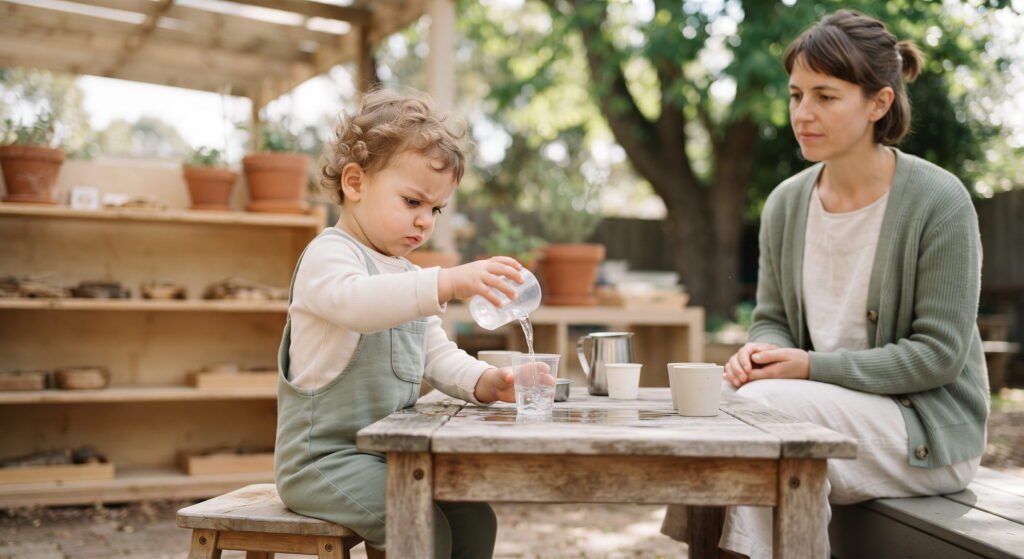
A toddler who pours water fifteen times is not failing to move on. They may be investigating volume, force, sound, control and prediction. A baby who repeatedly rubs two textures is comparing them. Adults can protect time for repetition, describe a useful contrast and resist turning the play into a demonstration with one correct method.
Common patterns adults may notice
- Patting, squeezing, rubbing or pressing
- Filling, emptying, dropping and retrieving
- Listening for a repeated sound
- Moving closer, pausing or turning away
- Watching another child before trying an action
Safety starts with developmental reality
An object safe for an older preschooler may be a choking risk for a baby. Materials must be non-toxic, hygienic and appropriate for mouthing, allergies and the level of supervision. Water requires close, active supervision. Food should not automatically be used as play material, particularly where allergies, cultural values or family access make that inappropriate. Ask how a centre assesses and cleans sensory resources.
Not every child wants the same sensation
One toddler may step into mud immediately; another may watch from a distance or use a tool. Respectful participation includes an acceptable way to observe, approach slowly or stop. Adults can offer a spoon, dry alternative or nearby experience without labelling reluctance as a problem. Familiarity may grow through repeated, pressure-free encounters.
A child’s ‘no’ is useful information
Turning away, stiffening, dropping an item or seeking an adult can show that an experience is too much, unfamiliar or simply uninteresting. A teacher can reduce intensity, create space and try another day. Sensory learning should support curiosity and wellbeing, not become a test of tolerance.
Language can stay close to what is happening
Words such as smooth, rough, heavy, splash, quiet, cold and sticky connect language with direct experience. A teacher may mirror a sound, name an action and wait. Questions should not dominate. Under-twos also communicate through expression, gesture and movement, so the adult’s job includes listening with more than ears.
Movement is part of sensory learning
Balance, pressure, position and motion give children information about their bodies. Crawling over a gentle change in surface, pushing a sturdy object or rocking with a song may be as sensory-rich as touching a material. Environments should offer freedom to move while maintaining safe boundaries and clear supervision.
Home connections make experiences more meaningful
Families can share familiar songs, natural materials, cooking experiences, languages and cultural knowledge. Teachers can use that information thoughtfully rather than creating a generic ‘culture activity’. Ask how the centre learns from whānau and how parents hear what captured their child’s attention. A Storypark post may document the learning, while a quick conversation can add important context.
A simple lens for evaluating sensory play
- Is the material safe for these children’s ages and behaviours?
- Can children choose how closely and how long to engage?
- Is there room for repetition rather than a required product?
- Are adults observing and responding instead of controlling every action?
- Can the experience connect with movement, language or home knowledge?
What a parent might see on a centre visit
Look for accessible materials rather than an overcrowded display. Notice whether teachers allow concentration, clean resources appropriately and adapt for children at different stages. Ask for a recent example of a child’s sensory interest developing over time. The answer should reveal observation and responsiveness, not simply a list of themed activities.
Plan for ending and recovery as well as beginning
A sensory experience needs an exit. Children may need clean water, a towel, dry clothing, a quieter space or simply time to watch after intense movement. Teachers can warn that an experience is finishing, help children transition and note whether a particular material left them calm, excited or uncomfortable. Parents can ask what spare clothing is needed and share sensitivities that affect washing or skin care. Thoughtful endings protect wellbeing and help the next encounter begin with trust rather than surprise.
Sensory play questions for parents
Does sensory play need a special tray?
No. Everyday objects, safe natural materials, movement, music, water and outdoor experiences can all support sensory exploration.
What if my child avoids messy play?
Offer observation, tools or a less intense alternative without pressure. Share known sensitivities and helpful approaches with the centre.
Are food-based activities always appropriate?
No. Allergy, hygiene, cultural and ethical considerations matter. Ask how materials are selected and managed.
How does sensory play connect to Te Whāriki?
It can support exploration, communication, wellbeing and relationships when children investigate actively and adults respond thoughtfully.
Contact Childsplay Unlimited
To see how babies and toddlers explore through play, arrange a visit with Childsplay Unlimited. Contact Mt Roskill on 09 627 9041 or Kingsland on 09 846 8908 and ask about current under-two spaces and experiences.