

Science and technology begin with curiosity, tools and design
Early science involves observing, wondering, predicting, testing and revising ideas about the natural, physical and social world. Technology includes tools, materials, systems and designs created to meet purposes; it is not limited to screens. Hands-on investigation should lead, while carefully chosen digital tools may document, magnify, record or revisit learning when they add genuine value.
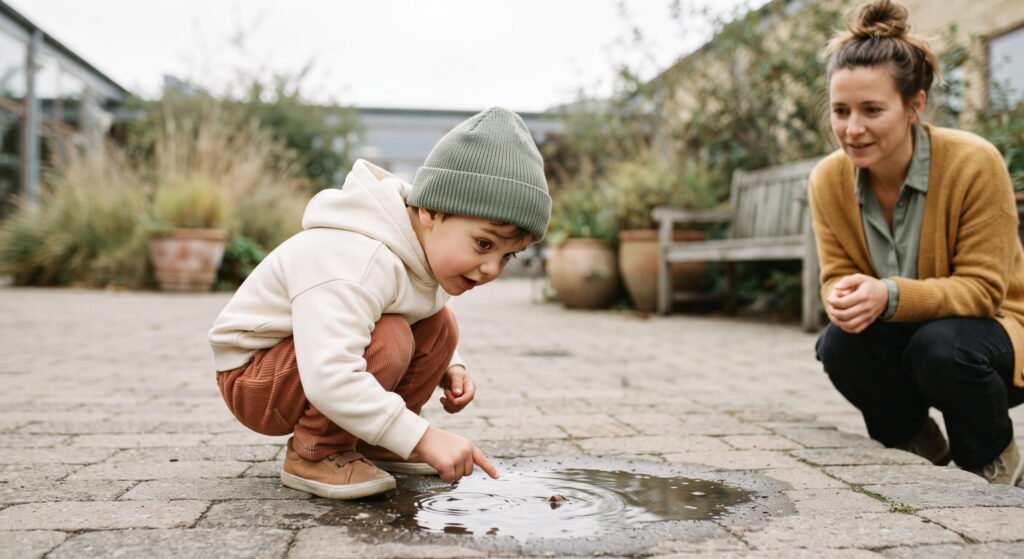
A puddle disappears from one part of the playground before another. A paper boat changes when its cargo is moved. A child photographs a plant each week and notices a new leaf. These moments combine curiosity with evidence. Children are developing working theories—evolving ideas that help them make sense of experience—and they adjust those ideas through further exploration.
Science and technology in early childhood do not require a miniature school laboratory or a collection of apps. They grow through sustained attention to real phenomena, useful tools, design problems and conversations in which children’s explanations are taken seriously.
Science starts with a phenomenon worth revisiting
A one-off experiment can be exciting, but deeper inquiry usually needs time. Children may return to shadows, insects, ramps, mixing, growth, sound or weather across days. Repetition lets them compare conditions and notice variation. Teachers can keep useful materials available, record questions and resist announcing the explanation before children have had an opportunity to investigate.
An inquiry conversation in five moves
- Notice closely: What can we see, hear, feel or measure safely?
- Invite ideas: What does each child think may be happening?
- Choose a test: What could we change or compare?
- Record evidence: How can we remember the result?
- Reconsider: Did our idea change, and what do we wonder now?
The adult does not need to pretend that every idea is equally supported by evidence. They can value the child’s contribution while helping the group compare what actually happened. Honest uncertainty—’I don’t know yet; how could we find out?’—models inquiry.
Observation is active, not passive
Children observe through movement and senses as well as still attention. They may roll, pour, squeeze, listen, compare or draw. Safety and respect for living things set boundaries. Magnifiers, transparent containers, mirrors, torches, scales or simple measuring tools can extend perception, but the tool should serve the question rather than become the entire activity.
Technology is broader than digital technology
A lever, wheel, sieve, fastening, bridge, water channel and recipe are technologies because people have designed processes or objects for purposes. Construction play allows children to identify a need, select materials, create, test and improve. Asking ‘Who will use it?’ or ‘What must it do?’ connects design decisions with human needs.
A child-sized design brief
- We need a way to move these objects without carrying them one by one.
- The puppet needs a shelter that will stay up outside.
- Our sign must be visible from the other side of the room.
- The water needs to reach the second container without spilling everywhere.
- We want to remember how the seedling changes each week.
Digital tools should add a capability
A camera can capture change, an audio recorder can preserve a child’s explanation and a digital microscope can reveal detail. The value lies in what becomes possible to observe, create or revisit—not in using a device for its own sake. Shared, adult-supported use is often more connected with inquiry than passive consumption. Centres should make decisions using current policy, privacy, consent, online-safety and curriculum guidance.
Documentation can strengthen evidence
Children might arrange photographs in sequence, compare two recordings, mark rainfall on a simple chart or draw what changed. Adults can write down a child’s prediction before the test so the group can revisit it honestly. Documentation should remain understandable to children and protect privacy. Not every image needs to be uploaded or shared beyond the learning context.
Science language can remain connected to experience
Words such as dissolve, absorb, transparent, balance, force and habitat can help children distinguish what they notice. Introduce terms in context and return to them, rather than presenting a vocabulary list. Te reo Māori and home-language knowledge can contribute to inquiry, particularly when families share accurate words, practices and relationships with the local environment.
Avoid the demonstration trap
An adult-led spectacle may show a surprising effect while giving children few decisions. Ask who can pose questions, handle materials, predict, change a variable and explain evidence. Some demonstrations are necessary for safety or access, but they should connect with opportunities for children to investigate rather than simply watch for a dramatic result.
Ethics and safety are part of inquiry
Teachers assess hazards, supervise tools and establish respectful ways to interact with plants, animals and materials. Children can participate in caring decisions without carrying adult responsibility. Cultural knowledge and local stories also require accurate context and appropriate permission. Curiosity does not justify collecting, disturbing or publishing everything children encounter.
Questions for Mt Roskill or Kingsland
Ask for a current inquiry that developed across time, how children’s ideas influenced the direction and what role tools or digital technology played. Look for hands-on exploration and thoughtful adult interaction. The centres may have different current projects and resources, so verify what is happening at the location your family is considering.
Science and technology in childcare: FAQs
Does early science need formal experiments?
No. Close observation, comparison, prediction and testing can grow through everyday play and sustained investigation of real phenomena.
Does technology mean screen time?
Not only. Technology includes tools, designs, materials and systems. Digital tools should be selected for a clear learning purpose and used within current safety and privacy guidance.
Should teachers correct an inaccurate theory immediately?
They can provide accurate language and evidence while preserving inquiry. A useful response may invite a safe test or comparison instead of simply announcing the answer.
How can families contribute?
Share relevant skills, questions, cultural knowledge and real-world tools with appropriate context and permission. Ask what investigation is currently meaningful to the group.
Contact Childsplay Unlimited
Explore current science and technology learning at Childsplay Unlimited. Contact Mt Roskill on 09 627 9041 or Kingsland on 09 846 8908 to arrange a visit and ask how children observe, design, test, document and revisit ideas at the relevant centre.