

Safe-sleep questions should produce specific answers
Parents should ask an early learning centre where children sleep, how the space and bedding are kept safe, how adults supervise and record checks, how individual routines are discussed, and how sleep information is shared. Safe practice is governed by current centre procedures and New Zealand licensing requirements, not by assumptions based on appearance or a home routine alone.
Sleep deserves a direct conversation during every under-two childcare enquiry. Parents do not need to become licensing experts, but they should understand the centre’s procedure well enough to know who is responsible, what is recorded and how information about their child moves between home and care.
This guide helps families structure that conversation. It does not replace a centre’s current policy, Ministry requirements or professional health advice, and it does not claim that Mt Roskill and Kingsland have identical sleep spaces.
Ask to have the sleep arrangement explained
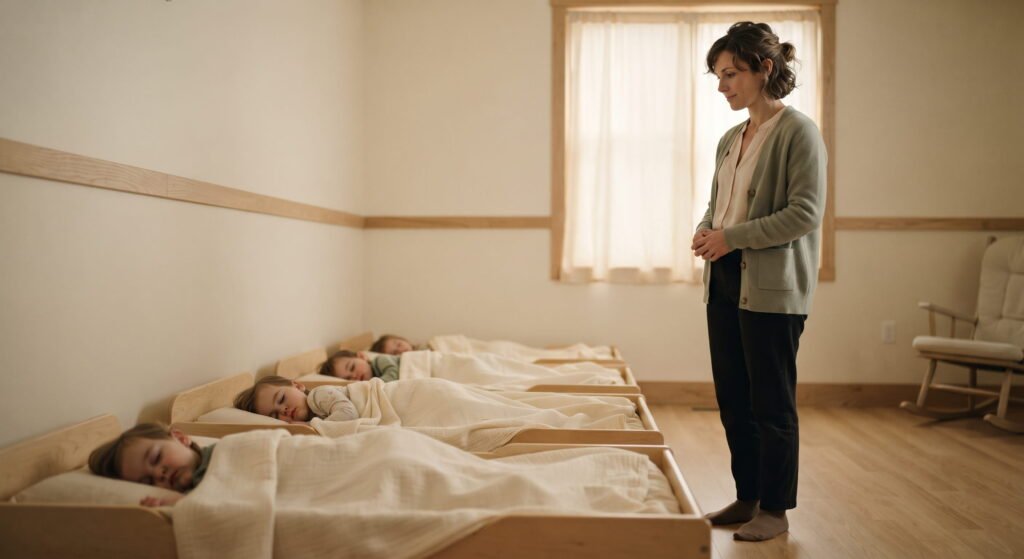
Begin with where children under two sleep and how adults can see, hear and access them. Ask what sleep furniture is used for children at different stages and how the space is kept suitable for rest. Ministry parent guidance says licensed centres must provide a safe dedicated sleeping area for under-twos. The precise room design can differ, so listen for a clear explanation linked to actual practice.
Understand monitoring and written records
Current Ministry centre-based licensing guidance requires a sleep-monitoring procedure and records that include the date, the names of sleeping children, when each child went to sleep and woke, and when adults checked them. Ask who completes the record, how responsibility is handed over and how parents receive relevant sleep information. Documentation supports accountability; it does not replace active supervision.
Five monitoring questions
- How are sleeping children actively monitored?
- What does each check involve under the current procedure?
- Where are sleep, wake and check times recorded?
- How is monitoring responsibility transferred between adults?
- How are concerns or unusual observations communicated to families?
Discuss bedding and the sleep space
Ask how bedding is allocated, stored and cleaned and what families need to supply. Ministry parent information notes that clean sheets and blankets are not shared between children and identifies safe bedding expectations, including no pillows for children under two. Procedures and current requirements should be confirmed directly rather than relying on a photograph or another family’s recollection.
Home routines inform care but do not set the safety rules
Tell the centre how the child usually signals tiredness and settles, plus any relevant health advice. The team can explain what it can safely incorporate. Some home arrangements or sleep products may not be suitable in an early learning service. A strong discussion separates helpful familiarity, such as a phrase or timing cue, from practices that must follow the centre’s safe-sleep procedure.
Bring current information, not an old routine
Under-two sleep can change quickly. Update the centre when naps consolidate, the child becomes more mobile, illness affects rest or a health professional gives new advice. Date written information so everyone can identify the current version.
Ask what happens when sleep does not go to plan
A child may not settle, may wake early or may show tiredness at an unexpected time. Ask how teachers respond and when they contact parents. Avoid seeking a guarantee that the child will sleep for a set duration. A safer question is how the team balances individual cues, wellbeing, supervision and the broader day when sleep differs from expectation.
Know how illness changes the response
Parents should provide accurate health information and keep an unwell child home according to the centre’s policy and public-health advice. Ask what teachers do if a sleeping child appears unwell or has an unusual breathing pattern, and how families are contacted. Any medical concern requires appropriate professional assessment; centre records and observations can support that conversation but do not diagnose the child.
Observe the culture around sleep
Procedure matters, and so does tone. Listen to how teachers talk about children who settle differently. Do they describe cues and strategies respectfully, or blame the child? Ask how noisy transitions are managed and how active parts of the day coexist with rest. A calm culture does not mean silence everywhere; it means adults understand sleep as part of wellbeing rather than an inconvenience.
Compare each Childsplay Unlimited centre separately
When visiting Mt Roskill or Kingsland, ask the same core questions but record the answers under separate headings. Confirm the actual space, current process, supplies and communication for that location. Do not transfer an answer from one centre to the other. If a point is important to enrolment, request that it be documented through the relevant centre’s process.
Use a final safe-sleep enquiry checklist
- Current sleep procedure explained in plain language
- Monitoring and record-keeping responsibilities clear
- Sleep space, furniture and bedding arrangements understood
- Individual cues and safe settling information recorded
- Family communication and escalation process confirmed
Safe-sleep confidence should come from evidence: current policy, specific explanations, direct observation where appropriate and responsive answers to questions. If something remains unclear, follow up before enrolment rather than filling the gap with an assumption.
Safe sleep in early learning questions
Do licensed centres record sleep checks?
Current Ministry guidance requires sleep records that include sleep and wake times and when adult checks occurred.
Can my baby use the same sleep setup as at home?
Discuss it with the centre. Service procedures and licensing requirements determine what can safely be used in that environment.
Should I ask to see the sleep area?
Ask the centre how it can explain or show the arrangement without disturbing sleeping children or compromising privacy and supervision.
Where can I find current safe-sleep advice?
Use current Ministry of Education and trusted New Zealand health information, and seek individual clinical advice from a qualified professional.
Contact Childsplay Unlimited
Ask the Childsplay Unlimited centre you are considering to explain its current safe-sleep procedure. Call Mt Roskill on 09 627 9041 or Kingsland on 09 846 8908 to discuss sleep spaces, monitoring, records and your child’s needs.