


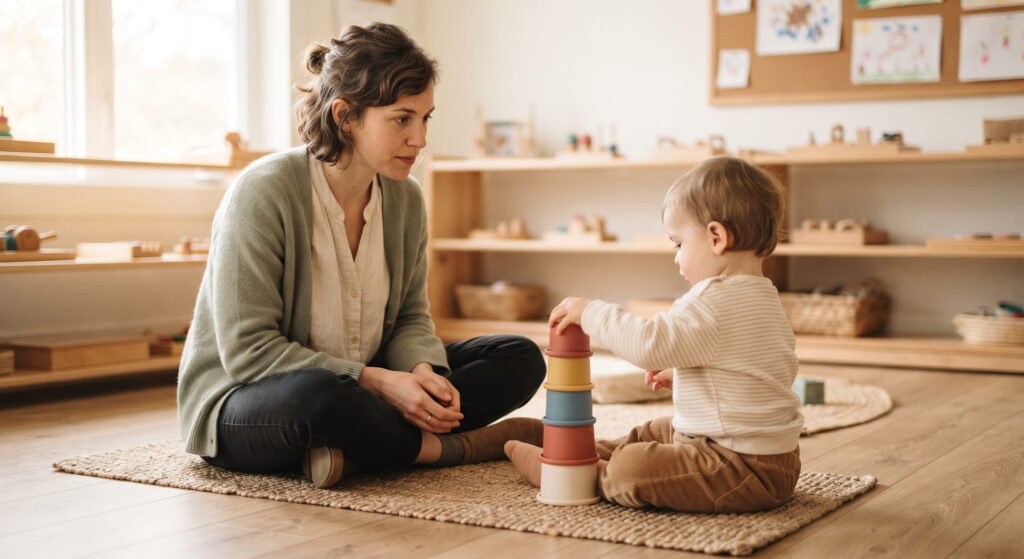
Trust is built in small, repeated responses
Responsive caregiving means noticing a baby or toddler’s cues, interpreting them thoughtfully and answering in a warm, timely and respectful way. Trust grows through repeated experiences of being greeted, comforted, listened to, fed, changed and invited into play. Responsiveness is not instant perfection; it is an attentive relationship that becomes more informed over time.
A centre tour may showcase rooms, resources and planned experiences, yet a young child experiences childcare mainly through relationships. Before children can explain what they need in sentences, they depend on adults to notice expression, movement, sound, attention and changes in behaviour.
Te Whāriki places reciprocal and responsive relationships at the heart of learning. For families, that idea becomes practical when teachers treat communication as a two-way process and allow a child’s signals to influence what happens next.
A cue is an invitation to pay attention
A baby turning away may need a pause. Reaching arms may ask for closeness. A toddler carrying shoes to the door may be communicating a plan. No single gesture has one guaranteed meaning, so responsive adults combine the cue with context and what they know about the child. They try an answer, watch the response and adjust. This respectful cycle is more important than claiming to read every signal correctly.
Warm timing changes the experience
Responsiveness includes timing. Acknowledging a child quickly can provide reassurance even when the adult cannot complete the requested action immediately. A teacher might say that they see the child waiting, move closer, finish a safety task and then return. The child experiences being noticed rather than ignored. In a group setting, skilled caregiving often involves transparent, calm prioritising.
Everyday places where trust grows
- A familiar greeting at arrival
- A pause for the child to respond during a care routine
- Comfort that changes when the first approach is not helping
- Language that describes what the child appears to notice or attempt
- A reliable reunion and useful family handover at collection
Consistency is relational, not mechanical
Young children benefit from familiar people and recognisable ways of being cared for. That does not require every interaction to follow a script. One day a toddler may walk into play; another day the same child may need to stay close to a trusted adult. Consistency means the response remains respectful and dependable even as the strategy changes.
Care moments allow focused connection
Feeding, dressing and nappy changing naturally bring an adult and child close together. When unhurried, these moments offer predictable language, eye contact, turn-taking and participation. A child can be told what will happen, invited to help and given time. The practical task is still completed safely, but it also communicates that the child’s body, signals and cooperation matter.
Play reveals what the child is thinking
Responsive teaching does not require adults to direct every activity. A teacher may sit nearby, watch a repeated action and add one possibility at the right time. If a baby is fascinated by a rolling object, the adult might return it slowly and name the movement. If a toddler is transporting leaves, the adult might provide a container. Following the child’s interest can extend concentration without taking ownership away.
Wait time is an active teaching choice
Babies and toddlers often need longer to process language, organise movement or decide whether to engage. An adult who asks, acts and moves on too quickly can miss the response. Waiting with attentive body language gives the child a genuine turn and helps the adult see capabilities that speed can hide.
Families hold knowledge the centre needs
Parents know home words, comfort strategies, cultural practices, recent events and the child’s history. Teachers see the child in a peer group and across centre routines. Neither view is complete by itself. Share specific observations rather than broad labels, and expect the centre to contribute what it notices. Storypark can support learning communication, while important care or wellbeing information may also need a direct conversation.
Responsive care still has boundaries
A responsive teacher cannot safely meet every request in the exact form or moment a child prefers. Health procedures, supervision and the needs of other children matter. The quality question is how the boundary is communicated and what support is offered. Calm acknowledgement, a simple explanation and a realistic alternative can preserve dignity while adults maintain safety.
What parents can observe during a visit
- Watch how adults respond to children who are not seeking attention loudly.
- Notice whether teachers get physically near and use a calm voice.
- Look for pauses that allow children to answer through words or actions.
- Ask how family knowledge enters planning and everyday care.
- Request an example of practice changing after a child’s cue or interest was noticed.
Trust is visible over a sequence, not a performance
One charming interaction on a tour cannot prove the depth of every relationship. Look for patterns across the room and ask how familiar caregivers, transitions and communication are managed. As children attend regularly, teachers and families can review who the child seeks, how they recover from distress, where they play with confidence and what new cues everyone is learning to recognise.
Responsive caregiving questions
Does responsive care mean a child never waits?
No. It means the child is noticed and supported thoughtfully while adults manage safety and other children’s needs.
How can parents help teachers understand cues?
Share specific examples, home words, recent changes and what different signals tend to mean, then compare observations over time.
Is responsive caregiving only for babies?
No. Toddlers also need adults who notice gestures, emerging language, emotions, intentions and changing needs.
What should I look for on a tour?
Look for warm proximity, careful listening, wait time, respectful care language and adults adjusting to individual children.
Contact Childsplay Unlimited
Visit the Childsplay Unlimited centre relevant to your family and observe relationships in everyday moments. Call Mt Roskill on 09 627 9041 or Kingsland on 09 846 8908 to discuss under-two care and arrange a visit.