

A strong partnership turns separate observations into one coherent pathway
Parents and kaiako can support school readiness by sharing strengths, interests, culture, communication, practical capabilities and situations that still require support. Agree on a small number of meaningful goals, compare what happens across settings and involve the child. Share information with the receiving school only when relevant and consented, and verify its current transition requirements directly.
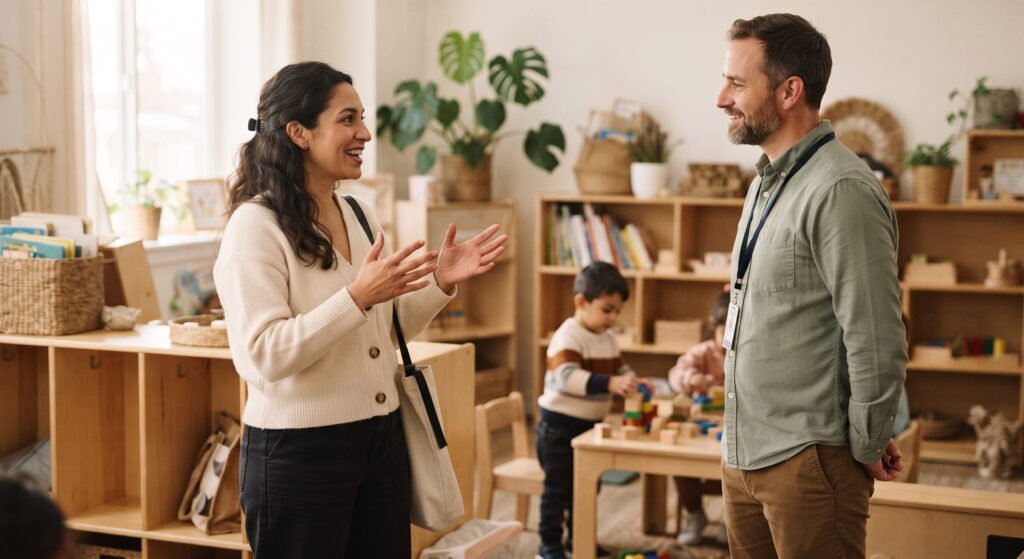
Parents see capabilities that may never appear during a centre day: caring for a sibling, explaining a family tradition, navigating a familiar journey or persisting with a home project. Kaiako see how the child participates among peers, enters group play, manages transitions and uses the environment. Neither view is complete alone.
Partnership brings these observations together without making one adult the expert on every part of the child. It also keeps school readiness from becoming a last-minute report card. Families and teachers can build a shared picture over time, choose useful supports and help the receiving school meet the child as a learner with history, identity and agency.
Start the conversation with strengths
Ask what the child enjoys, initiates, explains, returns to and contributes. A strength may be careful observation, humour, physical coordination, storytelling, empathy, pattern recognition or persistence. Describe a real example rather than applying a fixed label. ‘She watched the game twice, then proposed a role’ gives more useful information than ‘she is shy’.
Build a shared readiness profile
- Relationships and people who help the child feel secure
- Languages and methods used to communicate
- Interests that sustain attention and invite learning
- Ways the child joins, leads, watches or negotiates play
- Self-help tasks and the supports that make them accessible
- Responses to change, noise, uncertainty and group routines
The profile should remain open to change. It is a starting point for support, not a permanent description of what the child can or cannot do.
Choose one goal with a real purpose
A useful goal might be asking an unfamiliar adult for help, recognising belongings or contributing during a short shared experience. Define what participation could look like and which support is acceptable. ‘Will independently complete all tasks’ is too broad. ‘Will use speech, sign or a help card to tell an adult when a container is stuck’ is observable and respects different communication methods.
Use an observe–share–adjust cycle
- Observe the capability in ordinary contexts.
- Share a specific example and the conditions around it.
- Agree on one consistent support or phrase.
- Try it across home and early learning without forcing performance.
- Review what changed and adjust the goal or environment.
Let the child influence the plan
Ask what the child thinks they are good at, wants to know and would like the new teacher to understand. Accept answers through drawing, play, photographs, gesture or another communication method. Adults still hold responsibility for safety and administration, but the child should not experience transition as decisions happening entirely around them.
Use documentation selectively
A learning story, photograph, work sample or family account may show how the child reasons, communicates and persists. More material is not always better. Select examples that illuminate strengths or support needs and ask what the receiving school can use. Childsplay Unlimited uses Storypark, but parents should discuss consent, audience and privacy before any information is shared beyond its original purpose.
Keep family aspirations central
Families may value language continuity, cultural identity, confidence, relationships, curiosity, spiritual life, independence or connection with whānau. Invite those aspirations instead of treating school readiness as a universal adult checklist. Where expectations differ, discuss the reason and look for a plan that protects the child’s mana and access to learning.
Connect with the actual school
Ask the receiving school what transition visits occur, which information is useful, who coordinates additional support and how family knowledge is welcomed. Kaiako may have relationships with nearby schools, but arrangements can change and a child may attend elsewhere. Confirm current details directly rather than relying on a past transition.
Questions that improve the handover
- Which strengths should the new teacher notice quickly?
- What helps the child communicate, regulate and participate?
- Which words, names or cultural knowledge require accurate pronunciation and context?
- What has already been tried, and what was the result?
- What consent is in place for sharing records or professional information?
Avoid turning partnership into surveillance
Families do not need a daily score for every readiness skill, and teachers should not document private care details unnecessarily. Share information proportionately and use secure channels. Direct conversation may be more appropriate than a public or widely shared learning story. The child’s dignity matters during preparation as much as after school begins.
Continue the partnership through the transition
After the child starts, new strengths and difficulties may appear. Keep communication with the school focused and factual, allow time for adjustment and revisit supports when necessary. The early learning relationship may provide helpful continuity, but the centre and school should agree on any contact and information sharing. Transition is complete only gradually as the child develops belonging in the new setting.
Questions for both Childsplay locations
Ask the Mt Roskill or Kingsland team how families currently contribute aspirations, how transition goals are chosen and how consent is managed. Request examples from the relevant centre. Do not assume the two teams use identical documentation, school relationships or transition activities.
Parents, kaiako and school readiness: FAQs
Who decides the readiness goals?
Goals should be developed with family knowledge, teacher observations and the child’s voice, while considering information from the receiving school and relevant professionals.
Should every learning story go to school?
No. Select relevant material and share only with appropriate consent and purpose.
What if home and centre observations differ?
Compare the context, relationship, timing and demands. Different observations can both be accurate and help identify useful conditions for participation.
Can goals change?
Yes. Review them as the child develops and as more is learned about the receiving environment.
Contact Childsplay Unlimited
Build a shared transition picture with Childsplay Unlimited. Contact Mt Roskill on 09 627 9041 or Kingsland on 09 846 8908 to discuss family aspirations, current observations and the support available at the relevant centre.