
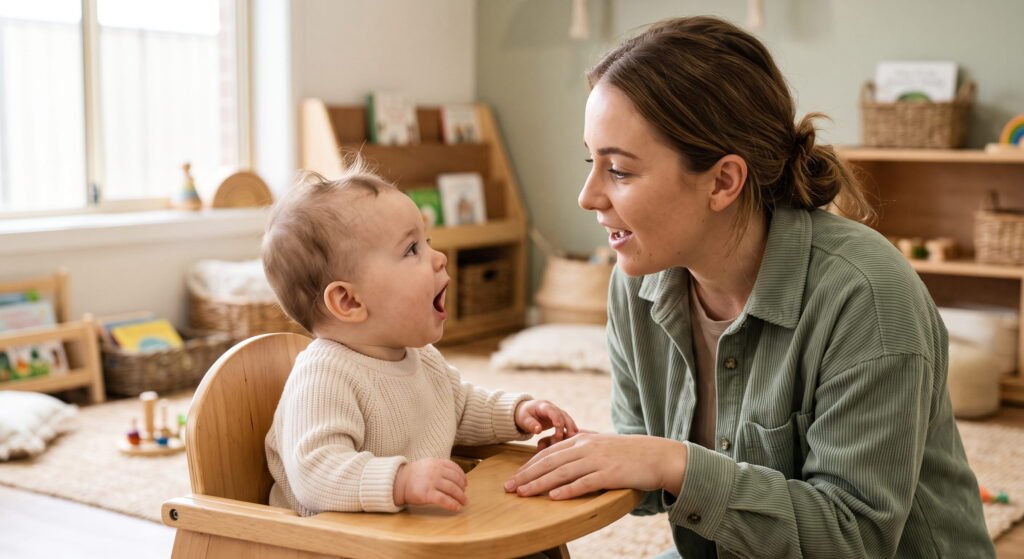
Communication is larger than spoken vocabulary
Mana reo | Communication supports children to express and interpret meaning through spoken and home languages, gesture, signs, stories, images, music, movement, dramatic play and other symbols. Responsive early learning gives children real reasons to communicate, protects the languages and cultural forms important to them, and recognises communication methods beyond conventional speech.
Before a child writes a sentence, they may choreograph a dance, point toward a missing object, repeat a rhythm, draw a route or arrange props to show what happens next. These acts are not distractions from communication. They are ways of making meaning and participating with others.
The Mana reo strand helps adults recognise this breadth. It also challenges centres to consider whose languages and symbols are promoted, whose are overlooked and whether every child has a workable way to be understood.
Communication starts with responsive exchange
A baby looks, an adult pauses, the baby vocalises and the adult responds. This reciprocal pattern shows that communication is relational before it is formal. Across early childhood, children need partners who notice their signals, allow time for response and treat attempts as meaningful. Rapid questioning or correcting can reduce the space in which a child develops an idea.
Oral language includes different communication pathways
Te Whāriki’s Mana reo guidance explains that oral language encompasses the method a child uses as a first language, including New Zealand Sign Language and, for non-verbal children, augmentative and alternative communication. Parents should not assume a communication board, sign or gesture is secondary to real participation. The relevant adults need to understand and support the child’s system consistently.
Ways children may make meaning
- Words, phrases, conversation and home-language storytelling
- Gaze, gesture, facial expression, body position and sign
- Drawing, mark making, maps, photographs and constructed symbols
- Music, rhythm, movement, dramatic role and visual art
- Communication devices, boards or other agreed supports
Communication support should travel across routines
A visual cue or agreed sign is most useful when the adults who work with the child understand it in arrivals, play, care and transitions. Inconsistent use can make the child appear less capable in one context than another. Families and the centre can agree on essential methods, review them as communication changes and seek specialist input where appropriate. The aim is reliable access to relationships and choice, not a special tool displayed only during planned language activities.
A language-rich environment is not an adult monologue
Useful adult language connects with what the child is attending to. A kaiako may comment, expand a phrase, introduce a precise word or wonder aloud, then leave space. A stream of instructions and test questions can sound busy while offering little reciprocal conversation. Quality depends on listening and shared attention as much as the number of words spoken.
Stories organise experience and imagination
Books matter, but story also appears in family memories, pretend play, oral traditions, songs and the sequences children invent around objects. Adults can invite prediction, retelling and alternative endings without insisting on one correct version. Home stories should be treated with consent and care, especially when they contain cultural knowledge or private family details.
Art and movement can hold complex ideas
A painting may explore colour and feeling; a block arrangement can represent a neighbourhood; repeated movement may communicate a character or pattern. Asking the child what the work means can be useful, but adults should accept that not every creation needs a verbal explanation. Documentation can record process, choice and change rather than guessing a fixed message.
Listen for repaired misunderstandings
Communication growth is also visible when a child clarifies a message, changes method or helps a partner understand.
Print becomes meaningful when it has a purpose
Labels, lists, signs, maps and messages help children notice that marks carry meaning. In dramatic play, a ticket or appointment book can support the story. Teachers can model writing and sound awareness while protecting experimentation. Correcting every invented form may shift attention from communication toward fear of being wrong.
A communication audit for a centre visit
- Listen for conversations in which adults pause and respond to children’s ideas.
- Look for books, songs and symbols connected with the children present.
- Ask how home languages and te reo Māori are supported accurately.
- Consider whether gesture, sign, art, movement and communication supports are respected.
- Notice who speaks most and who receives time, interpretation or help to join.
Multilingual communication is an asset
A child may mix languages, listen for a period or use different languages with different people. Official resources describe these as part of bilingual and multilingual pathways, not evidence that a home language should be dropped. Families can share key words, pronunciation, songs and aspirations; kaiako can learn while avoiding claims of fluency they do not possess.
Digital tools should have a communication purpose
A recording can preserve a child’s song, a photograph can support retelling and a device may provide essential access. The question is what the tool enables and who controls the message. Privacy, consent and current centre procedures matter, particularly when children’s images or voices may be shared online through platforms such as Storypark.
Partnership makes interpretation more accurate
Families often understand a gesture, word or reference that is unfamiliar to teachers. Sharing that knowledge can prevent adults from underestimating communication. Ask the relevant Childsplay Unlimited centre how it learns children’s communication patterns and how parents can contribute. Current resources and supports may differ between Mt Roskill and Kingsland.
Mana reo and communication: FAQs
Is Mana reo mainly about talking?
No. It includes languages and symbols expressed through speech, sign, gesture, story, art, movement, print and other communication systems.
Does using a home language delay English?
Official guidance supports bilingual and multilingual pathways and the value of home languages. Discuss individual development concerns with appropriate professionals rather than discontinuing a language based on a myth.
Should every artwork have an adult-written explanation?
No. Documentation can preserve the child’s words when offered, but it should not invent meaning or require a verbal account for every creative process.
How can parents help teachers understand communication?
Share key words, signs, gestures, pronunciation, interests and examples of how your child communicates in familiar settings.
Contact Childsplay Unlimited
Explore communication in all its forms at Childsplay Unlimited. Contact Mt Roskill on 09 627 9041 or Kingsland on 09 846 8908 to arrange a visit and discuss your child’s languages, expression and communication supports with the relevant centre.