

Cooperation develops through practice, modelling and fair support
Taking turns and cooperating are complex social skills, not automatic behaviours children can perform on command. Children need appropriate expectations, reasons to work together, language for joining and negotiating, and adults who protect fairness without controlling every interaction. Small-group play, predictable routines and repeated repair after conflict can gradually strengthen these capabilities.
‘Share nicely’ sounds simple to an adult. For a young child, the moment may require them to manage disappointment, understand another person’s intention, hold a rule in mind, communicate a plan and trust that they will have another opportunity. A demand for instant compliance can hide all that learning.
Early learning offers a social community where children can practise with support. The aim is not a room without disagreement. It is an environment where participation is equitable, conflicts remain safe and children gain more ways to wait, listen, contribute and work with others.
Set expectations that fit the child
Te Whāriki guidance notes that expectations for toddlers’ ability to cooperate, share, wait or take turns should be appropriate. Infants and toddlers may play alone or alongside others before complex collaboration becomes possible. Older children also vary with context, familiarity and emotional state. Teachers can invite participation without interpreting every solitary choice as a problem.
Turn-taking is easier when the sequence is visible
Children may cope better when they can see who is using an item, what ‘finished’ means and how their turn will arrive. A song, short list, timer or physical waiting place can help in some situations. The support should match the activity; rigid timing can interrupt deep engagement, while an undefined wait may feel unfair. Teachers need judgment rather than one universal rule.
Language for entering play
- Can I have a job in your game?
- What are you making?
- I have an idea for the next part.
- Can I use it when you are finished?
- Let’s find another piece while we wait.
Adults can model a phrase, gesture or communication support, then allow the child to make it their own. A scripted sentence should open access, not become a test of correct wording.
Give children a shared problem worth solving
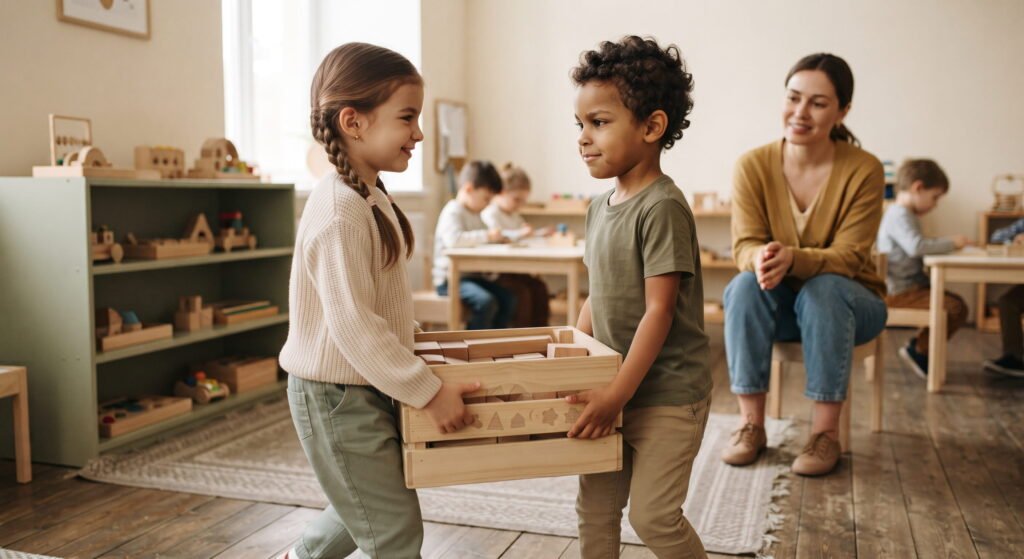
Cooperation is more likely when the task genuinely benefits from several contributors. Moving a large box, staging a puppet show, building a long track or caring for a garden creates interdependence. Roles can differ. Fair participation does not mean every child handles the same tool for the same number of seconds; it means each child has a meaningful way to influence the activity.
Model listening to different ideas
Kaiako can show that another person’s perspective changes the plan: ‘Ari thinks the door needs to be on this side. What would that make possible?’ This is more powerful than praising children only when they agree. Cooperation includes disagreement, explanation and revision. Adults can slow down a dominant voice and make space for gesture, home language or a quieter contribution.
Conflict is a learning context, not a teaching failure
When conflict is safe enough to address, teachers can help children describe what happened, hear essential information and consider next steps. They should not require a quick apology that the child does not understand. Repair might involve returning an item, rebuilding, checking whether someone is okay or agreeing on a new rule. Physical or emotional safety remains the adult’s responsibility throughout.
A calm conflict sequence
- Stop unsafe action and help bodies become calmer.
- Acknowledge each child’s message without deciding that one identity is the problem.
- State the practical issue in simple language.
- Invite one or two workable options when children are ready.
- Return later if reflection or repair needs more time.
Avoid forced sharing of every possession
Some centre resources are communal, while a personal comfort item may need different boundaries. A child deeply engaged with a material may reasonably need time to complete an idea. Teachers can protect a future turn or offer an equivalent resource instead of demanding immediate surrender. Consistent, explainable decisions build trust better than using the word ‘sharing’ to settle every dispute.
Families can share social context
Tell kaiako about siblings, familiar games, home languages and situations in which the child finds waiting or group entry difficult. Ask what teachers observe and which supports help. A child may cooperate differently in a large group, with a trusted friend or near the end of a long day. Patterns across contexts are more useful than a label such as bossy, shy or bad at sharing.
Revisit group rules with children
Rules are easier to use when children understand the purpose and have an age-appropriate voice in how shared spaces work. Teachers can revisit a rule after a real problem, test whether it is fair and adapt the explanation. Adult responsibility for safety remains clear.
What to ask during a Childsplay visit
Ask how small-group experiences are organised, how teachers include different communication styles and what happens when children want the same resource. Observe whether adults solve everything themselves or help children contribute safely. Confirm the current approach at Mt Roskill or Kingsland rather than assuming identical group dynamics or routines.
Turn-taking and cooperation questions
At what age should children share reliably?
There is no single deadline. Expectations should reflect development and context, with adults modelling, supporting and protecting equitable access.
Are timers always a good solution?
No. They can make a turn visible, but may interrupt meaningful play or fail to address the real need. Teachers should choose supports for the specific situation.
Should children be made to apologise?
Repair matters, but a forced word may have little meaning. Adults can help children understand impact and take an appropriate action when they are regulated enough to participate.
What if my child prefers solitary play?
Solitary and alongside play can be valuable. Discuss the full pattern with kaiako and look for respectful invitations rather than pressure to perform socially.
Contact Childsplay Unlimited
Ask how cooperation is supported in everyday play at Childsplay Unlimited. Call Mt Roskill on 09 627 9041 or Kingsland on 09 846 8908 to arrange a visit and discuss group experiences, turn-taking, communication and conflict guidance at the relevant centre.