


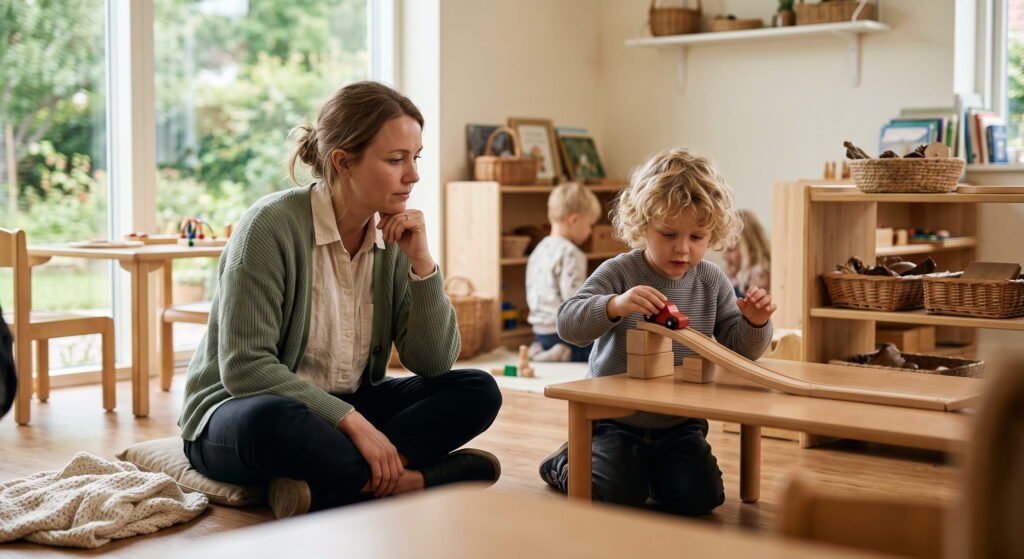
Intentional teaching is purposeful, responsive decision-making
Intentional teaching means kaiako make thoughtful decisions about when and how to support learning. They may arrange an environment, model a skill, introduce language, ask a question, connect children or wait. The intention is not to direct every outcome, but to respond to evidence and extend participation without taking over children’s play.
Play-based education and intentional teaching are sometimes presented as opposites. In practice, a high-quality programme needs both child agency and adults who understand why they are making particular teaching choices.
The word intentional describes the purpose behind the response. A teacher can explain what they noticed, why they acted or waited, and how they will review what happened. This distinguishes thoughtful teaching from constant intervention or activity for activity’s sake.
Intentions begin with careful observation
Before changing play, kaiako need to understand it. They may notice a child repeatedly testing ramps, struggling to enter a peer group or using a new pattern in drawing. Observation includes context: what came before, how long the child persisted, which strategies were tried and whether the experience looks satisfying, frustrating or unfinished.
Planning can happen before, during and after play
Teachers plan environments and possible experiences before children arrive. During play, they interpret changing needs and make responsive choices. Afterwards, they reflect with colleagues, children or families. Intentional teaching is therefore not limited to a scheduled adult-led activity. It is a continuous cycle of noticing, deciding, acting and reviewing.
A menu of possible teaching responses
- Wait and give the child uninterrupted thinking time
- Describe an action or introduce precise vocabulary
- Model one technique, then return control
- Add or remove a material to clarify the problem
- Invite a peer whose knowledge may contribute
- Help the child recall or document an earlier idea
Modelling should open possibility
A short demonstration can make a tool accessible or show one way to join materials. The risk is that children begin copying an adult product instead of exploring. Teachers can model the minimum needed, make it clear there are alternatives and watch whether the child’s own plan becomes stronger. The goal is capability, not uniform results.
Language can sharpen attention
Words such as heavier, transparent, beneath or frustrated can help children notice distinctions and communicate. Useful language is connected to the immediate experience and offered conversationally. A stream of questions can interrupt concentration. Sometimes a comment—’the shadow moved when you turned it’—invites more thinking than asking the child to supply an answer.
Teaching can connect people
Learning is social as well as individual. A teacher may help a child gain entry to play, translate an idea between children or make a quieter contribution visible. They may also intervene when a role becomes controlling or exclusionary. The intention is to support equitable participation and help children build the communication needed to sustain shared activity.
Challenge needs calibration
If a task is solved instantly, it may not invite new thinking. If it is inaccessible, the child may disengage. Kaiako adjust challenge by changing one element, offering a prompt or breaking a process into manageable steps. They remain attentive to age, experience, emotion and additional support needs rather than using the same expectation for everyone.
The difference between extending and hijacking
An extension remains connected to the child’s purpose and leaves room for choice. Hijacking replaces that purpose with the adult’s preferred lesson. One test is to watch what happens after the teacher joins: does the child develop the idea, or wait for instructions? Skilled kaiako are prepared to step back when their contribution is not helping.
Intentional teaching includes safety and care
Teaching is present when adults help children judge a physical challenge, use tools safely, manage conflict or participate in care routines. The response can protect wellbeing while also building understanding and independence. Boundaries should be clear and respectful, with an explanation suited to the child’s communication and development.
Whānau aspirations influence purpose
Families may value confidence in a home language, care for younger relatives, connection with whenua, creativity or independence. Teachers can consider these aspirations alongside observations and curriculum responsibilities. Partnership prevents intentional teaching from becoming a set of generic targets disconnected from the child’s identity and community.
Assessment closes the loop
After a response, kaiako consider what changed. Did the child use the new word, strategy or relationship independently? Did the resource remain useful? Is another perspective needed? Documentation can support this reflection and help families contribute. Not every interaction needs a formal story, but teaching decisions should be open to evaluation.
What to listen for during a centre visit
- A specific example of what teachers noticed before acting
- Several possible responses, including waiting
- Evidence that the child retained agency
- Attention to culture, inclusion and family aspirations
- Reflection on whether the teaching choice worked
Intentions should remain visible to the teaching team
Consistency does not mean every kaiako uses the same sentence or response. It means colleagues share enough understanding of the child, the learning question and the reason for an approach. Brief planning notes, team discussion and family communication can prevent one adult’s useful insight from disappearing between shifts. Shared understanding also allows another teacher to notice whether the strategy works in a different space or relationship, strengthening evaluation without turning everyday play into a checklist.
Intentional teaching in play-based learning
Is intentional teaching the same as teacher-directed learning?
No. It can include direct guidance, but also observation, environment design, modelling, conversation, connection and deliberate waiting.
Can infants experience intentional teaching?
Yes. Responsive positioning, language, materials, care and interaction can all be purposeful while respecting infants’ cues and pace.
Should teachers explain every learning goal to children?
Not always. The adult purpose guides decisions, but play should remain meaningful rather than becoming a running lesson commentary.
How can parents contribute?
Share aspirations and current interests, then ask how observations and family knowledge influence planning and assessment.
Contact Childsplay Unlimited
Discuss intentional teaching with Childsplay Unlimited. Call Mt Roskill on 09 627 9041 or Kingsland on 09 846 8908 to arrange a visit and ask how kaiako balance child agency, thoughtful guidance and reflection.