


Indoor and outdoor learning should work as one programme
Indoor and outdoor play offer different scales, materials, movements and social possibilities. A balanced early learning programme gives children meaningful access to both, rather than using outside only for energy release or inside only for formal learning. Teachers observe interests, manage safety and help ideas travel between spaces, weather and changing group needs.
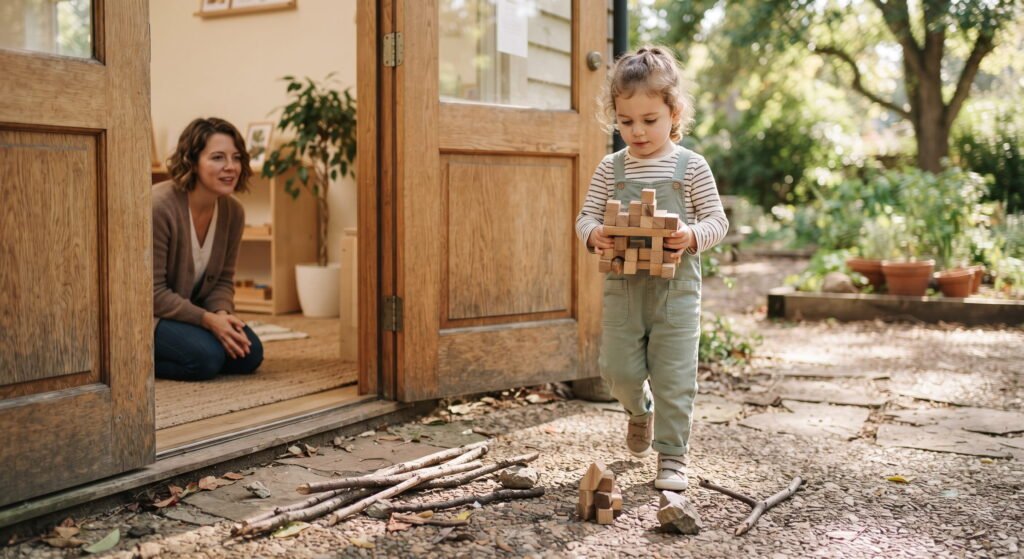
Children do not divide their thinking into indoor subjects and outdoor subjects. A bridge designed with blocks may become a plank-and-crate structure outside. Leaves collected in the garden may lead to sorting, art, storytelling or questions indoors.
The quality of balance is not measured by equal minutes. It is seen in the range of opportunities, the freedom to become deeply involved and the way teachers connect movement, creativity, language, problem-solving and relationships across environments.
Indoor spaces can support sustained detail
Books, drawing, puzzles, construction, music and dramatic play can be arranged so children work alone, alongside others or collaboratively. A well-organised room gives resources a clear place without prescribing one use. Ministry guidance for indoor activity areas recognises the need for different kinds of play, including individual and group experiences, messy play and dramatic play.
What adults can notice indoors
- How long a child remains with an idea
- How resources are combined or transformed
- Which spaces invite conversation or retreat
- Whether children can access and return materials independently
Outdoor play changes scale and consequence
Outside, children can run farther, carry larger objects, encounter uneven surfaces and experience wind, water, soil and seasonal change. These conditions create questions about force, balance, distance, living things and cooperation. Outdoor learning is not limited to gross-motor development, just as indoor learning is not limited to books and table activities.
The doorway is a curriculum space
Moving between environments involves planning, dressing, remembering belongings and adapting an idea. Teachers can reduce congestion and support children who find transitions difficult. When access is flexible and safely supervised, children may follow an interest while it is meaningful rather than waiting for the whole group to change location.
Weather adds information, not only inconvenience
Rain changes surfaces, wind moves materials and heat changes what is comfortable. Centres must make safe decisions and families need to provide suitable clothing when requested. Rather than promising outdoor access in every condition, ask how the team uses weather thoughtfully, maintains sun protection and manages wet or messy clothing.
Questions about clothing and access
- What spare clothing should remain at the centre?
- How are sun hats and sunscreen handled?
- What happens to wet or muddy items?
- How do children who prefer quieter play use the outdoor space?
Ideas can migrate between environments
A teacher may photograph an outdoor pattern for later drawing, bring measuring tools to a construction or introduce natural materials to dramatic play. Children can revisit, represent and revise what they discovered. This continuity is often more educationally valuable than presenting two unrelated activity menus.
Risk and challenge need thoughtful distinction
A manageable challenge—such as balancing on a low structure—can support judgment and confidence. A hazard is a source of harm children cannot reasonably assess or manage. Teachers inspect environments, position themselves for supervision and adapt equipment while allowing children to solve appropriate physical problems. Parents can ask for examples rather than assuming that all challenge is unsafe.
Noise and energy need places to move
Active play can produce sound, while other children need concentration or rest. Design, group size and teacher decisions can help prevent one experience from dominating. The Ministry’s noise guidance encourages services to monitor levels and separate high-energy activity from quiet zones where practicable. Balance includes sensory and emotional access, not just physical square metres.
Inclusion may require more than open access
A doorway, surface, sound level or social expectation can affect participation. Families should share mobility, sensory, communication or health needs. Teachers can adapt materials, positioning, groupings and time. An inclusive environment does not offer every child the identical experience; it creates meaningful ways for each child to belong and contribute.
A centre-tour observation route
- Follow one idea across more than one space.
- Notice whether children can be energetic and quiet without conflict.
- Look for open-ended materials rather than display alone.
- Observe teacher positioning and the quality of interaction.
- Ask how weather, clothing and individual needs affect access.
Balance is reviewed over time
One rainy visit or a single indoor activity cannot show the whole programme. Ask how teachers reflect on which children use each space, whose interests are visible and what experiences have been extended. Storypark or learning stories may provide examples, while direct observation helps families see how the environment works in real time.
Storage and display influence who can participate
Resources placed too high, crowded into unclear containers or reserved mainly for adult-led times may limit children’s ability to initiate ideas. Accessible storage and simple visual organisation can support choice and responsibility, while some tools still require adult management. Displays should reflect real learning and the people in the community rather than making every surface visually busy. During a visit, notice whether children know where materials belong, can return to an unfinished plan and see their languages, families or current questions represented in both indoor and outdoor areas.
Indoor and outdoor childcare questions
Should children go outside every day?
Ask the centre how it makes safe, weather-responsive decisions and what clothing families need to provide.
Is outdoor play mainly physical?
No. It can support language, science, mathematics, creativity, relationships and imaginative thinking as well as movement.
What if my child prefers quiet play?
Look for quieter possibilities in both environments and ask how teachers support choice without isolating the child.
How can I judge the learning spaces on a tour?
Observe access, engagement, teacher interaction, supervision and whether children can sustain and revisit ideas.
Contact Childsplay Unlimited
Explore the indoor and outdoor environments at Childsplay Unlimited. Call Mt Roskill on 09 627 9041 or Kingsland on 09 846 8908 to arrange a visit and ask how each centre supports varied play throughout the day.