

Friendships grow through repeated shared experiences
Young children build friendships by seeing one another regularly, discovering shared interests, communicating invitations, solving problems and repairing misunderstandings. Adults can create conditions for connection and support access to play, but they should not assign best friends or force social performance. Friendship patterns change, and solitary or alongside play can still be valuable.
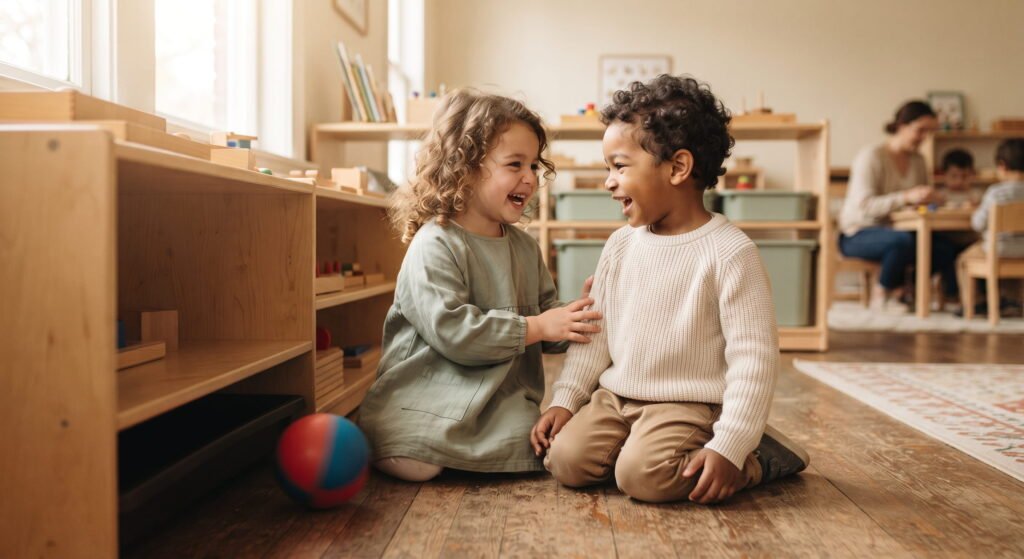
A friendship may begin with something very small: two children laugh when a ball rolls under a shelf, one saves a place at the playdough table, or they repeat the same chase game over several days. Early friendships are built through shared history. They are also affected by language, attendance, temperament, age, interests and whether the environment makes participation possible.
Parents may worry when a child does not name a best friend or when friendships change quickly. A broader view looks at how the child approaches others, responds to invitations, contributes to shared play and seeks help when a social situation becomes difficult.
Connection does not begin with a friendship label
Before children call someone a friend, they may watch closely, play beside each other, exchange objects or repeat a familiar routine. These small patterns matter. Teachers can notice them and make another meeting likely without announcing that the children must become friends. A shared interest provides a natural focus and reduces the pressure of direct social conversation.
Regularity creates shared history
Children who encounter one another consistently can remember roles, jokes, projects and previous disagreements. They learn what a peer enjoys and how that person communicates. Attendance patterns can influence who is available, so friendship opportunities may look different across days. A centre can support continuity but should not promise a specific friendship or expose private details about another child’s schedule.
Ways kaiako can make connection more possible
- Protect enough time for shared play to develop beyond a first idea.
- Offer small-group experiences linked to children’s genuine interests.
- Model inclusive invitations and ways to decline respectfully.
- Interpret gesture or communication supports so peers can respond.
- Notice and challenge patterns that repeatedly exclude one child.
Joining play is a learnable skill
Entering an established game can be difficult. Asking ‘Can I play?’ may still leave the group unsure which role is available. A teacher might help the child observe the storyline and offer a connected contribution: ‘They are delivering food to the cafe. You have a basket—what could you bring?’ This supports entry without requiring the existing players to abandon their idea.
Friendship and conflict belong together
Friends can disagree intensely because the relationship matters and both children have strong ideas. Adults should protect safety and help children communicate, but not assume conflict means the friendship is harmful or finished. Learning to repair, renegotiate and return to play is part of social development. At the same time, repeated intimidation or exclusion requires adult attention rather than being dismissed as normal friendship drama.
A friendship repair may involve
- Calming with enough adult support to make interaction safe
- Hearing the essential message from each child
- Naming the practical effect without shaming
- Choosing a meaningful action such as returning, rebuilding or changing the rule
- Reconnecting now or agreeing that space is needed first
Quiet, multilingual and differently communicating children need access
A child may understand a game without having the spoken English to enter quickly. Another may communicate through gesture, signs, pictures or a device. Kaiako can help peers attend to these methods and learn names or useful phrases. They should not speak about the child as though the child is absent. Social access improves when the group treats multiple communication methods as ordinary.
Adults should not engineer exclusivity
Calling two children best friends can unintentionally narrow their social options or make later change feel like failure. Teachers can celebrate connection while inviting a wider network of relationships. Groupings should also be reviewed so the same confident children do not always control valued roles and resources. Friendship support and equitable participation are closely linked.
Family conversations add context
Parents may hear names, stories or worries that do not appear during the centre day. Share useful information without asking teachers to report on another child or disclose a family’s circumstances. Teachers can describe how they are supporting your child and the group. Storypark posts may show shared learning, but individual consent, privacy and dignity still matter.
Use observation rather than a popularity test
During a centre visit, notice whether children can join, withdraw and reconnect. Ask how teachers respond to exclusion and help children communicate across differences. Request examples from the current Mt Roskill or Kingsland group, since friendship dynamics and available peers are inherently local and change over time.
When a child says nobody played with me
Start by listening rather than correcting the account. Ask gentle questions about what happened and what the child wanted. Share the concern with kaiako so they can observe patterns across several days, not interrogate children about one report. A collaborative response may involve supporting entry, creating a small-group opportunity or addressing a repeated barrier.
Childcare friendships: FAQs
Does my child need a best friend at childcare?
No. Warm connections with several children and trusted adults can be valuable. Friendship labels and patterns may change.
Is solitary play a warning sign?
Not by itself. Children may choose solitary or alongside play for many reasons. Consider the wider pattern and discuss any concern with people who know the child.
Should teachers make children include everyone in every game?
Teachers should address unfair exclusion and protect access, but they also need to respect established play and help children find meaningful, workable entry rather than forcing a role.
Can parents ask what another child did?
The centre should protect every child’s privacy. Ask what happened to your child, how the situation was supported and what the team will observe or do next.
Contact Childsplay Unlimited
Explore how relationships develop at Childsplay Unlimited. Call Mt Roskill on 09 627 9041 or Kingsland on 09 846 8908 to arrange a visit and ask how the relevant team supports shared play, friendship entry, conflict repair and inclusive participation.