
The strands are connected areas of learning
Te Whāriki‘s five strands are Mana atua | Wellbeing, Mana whenua | Belonging, Mana tangata | Contribution, Mana reo | Communication, and Mana aotūroa | Exploration. They help kaiako design environments and recognise learning over time. A single experience can involve several strands, so they should be woven together rather than delivered as five separate subjects.
When parents first see the five strands, it is tempting to imagine five programme headings. Monday could be wellbeing, Tuesday communication and Wednesday exploration. That is not how the framework is intended to work. Children bring their bodies, emotions, relationships, languages, identities and curiosity to the same moment.
The value of the strands is that they help adults notice the breadth of what is developing. This article follows one child’s possible day, then shows the different questions each strand invites.
Morning arrival: wellbeing and belonging meet first
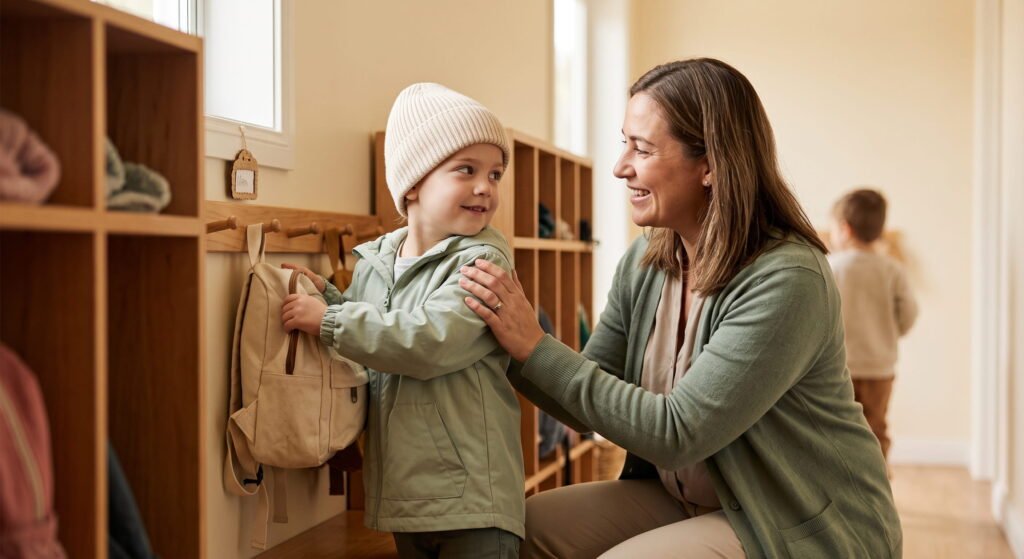
A familiar welcome, a place for belongings and an adult who understands the child’s cues can protect emotional security while reinforcing that the child and whānau have a place. Mana atua and Mana whenua are already present before any planned experience begins. If separation is difficult, responsive care and predictable routines matter more than rushing the child toward an activity.
Joining a shared project: contribution becomes visible
Later, the child approaches a group building a roadway. Mana tangata asks whether there is a genuine way to participate, whether each contribution is valued and whether differences in age, confidence, language or ability create barriers. Fair participation does not require every child to do the same thing. One may design, another carry blocks and another explain where the road leads.
Negotiating the plan: communication has many forms
The children use words, gesture, facial expression, drawing and objects to share meaning. Mana reo includes oral language, stories, symbols, creative expression and communication systems such as New Zealand Sign Language or augmentative and alternative communication. Teachers can model vocabulary and help peers listen without turning the conversation into a performance for adults.
Testing the bridge: exploration drives revision
A truck makes the bridge collapse. Instead of fixing it immediately, a kaiako may wonder aloud, provide another shape or allow time for trial and error. Mana aotūroa values active exploration of natural, social, physical, spiritual and human-made environments. The child’s working theory changes through doing, observing, comparing and trying again.
Five strands, five useful questions
- Mana atua: does the child feel safe, cared for and increasingly able to communicate needs?
- Mana whenua: can the child recognise connections with people, culture, place and routine?
- Mana tangata: are opportunities equitable, and is this child’s contribution taken seriously?
- Mana reo: which languages, symbols and creative forms can the child use to make meaning?
- Mana aotūroa: can the child investigate, move, take manageable risks and revise ideas?
The strands describe environments as well as children
Te Whāriki includes goals for what children should experience. That directs attention toward adult decisions and conditions, not supposed deficits in the child. If a child rarely contributes, the first question is not simply why they are quiet. Adults can examine group size, language demands, accessibility, peer patterns, timing and whether the available roles connect with the child’s strengths.
Learning outcomes develop over time
Confidence, resilience, communication and curiosity are not boxes completed after one activity. They appear differently across ages and contexts and become more complex with guidance and encouragement. A toddler who points for help, a child who explains a plan in a home language and a peer who redraws a map may all be showing important movement within the strands.
What a learning story should help you understand
- What the child was trying, communicating or investigating
- Which relationships and cultural knowledge gave the event meaning
- How a strand or learning outcome helps interpret the observation
- What the child, kaiako or whānau might revisit next
No strand can carry the whole curriculum alone
A programme rich in challenging equipment but weak in emotional security is not balanced by labelling it exploration. Communication cannot flourish if a child’s home language is treated as irrelevant. Contribution depends on belonging and relationships. Parents can listen for how teachers connect the strands rather than counting displays devoted to each name.
Ask for current examples at both centres
Mt Roskill and Kingsland both work within Te Whāriki, but their current groups and local curricula may differ. Ask each relevant centre for an example of how several strands appeared in one recent experience. This avoids assuming identical programmes and gives a clearer picture of the teaching decisions that shape children’s days.
The strands are a language for partnership
Families can use the strand names without needing specialist knowledge. If your child is finding arrival difficult, a belonging and wellbeing conversation may help. If they communicate through movement or a home language, Mana reo offers a broader lens. The purpose is not to label the child. It is to create shared attention around capabilities, environment and next possibilities.
Questions about the five strands
Does one activity need to cover all five strands?
No. Several may be relevant, but teachers should interpret the learning that is genuinely present rather than attaching every label.
Are the Māori and English strand names exact translations?
They are presented together, but official guidance notes that different cultural connotations mean the paired names are not simply equivalents.
Do the strands apply to infants?
Yes. Te Whāriki includes infants, toddlers and young children, with practice responsive to age, cues, relationships and development.
Can parents mention a strand in their Storypark response?
Yes. You can connect the story with home observations, family aspirations or a capability you have noticed developing.
Contact Childsplay Unlimited
See how the strands connect in everyday learning at Childsplay Unlimited. Contact Mt Roskill on 09 627 9041 or Kingsland on 09 846 8908 to arrange a visit and ask for current examples from the centre relevant to your family.