
Early numeracy is useful mathematical thinking, not speed or pressure
Before school, children can develop numeracy by counting for a reason, comparing quantities, sorting by different rules, noticing patterns, measuring, building and talking about space. Adults can introduce precise language and useful tools inside play and everyday tasks. Reciting numbers or completing worksheets is not a complete picture of mathematical understanding.
A child decides there are not enough cups, turns a puzzle piece, makes two block towers the same height and predicts which container will hold more water. None of these moments looks like a worksheet, yet each involves mathematical reasoning. The child is noticing relationships and using an idea to achieve a purpose.
This is strong preparation for later mathematics because it joins thinking with action, language and evidence. Te Whāriki Online describes early maths across areas such as quantity, pattern and spatial thinking, and current continuity resources connect early learning with the first months of school. The pathway does not require preschool to copy classroom exercises.
Follow one ordinary morning of mathematics
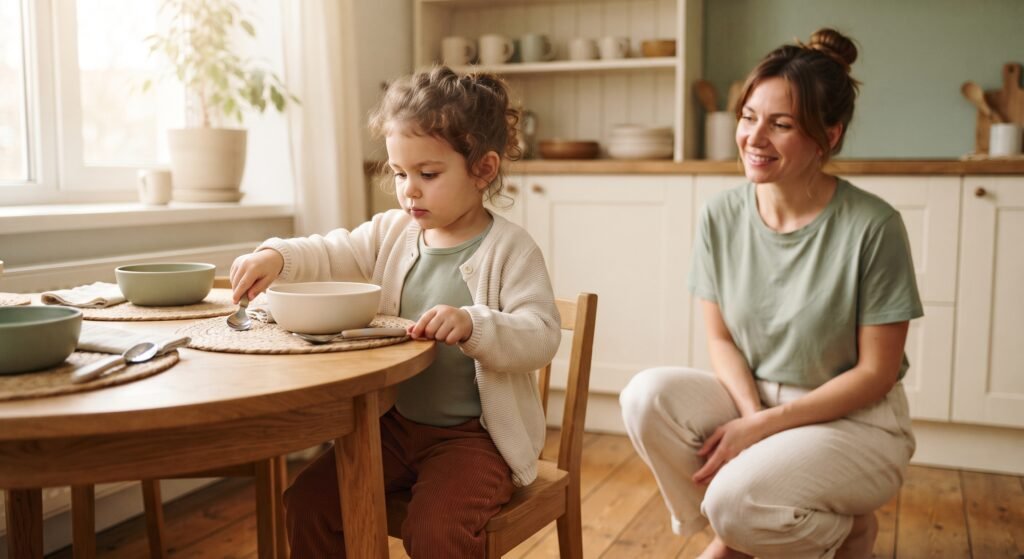
Breakfast: quantity and one-to-one matching
Invite the child to place one spoon for each person or decide whether enough fruit pieces are available. Count only when it answers the real question. Touching or moving each item can support one-to-one correspondence. If the total changes, ask what the child notices rather than immediately announcing the answer.
Getting dressed: sequence and pattern
Daily routines have an order, but the order may contain flexible and fixed parts. Talk about first, next, before and after. Notice stripes, repeats or matching pairs without turning a rushed morning into a test. A child can invent a pattern with socks or movements later when time allows.
The journey: position, distance and time
Use words such as beside, behind, through, nearer, farther, earlier and later. Follow a simple map or notice a repeated route. Estimates such as ‘Will we arrive before the song ends?’ introduce prediction without requiring clock reading. Allow the child to explain landmarks in their own language or communication method.
Counting should answer a question
Saying the number sequence is one capability; understanding quantity requires more. Count how many blocks are needed to bridge a gap, how many people want plates or how many jumps reach a marker. After counting, discuss the total and whether it solves the problem. Avoid asking ‘How many?’ constantly when the answer has no purpose beyond adult approval.
Sorting can have more than one correct rule
Leaves can be grouped by size, colour, edge, texture or where they were found. Ask the child to explain the rule and try another arrangement. An object that seems misplaced may reveal a feature the adult overlooked. Sorting supports classification, flexible thinking and mathematical language when the child has agency over the categories.
Construction makes spatial reasoning tangible
- Rotate and fit pieces rather than relying on one orientation.
- Compare bases before building higher.
- Enclose a space and decide what will fit inside.
- Create a route over, under, around or between obstacles.
- Represent a structure in a drawing, photograph or simple map.
Adults can describe what changes and invite prediction. Giving the solution too quickly removes the opportunity to test and revise.
Measurement begins with comparison
Children can compare objects directly, fill containers or measure a distance with repeated blocks or footsteps before using standard units. The important ideas include consistency, relationship and purpose. A ruler or tape measure becomes meaningful when the group needs to know whether a design will fit, not simply because the tool has numbers.
Patterns live in culture, sound and movement
Repeating and growing patterns appear in clapping, dance, music, weaving, stories, nature and designed objects. Cultural patterns need accurate context and respect; they should not be copied as decoration without understanding. Invite family knowledge and follow appropriate guidance. Children can create, continue, change and explain patterns in many media.
Respond to mistakes as information
An unexpected answer shows how the child may be reasoning. Ask, ‘How did you decide?’ and invite a test. Adults can provide accurate language and evidence without making the child afraid to guess. Confidence in mathematics grows when revising an idea is normal rather than proof of being bad at maths.
A low-pressure maths basket
- Containers of different capacities
- Loose parts that vary in shape, size and texture
- A tape measure, balance or timer used with supervision
- Pattern materials and simple puzzles
- Paper for plans, maps, tallies and invented records
Ask for local examples, not a standard promise
At Childsplay Unlimited, ask how teachers notice mathematical thinking during current play and how they extend it without taking over. Mt Roskill and Kingsland may have different interests, resources and projects. Families can share mathematics from cooking, transport, gardening, making and cultural life, helping the relevant centre connect learning across settings. When a learning story includes maths, look for the child’s strategy and purpose rather than only a number word. Ask what the child predicted, changed or explained and how the next experience might deepen the same idea. This makes progression visible without converting play into a test. Keep the experience brief, compare several attempts and return to the same idea another day when the child is interested.
Early numeracy before school: FAQs
Is counting high the best sign of numeracy?
No. Quantity, comparison, spatial thinking, pattern, measurement, classification and reasoning are also important.
Are maths worksheets needed before school?
No. Purposeful play and everyday tasks can build rich foundations. Ask the receiving school how formal recording is introduced.
Should adults correct every wrong answer?
Explore the reasoning first, then compare the idea with evidence. This supports accuracy without discouraging explanation.
Can home languages be used for maths?
Yes. Mathematical thinking is not limited to English vocabulary. Share useful words, methods and cultural contexts with teachers.
Contact Childsplay Unlimited
See how early numeracy develops through purposeful play at Childsplay Unlimited. Call Mt Roskill on 09 627 9041 or Kingsland on 09 846 8908 and ask the relevant centre for current examples of counting, pattern, measurement and spatial thinking.