

Communication grows through responsive, meaningful exchanges
Early learning supports communication when children have attentive partners, useful reasons to communicate and many ways to express meaning. Conversations, songs, stories, gesture, movement, drawing, home languages, te reo Māori, New Zealand Sign Language and communication supports can all contribute. Progress is best noticed across everyday relationships rather than through pressured performance.
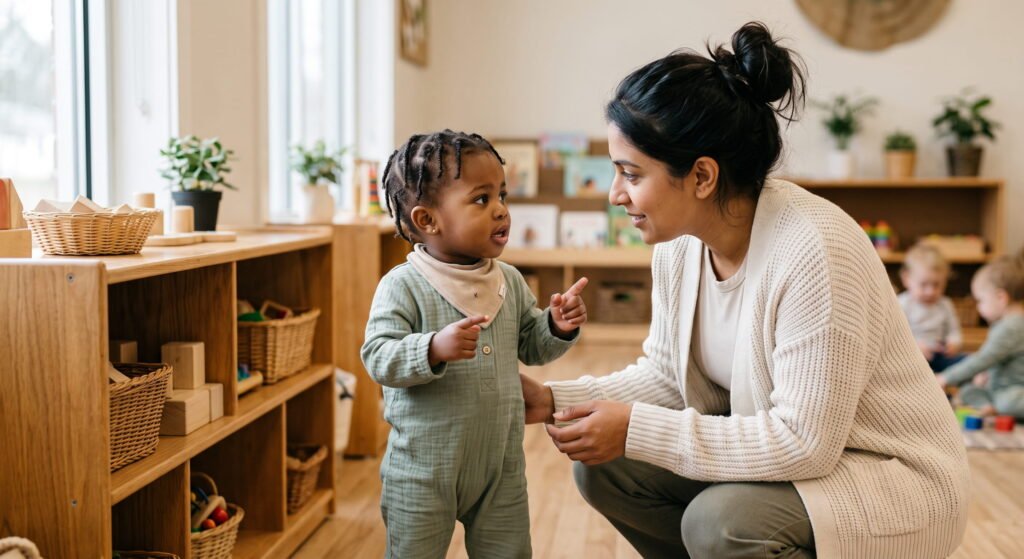
Communication is much wider than how many words a child can say. A baby turns toward a familiar voice, a toddler carries an object to an adult, and a preschooler negotiates the rules of an invented game. Each is sharing attention, intention or meaning. Early learning can strengthen these capabilities because a centre day offers repeated exchanges with trusted adults and other children.
The quality of those exchanges matters more than constant adult talk. Children need time to initiate, respond, watch, try a new method and repair misunderstandings. This guide explains what supportive communication can look like and what parents can ask about when visiting Childsplay Unlimited Mt Roskill or Kingsland.
Begin with listening, not a vocabulary target
A responsive adult watches facial expression, movement, gesture, sound and words before deciding what the child means. They may acknowledge the message, add a little language and wait. This creates a genuine exchange instead of a quiz. Repeated questions such as ‘What colour is that?’ can produce short answers, while a comment such as ‘Your bridge keeps getting longer’ may invite the child to explain an idea or demonstrate what should happen next.
The pause is part of the conversation
Young children often need more processing time than adults expect, especially when a situation is new or more than one language is involved. Waiting without immediately repeating, answering for the child or changing the subject shows that their contribution is worth hearing. A response may arrive as a look, sign, action or word. The adult can then follow the child’s method and gently extend it.
Play gives communication a real purpose
In play, language does useful work. Children request materials, assign roles, describe a problem, invite a partner, protest, joke and retell events. A teacher can help by supplying a missing word, modelling a respectful phrase or making room for a child whose ideas are being overlooked. The aim is not to turn the game into a lesson. It is to increase each child’s ability to participate and be understood.
Stories and songs build shared language
A familiar book allows children to anticipate, join repeated phrases, discuss pictures and connect the story with their own experience. Songs offer rhythm, repetition and a predictable place to contribute. Props, puppets and movement can make meaning accessible before a child is ready to speak in a group. Revisiting favourites is valuable: repetition gives children another chance to notice patterns and take a larger role.
Conversation can continue after the book closes
- Recall a surprising event from the story during later play.
- Offer drawing, blocks or dramatic play so children can represent an idea differently.
- Invite family knowledge about a place, word, character or experience.
- Make room for alternative endings and children’s own storytelling.
Communication includes more than spoken English
Te Whāriki’s communication strand recognises multiple modes and languages. A child may use te reo Māori, a home language, New Zealand Sign Language, gesture, pictures or augmentative and alternative communication. These are not side activities; they are ways of accessing relationships and learning. Teachers should learn the methods that matter to the child and avoid treating fluent English speech as the only evidence of understanding.
Peer exchanges add a different challenge
Children communicate differently with peers because play partners do not interpret every cue as quickly as a familiar adult. That creates opportunities to clarify, listen and negotiate. Kaiako can support the exchange without taking over: ‘Mila is pointing to the long block. I wonder what she wants us to know.’ This protects the child’s agency while helping the group attend to the message.
Families hold essential communication knowledge
Parents can share names and pronunciation, words used for comfort or care, favourite songs, current interests and how the child shows yes, no, worry or excitement. Home observations may reveal capabilities that are less visible in a busy group. Childsplay Unlimited uses Storypark, alongside direct conversations, so families can ask how observations from both settings are connected and how private information is protected.
What to notice during a centre visit
- Watch whether adults get close, observe and allow children time to respond.
- Listen for comments and open invitations as well as questions.
- Notice whether books, songs, symbols and displays reflect the current community.
- Ask how a quiet child or a child using another communication method participates.
- Request a current example from the centre you are considering.
Mt Roskill and Kingsland may have different groups, languages and current interests. Ask each relevant team what communication support looks like in practice rather than assuming the same resources or examples apply at both locations.
Raise individual concerns through a real conversation
A general article cannot assess a child’s speech, hearing, language or development. If parents or teachers have a concern, share specific observations across settings and discuss sensible next steps with people who know the child. Appropriately qualified health or learning-support advice may be needed. Support should consider all the child’s languages and communication methods, not a brief performance in one context.
Communication development: parent questions
Should adults correct every word a child says?
Usually it is more supportive to respond to the meaning and model the word naturally. Individual advice may differ where a qualified professional has recommended a specific approach.
Does a quiet child need to be pushed to speak in a group?
No. Offer safe ways to participate, wait, observe communication across contexts and build trusted relationships without turning speaking into a public test.
Can home languages be used at childcare?
They should be valued as part of identity and communication. Ask how the centre learns important words and works with families, while being realistic about current staff language capacity.
How can parents contribute through Storypark?
Add relevant home observations, language, interests or context, while discussing privately any information that should not be shared in a digital learning story.
Contact Childsplay Unlimited
Talk with Childsplay Unlimited about how communication is supported in the current programme. Call Mt Roskill on 09 627 9041 or Kingsland on 09 846 8908 to arrange a visit, share how your child communicates and ask for examples from the centre relevant to your family.