


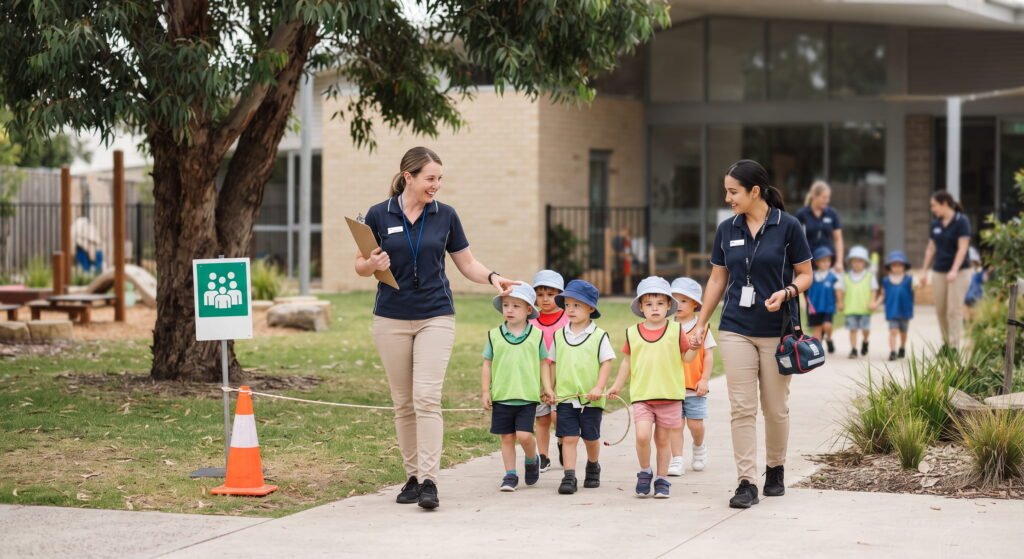
Emergency drills help children and adults practise roles, routes and communication before pressure is real
Licensed early learning services maintain emergency plans and practise drills. Procedures may address fire, earthquake, evacuation, sheltering or lockdown according to the service’s plan and risks. Drills should be age appropriate, supervised and reviewed. Parents can ask where children may relocate, how families are contacted and how individual mobility, communication, medical and emotional needs are included.
A written emergency plan matters, but people also need experience using it. A drill tests whether routes work, roles are understood, children can be accounted for and supplies or communication are accessible. It can reveal a blocked exit, an unclear handover or an individual support need that was invisible on paper.
The Ministry’s centre-based licensing criteria include emergency plans, supplies and drills. The details belong to the individual service and may change with building work, staffing, enrolment or official guidance. Parents should ask the relevant Childsplay Unlimited centre for current information without expecting staff to publish sensitive security procedures broadly.
Different emergencies require different actions
- Fire may require rapid evacuation to an assembly point.
- Earthquake response may begin with immediate protective action before evacuation.
- A local hazard may require moving to an alternative location.
- Severe weather may require sheltering and delayed collection.
- A security threat may require lockdown or restricted movement.
Families should follow the centre’s instructions rather than applying one response to every event.
A drill has a cycle, not just an alarm
- Prepare: maintain roles, routes, contacts, supplies and individual information.
- Practise: carry out the relevant procedure under controlled conditions.
- Account: confirm children, adults and visitors according to the plan.
- Review: identify what worked, what delayed action and what needs change.
- Update: revise training, environment, records or supplies and practise again.
Practice should be age appropriate
Young children need simple language, calm adult leadership and repeated familiar actions. Adults should not create frightening scenarios to make a drill feel realistic. Explain enough for the child to follow the routine without providing graphic detail. Afterward, allow questions, play or reassurance and return to ordinary activity.
Support children who find drills difficult
- Provide advance information when the plan permits.
- Use visuals, objects, signs or communication devices already understood.
- Plan for loud sounds, crowding, mobility and sensory needs.
- Identify the adults responsible for medicine or equipment.
- Review distress and adjust support without removing necessary safety practice.
Accounting for people is a core task
Attendance information needs to reflect arrivals, departures, visitors and staff movement. During an emergency, the team must know who is present and where groups have moved. Parents support this by completing sign-in and sign-out correctly rather than treating attendance records as optional paperwork.
Emergency supplies should match the community
Planning considers the number and ages of children and adults, the likely duration and individual needs. Supplies for infants may include items not required for older children. Medication, feeding, mobility and communication arrangements need specific review. Parents can ask how personal supplies are maintained and replaced without requesting confidential details about another child.
Family communication may not be immediate
During an event, staff priorities include children’s immediate safety and accounting. The Ministry says services may contact families by phone, text, a notice, social media or another method and may advise an alternative collection place. Keep contacts current, monitor the channels the centre identifies and avoid repeatedly calling if that interferes with emergency response.
What parents should know in advance
- The centre’s main emergency communication channels
- Where relocation information will be provided
- Which adults are authorised to collect
- What identification or sign-out may be required
- How changes to medical or contact information are submitted
Lockdown information requires careful boundaries
Parents can ask how children’s wellbeing, accounting and family communication are considered without requesting operational details that could reduce security. During an actual lockdown, follow official and centre instructions. Do not arrive at the site, share unverified information or encourage a child to leave a protected area.
The review should lead to action
A drill record is useful when the team examines timing, communication, children’s responses, route access, staffing and individual plans. Changes may include moving supplies, updating a visual cue, clarifying a role or correcting contacts. Parents can ask how lessons are incorporated while recognising that sensitive details may remain private.
Reconnection and collection need the same discipline
An emergency is not over for a family simply because children have reached an assembly or relocation area. The centre may need to verify authorised collectors, maintain an accurate record of each release and preserve supervision for children still waiting. Parents should bring any identification the procedure requires, avoid taking another family’s child without authority and tell staff before leaving. Repeated calls, social-media speculation or arriving at the wrong location can complicate communication.
After the event, children may repeat the experience in play, ask practical questions or show delayed worry. Adults can offer simple truthful explanations, familiar routines and opportunities to talk without forcing a detailed retelling. Share significant reactions privately with the centre so family and teachers can respond consistently. Seek qualified support if distress is severe, persistent or affecting everyday life.
Ask the centre you will actually use
Mt Roskill and Kingsland are different buildings with different hours and local surroundings. Ask the relevant team about its current emergency guide, family communication and individual planning. Do not assume the same assembly or relocation arrangements apply to both.
Childcare emergency drills: FAQs
Do early learning services practise emergency drills?
Licensed services have emergency planning and drill requirements. Ask the relevant centre about its current process.
Should drills frighten children to feel realistic?
No. Practice should be calm, age appropriate and focused on familiar actions, supervision and reassurance.
Can parents collect immediately during an emergency?
Follow the centre’s instructions. It may relocate or delay collection while maintaining safety and accounting.
Can all lockdown details be published?
No. Families can receive necessary guidance, but sensitive operational information should be protected.
Contact Childsplay Unlimited
Ask Childsplay Unlimited how families receive emergency information. Contact Mt Roskill on 09 627 9041 or Kingsland on 09 846 8908 to discuss the current plan, contacts and individual needs with the relevant centre.