

Adapt the route into learning while protecting purpose, dignity and challenge
Childcare activities can be adapted through materials, positioning, pace, group size, sensory conditions, communication, adult support and different participation roles. Begin with the real learning purpose, remove demands that are not essential and offer choices that preserve agency. Observe the child’s response and review the adaptation with families and relevant professionals rather than lowering expectations automatically.
An activity is rarely one single demand. Painting may involve choosing an idea, reaching materials, tolerating texture, gripping a tool, seeing contrast, communicating and sharing space. When a child cannot access one component, adults may mistakenly remove the whole experience. A better approach separates the meaningful learning from the barrier.
Adaptation is not a special version prepared only after exclusion occurs. Responsive environments offer varied routes from the start, then add individual supports where needed. This can improve access for children with different developmental levels, physical abilities, sensory profiles, communication methods and levels of familiarity while keeping the group experience connected.
Use a purpose–barrier–option check
- Purpose: What meaningful learning or participation does the experience invite?
- Barrier: Which physical, sensory, communication, social or timing demand blocks access?
- Option: What can change without losing the purpose?
- Choice: How can the child influence the method, role or timing?
- Review: Did the adaptation increase engagement, agency and learning?
Adapt materials without making them less interesting
Offer tools with varied handles, sizes, weights or resistance; stable containers; high-contrast pieces; larger construction parts; or switch-accessible resources where professionally recommended. Keep open-ended possibilities. A simplified tool should still allow the child to create, test and make decisions rather than merely complete a preset product.
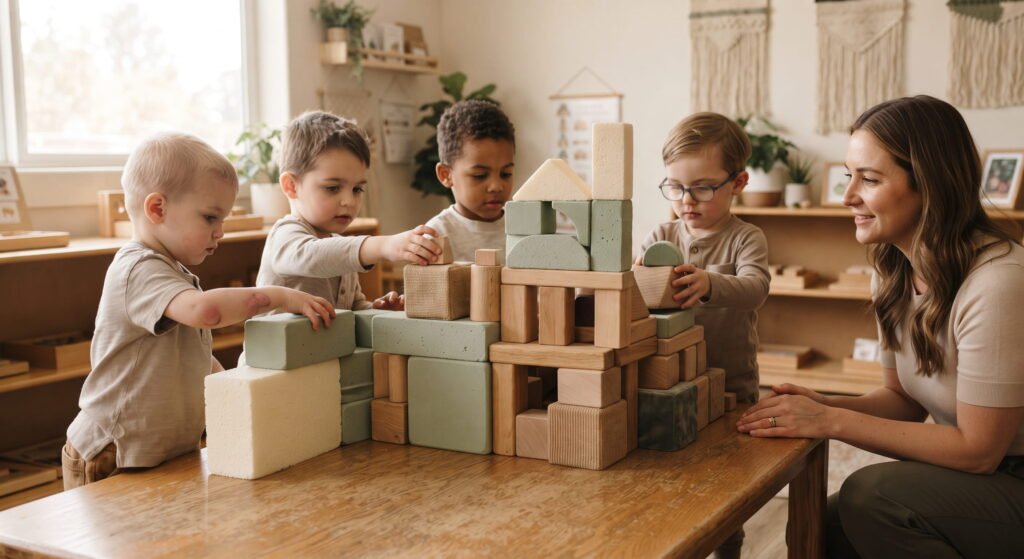
Example: a shared construction challenge
- Use blocks that differ in size, texture and ease of grasping.
- Place materials within each child’s reachable range.
- Offer roles such as choosing, positioning, connecting, testing or photographing.
- Provide a picture, gesture or device vocabulary for ideas such as more, stop and help.
- Allow children to work on the floor, at a table or from supportive seating.
The group shares the design problem while individuals contribute through different actions.
Change pace and sequence
Some children need advance information, a longer response time or the opportunity to explore materials before a group begins. Break a complex sequence into visible steps and allow pauses. Others may need extra challenge or a way to continue after the group moves on. Avoid equating faster completion with higher learning.
Use group size strategically
A large group adds language, movement, waiting and sensory demands. The same learning may be available in a pair, small group or one-to-one introduction before broader participation. Smaller does not have to mean permanently separate. Plan a bridge back to peers when the child is ready and the shared context remains meaningful.
Offer several ways to understand and respond
Combine concise speech with objects, pictures, gesture or demonstration. A child may respond by choosing, moving, signing, pointing, speaking, drawing or using a device. Check that the response method matches the actual learning goal. If the goal is recognising a pattern, requiring a spoken sentence may measure language instead.
Adjust sensory conditions without removing all sensation
Noise, lighting, texture, smell, crowding and movement can affect participation. Offer a quieter position, gradual contact, an alternative material or a predictable break. Follow individual professional guidance where sensory or medical considerations apply. The aim is supported access and choice, not forcing tolerance or eliminating every rich experience.
Adult support should create space for action
- Wait before prompting so the child can initiate.
- Model one step, then return control.
- Position support where the child can still see and communicate with peers.
- Use the least intrusive prompt that works.
- Reduce support gradually only when access and safety remain secure.
Include care routines in adaptation
Dressing, eating, toileting, rest and transitions are participation contexts too. Adapt equipment, privacy, timing, communication and adult positioning with the family and relevant professionals. Never improvise around medical, feeding, mobility or safety guidance. A child’s dignity during care is as important as access during play.
Document learning, not just accommodation
Record the child’s idea, strategy, persistence and contribution alongside the support used. This prevents the adaptation from becoming the entire story of the child. Ask whether the next step should change the environment, extend the challenge or offer another role. Share sensitive information privately.
Ask about adaptation at each Childsplay centre
During a visit, ask the Mt Roskill or Kingsland team to explain how a recent experience was opened to different learners. Bring relevant equipment or recommendations to a planned discussion rather than expecting an instant answer on a tour. The physical environment, current group and staff capacity differ, so suitability must be assessed at the specific location.
Review from the child’s position
After an adapted experience, consider what the child could reach, understand, choose, communicate and change. Notice whether peers interacted directly with the child and whether adult support left room for initiative. If participation depended on one person constantly guiding the child’s hands, speaking for them or keeping them separate, the route may need redesign. A successful adaptation should make the child’s contribution more visible while keeping necessary help available.
Adapting childcare activities: FAQs
Does adaptation lower expectations?
Not when it removes unrelated barriers while preserving meaningful challenge, choice and learning.
Should a child always join the large group?
Not necessarily. A smaller or different context may provide access, with a planned connection to peers where appropriate.
Can teachers improvise medical or mobility adaptations?
No. Follow family information and appropriately qualified professional guidance for health, feeding, positioning, mobility or safety needs.
How do we know an adaptation works?
Observe access, agency, wellbeing, communication and learning. Review across contexts with the child, family and relevant professionals.
Contact Childsplay Unlimited
See how responsive activities can support different learners at Childsplay Unlimited. Call Mt Roskill on 09 627 9041 or Kingsland on 09 846 8908 to discuss your child’s access needs with the relevant centre team.