
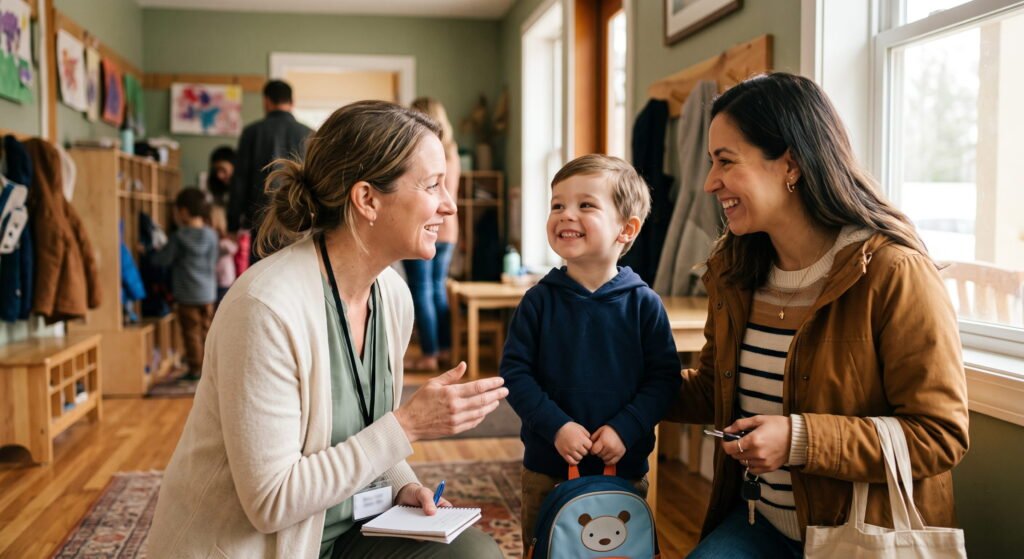
Belonging grows when family cultures shape everyday relationships and curriculum
Multicultural belonging is built through accurate names, home languages, family knowledge, visible representation, responsive routines and genuine opportunities for whānau to influence the programme. It is not achieved by occasional festivals alone. Kaiako can learn with families, avoid stereotypes, explain the centre’s bicultural responsibilities and connect children’s cultural identities with ordinary play, care, stories, music and relationships.
A welcome poster in many languages can be a positive sign, but families learn whether they belong through what happens next. Is a child’s name pronounced accurately? Can a parent explain a comfort routine without embarrassment? Does family knowledge influence play, or appear only during a cultural celebration? Do teachers remain curious when their expectations differ from those at home?
Te Whāriki places family and community within curriculum and gives Aotearoa early learning a bicultural framework. Welcoming multicultural families does not replace commitments to te ao Māori, te reo Māori and relationships with tangata whenua. A thoughtful local curriculum can uphold those foundations while recognising the many languages, migration histories, faiths, cultures and family structures in the community.
Learn the person before selecting the symbol
Ask families how names are pronounced, which languages are used with whom, what the child understands, who belongs in the child’s family and what practices matter in care and learning. A flag or festival may not represent the family’s identity. Use the family’s description and check permission before displaying photographs, stories or cultural objects.
Make names and pronunciation a daily responsibility
Record pronunciation in an agreed way and practise it. Avoid shortening a name for adult convenience unless the child and family use that form. Children notice whether adults repair mistakes respectfully. Accurate names communicate that a person does not need to become easier to pronounce in order to belong.
A practical family knowledge profile
- Names, relationships and pronunciation
- Home languages and useful everyday phrases
- Songs, stories, games, objects or places with personal meaning
- Care, food, clothing, faith or celebration practices relevant to the centre day
- What the family would like to contribute—and what should remain private
Use home languages for connection, not decoration
Learn a manageable set of greetings, comfort words, care phrases and play vocabulary with reliable guidance. Displaying translated labels is useful only when adults and children understand or use them. Te Whāriki Online recommends supporting bilingual and multilingual pathways by using home languages, music, songs, peer communication and visual resources. Be honest about current staff capacity and keep learning.
Invite participation without assigning unpaid responsibility
A family may enjoy sharing a story, skill or celebration, but it should not be expected to represent an entire community or translate every communication. Offer several ways to contribute, including conversations, objects, recordings, recipes, suggestions or choosing not to participate. Explain how contributions will be used and obtain consent.
Move beyond the calendar-event model
- Notice a current child or family interest.
- Ask for accurate context and appropriate permission.
- Connect the knowledge with ordinary play or inquiry.
- Revisit it beyond one day or display.
- Reflect on whose perspectives remain absent or simplified.
Celebrations can be meaningful, but belonging is stronger when cultures appear in routines, relationships and learning across the year.
Represent difference without stereotyping
Books, dolls, dramatic-play resources, music and images should show varied contemporary lives as well as heritage. Avoid presenting one costume, food or craft as the essence of a culture. Include disability, different family structures and intersectional identities. Review materials with families and credible sources when context is uncertain.
Respond respectfully when practices differ
- Ask what the practice means rather than judging it from appearance.
- Explain the centre’s obligations and practical constraints clearly.
- Identify the shared concern, such as safety, dignity or belonging.
- Look for an arrangement that preserves the family’s intent where possible.
- Record the agreement and review it when circumstances change.
Support children learning more than one language
Do not treat a period of observation or limited English output as evidence that the child has nothing to say. Use gesture, visuals, familiar routines, peers, music and family language knowledge. Give processing time and respond to all reliable communication. Where there is a specific concern, consider the child’s capabilities across languages and seek appropriately qualified advice.
Make family communication accessible
Ask which communication channel and language work best. Use clear language and appropriate interpretation where available rather than relying on a child to translate sensitive information. Digital updates can support connection, but private matters may need direct conversation. Explain who can see Storypark content and what choices families have. Check understanding in both directions: a polite nod may not mean the practical detail is clear. Provide time for questions, avoid unexplained sector terms and follow an important discussion with a concise written summary that families can revisit or translate accurately afterwards.
Visit both Childsplay centres as distinct communities
Mt Roskill and Kingsland may have different current languages, family networks, staff knowledge and curriculum interests. Ask each relevant team how it learns from families and connects cultural knowledge with everyday practice. Look for accurate relationships rather than counting flags or festival displays.
Multicultural belonging in childcare: FAQs
Is celebrating cultural events enough?
No. Events can contribute, but belonging is built through everyday names, languages, care, relationships, curriculum and family participation.
Should families provide translations?
Families can contribute if they wish, but should not carry sole responsibility. Agree on reliable resources and accessible communication.
Can home languages be used at childcare?
They should be valued. Ask how the relevant centre learns key language and supports communication while being honest about staff capability.
How does bicultural practice fit with multicultural inclusion?
Aotearoa’s bicultural foundations and commitments to Māori remain central while the local curriculum also responds to the diverse families in its community.
Contact Childsplay Unlimited
Talk with Childsplay Unlimited about your family’s languages, culture and aspirations. Contact Mt Roskill on 09 627 9041 or Kingsland on 09 846 8908 to visit the relevant centre and ask how families currently contribute to belonging and curriculum.