

Introduce real routines gradually while keeping adults responsible for support
Children can become familiar with primary school routines by visiting the actual school, using accurate photos or maps, practising belongings and food containers, experiencing short group transitions and learning how to ask for help. Confirm every procedure with the receiving school. Preparation should build predictability and agency, not demand that preschoolers copy a full school timetable.
Routines help children predict what happens next and where to find support. They can also create worry when adults talk about them as rules a child must master before arrival. The purpose of preparation is to make a few important patterns more understandable, while remembering that new entrants learn school routines after they begin too.
There is no single primary school day. The bell, classroom entry, food breaks, toilets, assemblies, transport and collection systems differ. Begin with information from the school the child will actually attend, update it when needed and avoid teaching procedures based only on an adult’s childhood memory.
Map the day as a sequence of places and people
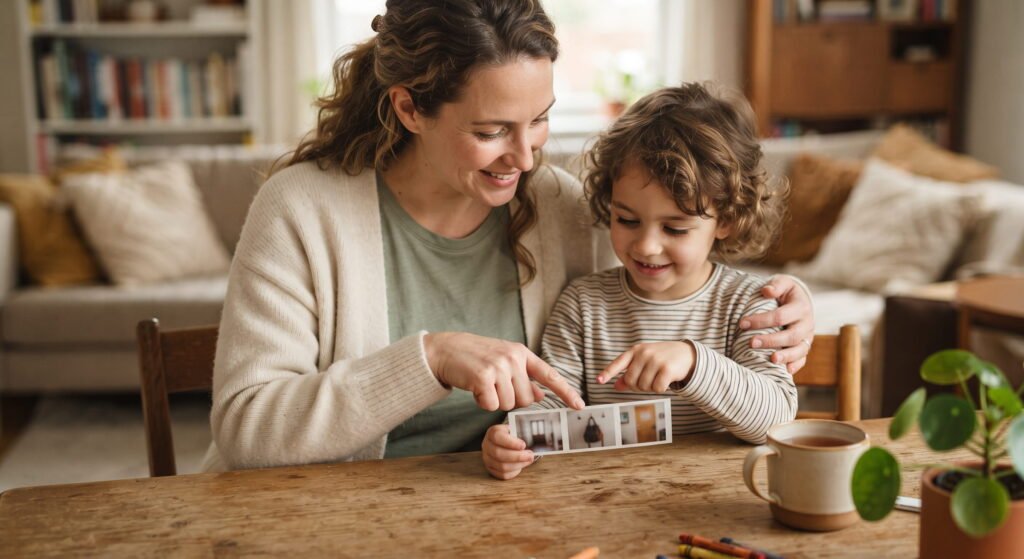
Instead of presenting a long timetable, identify the first few anchors: where the child arrives, who welcomes them, where their bag goes and what signals collection. Add other parts only when useful. A simple strip of approved photographs or drawings can show the sequence. Include the adult who can help at each point, not just the task the child is expected to complete.
Practise arrival without rehearsing separation endlessly
Travel the route and attend school visits where possible. Agree on a short goodbye and tell the child who will collect them. At home, role-play the sequence once or twice if the child is interested, then return to ordinary play. Repeated dramatic farewells can make the transition feel larger rather than safer.
Arrival information to confirm
- Which entrance families use
- When and where supervision begins
- Where bags and communication items belong
- Whether an adult accompanies the child to the room
- Who to contact if the normal plan changes
Make belongings easier to recognise
Use clear labels and involve the child in packing a small number of familiar items. Practise finding their bag among others and returning an item to a consistent place. A photo or symbol may help. Adults should still check essential supplies and comply with school requirements; forgotten equipment is not a moral failure.
Test lunch and drink equipment in a relaxed setting
Open the actual containers during a picnic or ordinary meal. Notice which clips, lids or packets are difficult and change the design if possible. Teach a help request as well as the physical action. Confirm food, allergy, waste and break procedures with the school. Do not assume the system shown in a book or used by another school applies.
Build experience with transitions, not long sitting
A short group story, movement game or collaborative task can involve listening for a cue, shifting activity and carrying a message into action. Children do not need to spend preschool seated for long periods to prepare for learning. Movement, play and exploration remain essential. Gradually extend participation when the experience is meaningful and accessible.
A transition game with genuine choice
- Show the next activity with an object or picture cue.
- Give a brief warning that the current experience will change.
- Offer two useful roles in the transition.
- Move together and acknowledge children who need extra time.
- Review which cue helped and adapt the next transition.
Teach routes to help, toilets and quiet
During a school visit, notice where the child can find a teacher, toilet, office or quieter place, subject to the school’s guidance. Practise the language, sign, picture or device message the child can use. If access, continence, sensory or medical support is required, plan directly with the school early and involve appropriately qualified people.
Talk about bells and crowded moments
Some routines include loud or sudden signals and busy movement. Ask what the school uses and whether the child can encounter it during a visit. Headphones, visual warnings, a buddy, an alternative route or other adjustments may be appropriate for some children. The school should advise what can be supported; do not wait for distress to prove a need.
Clarify collection and authorised adults
Children need a simple, consistent explanation of where to wait and who may collect them, while adults manage the formal authorisations. Create a backup plan and tell the school about changes through its required channel. Avoid instructing a young child to leave the designated place to search for a late adult.
Let routines remain flexible supports
The child may know the sequence and still need help on a tired or emotional day. Routines should reduce uncertainty, not justify withholding support. After school begins, ask which parts are becoming familiar and which remain difficult. Adjust the home routine to allow rest rather than adding more practice automatically.
A five-question weekly review
- Which place or person now feels familiar?
- Which routine is still unclear?
- Did the child successfully ask for help?
- What information needs checking with the school?
- Does the child need practice, an environmental change or simply more time?
Ask Childsplay Unlimited for current examples
Mt Roskill and Kingsland can discuss how the child currently manages belongings, group changes, communication and help-seeking. Ask what school-related familiarity work is happening at the relevant centre and how it remains play based. Because nearby schools and centre programmes differ, confirm the destination school’s routines yourself.
Primary school routines: parent questions
Should we copy a full school day at home?
No. Focus on a few real routines and continue normal family life, rest and play.
What if the school changes a procedure?
Update the child calmly using current information and revise any visual sequence or role play.
Does needing help mean the child is not ready?
No. New entrants are learning routines. Effective help-seeking and appropriate adult support are part of a successful transition.
How can visual supports be used?
Use accurate, simple images or symbols to show a sequence, place or help option. Confirm permission before using school photographs.
Contact Childsplay Unlimited
Help your child connect familiar capabilities with new school routines. Call Childsplay Unlimited Mt Roskill on 09 627 9041 or Kingsland on 09 846 8908 to discuss current observations and transition support with the relevant team.