

Stories and pretend play turn an unknown school into something discussable
Books and role play can help children explore starting school, ask questions and rehearse possible situations without claiming that every school day will look the same. Choose varied stories, connect them with current information from the actual school, let children control the play and listen for misconceptions or worries. The aim is familiarity and conversation, not a scripted performance.
School can be difficult to imagine when a child knows only fragments: a sibling’s story, a building seen from the road or an adult’s enthusiastic promise. Books provide characters and events to think with. Role play allows the child to rearrange those ideas, take different roles and show what feels important.
Neither method predicts the real first day. A picture book may come from another country, and a pretend classroom may reflect adult memories more than current practice. Their value lies in opening conversation. Families and kaiako can then replace guesses with information from the receiving school and still leave room for the child’s imagination.
Choose books for discussion, not as instruction manuals
Look for stories with different children, family structures, languages, abilities and emotional responses. Include both fiction and simple factual material if available. One character may feel eager, another cautious. Avoid presenting one book as the correct model of school. Check whether uniforms, lunches, transport and classroom routines match the actual setting before treating any detail as fact.
A responsive way to read
- Look at the cover and invite the child’s first ideas.
- Pause at a meaningful moment rather than questioning every page.
- Acknowledge the character’s feeling without assigning it to the child.
- Connect one detail with confirmed information about the real school.
- Invite drawing, play or later conversation instead of demanding an immediate response.
Set up role play with open-ended materials
Bags, containers, paper, pencils, name cards, blocks and a few dress-up items may be enough. Children can create a classroom, office, playground, bus or home-after-school scene. Resist arranging a perfect miniature school. When the materials are flexible, the child can reveal whether the important issue is finding a friend, losing an item, using the toilet, meeting a teacher or being collected.
Let the child direct the plot
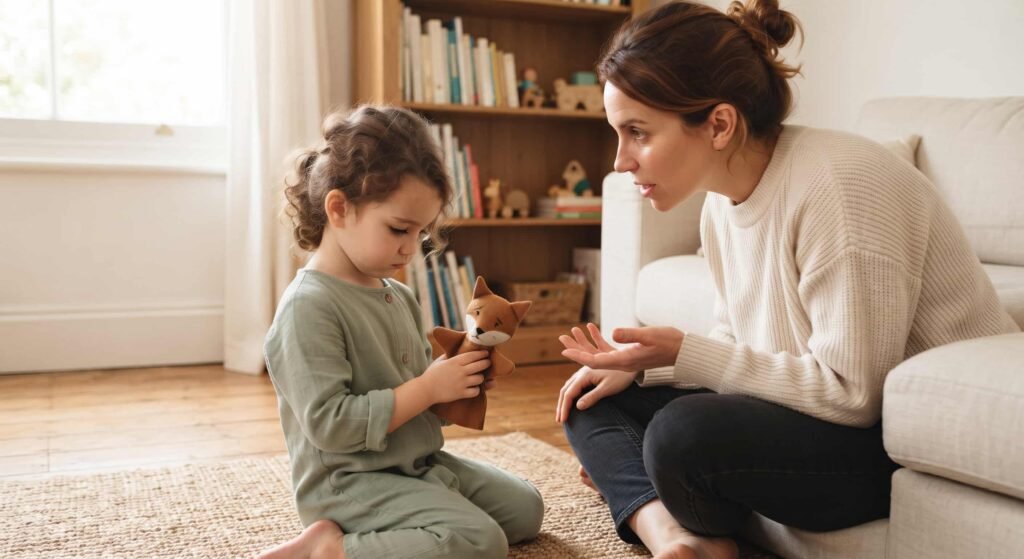
Adults often rush to make school play cheerful. If the child repeatedly makes the puppet miss home or get confused, stay curious. ‘What does the puppet need?’ is more useful than correcting the story. The child may propose a teacher, sibling, comfort object, picture cue or safe place. These ideas can inform real questions for the school.
Switch roles to widen perspective
- The child plays the teacher and explains a routine.
- The adult plays a new student who asks for help.
- A puppet does not understand and needs another explanation.
- Two characters solve a playground problem together.
- A family character returns at the agreed collection time.
Role reversal gives children agency and lets adults model clarification or help-seeking without lecturing.
Correct misinformation gently and specifically
If the child believes parents stay all day or that nobody can help with a lunchbox, first ask where the idea came from. Then provide what is known: ‘At your school, adults leave after the morning routine, and this is the person we can ask about lunch.’ If you do not know, make a plan to find out. Honest uncertainty builds trust better than confident guessing.
Include home language, culture and familiar stories
Invite school conversations in the language the child and family use most naturally. Family stories about starting new places can offer continuity, provided adults do not turn them into comparisons. A child’s whakapapa, name and cultural knowledge travel with them. Ask how the receiving school will recognise these strengths rather than presenting transition as becoming a different kind of child.
Use a real visit to refresh the play
After a school visit, ask what the child noticed rather than what they should have noticed. Add an approved photograph, draw the route or recreate one routine. The play may change as uncertainty reduces. It may also reveal a new question. Current Ministry resource Kua tupu au is designed to prompt conversations and connections between home, early learning and school; families can explore it with the adults involved.
Know when to stop rehearsing
If every book and game becomes about school, anticipation can feel like pressure. Follow the child’s cues and keep plenty of unrelated play. Some children return to the topic repeatedly; others prefer brief, factual conversations. Neither response alone proves readiness or worry.
A simple conversation record
- What the child says they already know
- What the child wants to find out
- Which detail an adult needs to verify
- Which support or relationship seems reassuring
- What the child wants to revisit—or leave alone
Connect the story across Childsplay and school
Share relevant questions with the Childsplay Unlimited Mt Roskill or Kingsland team and ask what transition stories or role-play opportunities are currently meaningful. With consent, useful observations may be shared with the receiving school. Confirm all school procedures directly; neither centre should be expected to speak for another organisation’s current routines.
Books and role play about school: FAQs
What if a book shows different school routines?
Name the difference and check the real school’s current arrangements. The contrast can become a useful discussion rather than a problem.
Should adults always make the pretend story positive?
No. Allow manageable worries and problems to appear, then explore what the character needs. Avoid frightening scenarios or forced reassurance.
What if my child does not want school role play?
Do not force it. Offer factual information and other ways to communicate, then follow the child’s interests.
Can we use photographs from the school?
Use only images supplied or approved for that purpose, and protect the privacy of other children and staff.
Contact Childsplay Unlimited
Ask Childsplay Unlimited how transition conversations can be supported through play. Contact Mt Roskill on 09 627 9041 or Kingsland on 09 846 8908 and speak with the relevant team about your child’s questions and receiving school.