


Useful independence includes knowing when and how to get help
Before school, children can practise caring for belongings, managing parts of dressing and toileting, opening food containers, making choices, packing away and asking for assistance. Independence is not doing everything alone. Adults should teach in small steps, adapt tasks to the child, protect dignity and provide tools or support where disability, development or context makes a task difficult.
The phrase ‘independent before school’ can create an unrealistic image of a child who never needs help. Primary school beginners still need attentive adults. A more useful goal is growing participation: the child understands part of a routine, attempts a manageable step, communicates when something is wrong and accepts support without feeling that help equals failure.
Independence develops unevenly. A child may confidently organise a game but struggle with a zip, or manage the toilet at home but need reminders in a new environment. Fine-motor skills, sensory needs, communication, clothing, culture and opportunity all affect the task. Preparation should remove unnecessary barriers rather than judge character from performance.
Use the participation ladder
- The adult completes the task while describing the relevant step.
- The child participates in one predictable part.
- Adult and child complete the sequence together.
- The child attempts more while the adult waits nearby.
- The child completes the task and knows how to request help when conditions change.
Progress does not always move upward in a straight line. Tiredness, stress, unfamiliar bathrooms or different clothing may increase the support needed. Adults can step back in without saying the child has become lazy or babyish.
Belongings: make the system visible
Start with a small number of consistently placed items. Use a recognisable name label or symbol, and let the child help pack and check the bag. Practise identifying what belongs to them among similar objects. If remembering several items is difficult, a picture checklist can reduce language and memory demands. The adult remains responsible for critical supplies.
A two-minute bag routine
- Place the bag in the same home location.
- Invite the child to add one or two familiar items.
- Use the same short checking sequence.
- Praise the useful action, not speed or perfection.
- Reset the bag together after the day ends.
Clothing: choose access as well as appearance
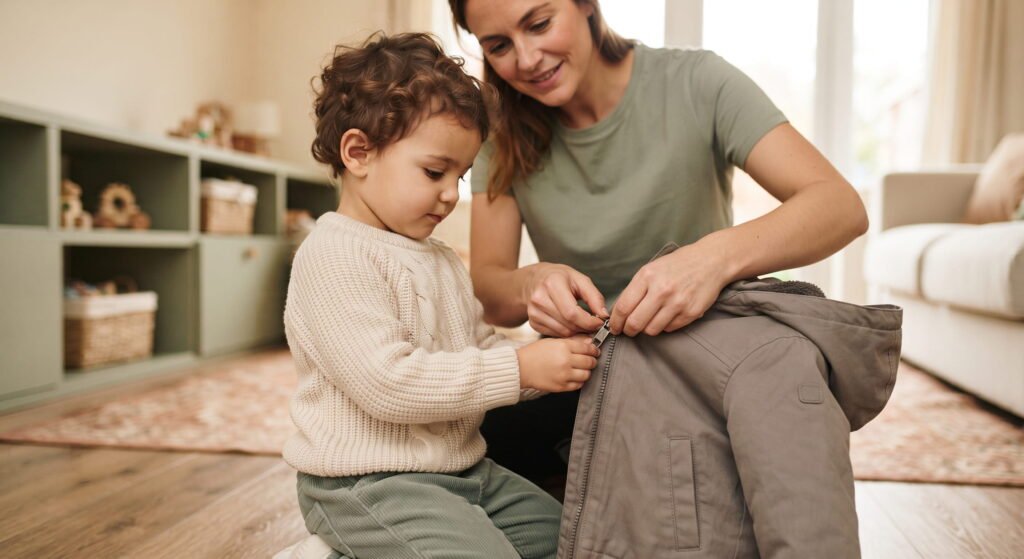
Fastenings can become a practical barrier during toileting, active play or changing weather. Where possible, choose items the child can recognise and operate, then practise when nobody is rushed. Teach one step such as holding the base of a zip while the adult starts it. Adaptive clothing and other supports are valid independence tools, not shortcuts.
Toileting: protect privacy and avoid deadlines
Toileting readiness varies and may be affected by health, disability, sensory experience and stress. Teach words, signs or other methods for requesting the toilet and help. Discuss the school’s facilities and support directly with the school. Never shame accidents or withhold assistance. Individual medical concerns need appropriate professional advice.
Food: practise the real containers
If the school uses lunchboxes, let the child practise opening the actual clips, packets and bottle they will use. Observe whether the portions and packaging remain manageable when the child is hungry or distracted. Teach how to identify which food is for which break only if that matches the school’s system. Confirm allergy and food procedures with the receiving school.
Decision-making: offer bounded choices
Choosing between two suitable options builds agency without transferring adult responsibility. A child might choose which book goes in the bag, where to begin packing away or which comfort strategy to try. Adults still set safety and time boundaries. Too many choices can be harder than none, especially during a transition.
Help-seeking is an independence skill
Children need ways to attract an adult’s attention, explain a need and persist if the first attempt is missed. Practise phrases, signs, a communication card or approaching a designated person. Role-play common situations such as a stuck container, missing hat, playground worry or unclear instruction. The purpose is not to make the child responsible for solving unsafe situations alone.
What adults should not turn into a test
- Completing a task while the child is distressed
- Performing a skill on demand for visitors
- Managing equipment that is inaccessible by design
- Hiding the need for a reasonable adjustment
- Competing with another child’s speed or capability
Connect practice between home and the centre
Tell the Childsplay Unlimited team which steps your child is practising and what wording or visual support helps. Ask what the team observes in a group context. Mt Roskill and Kingsland may use different routines, so agree on a principle rather than assuming an identical sequence. Storypark and direct conversations can help families notice progress while keeping sensitive care details private. If a skill appears in one setting but not another, compare the equipment, time pressure, sensory conditions and adult prompts. A small environmental change may be more useful than additional repetition. Share any professional recommendations through the agreed private channel and clarify who will review the support before the child starts school. Review the plan again together after a school visit.
Independence before school: FAQs
Must a child manage every item alone?
No. The aim is growing participation and effective help-seeking. Adults remain responsible for safety, access and necessary support.
Should we reward speed?
Usually no. Speed can increase stress and mistakes. Notice the strategy, communication and gradual participation instead.
What if the school equipment is hard to use?
Tell the school early. Ask about accessible alternatives, adjustments and the support available rather than repeatedly drilling an unsuitable task.
Can visual checklists help?
Yes. A short picture sequence may support memory, language and predictability. Keep it accurate and use it as a tool, not a compliance chart.
Contact Childsplay Unlimited
Talk about practical independence with Childsplay Unlimited. Contact Mt Roskill on 09 627 9041 or Kingsland on 09 846 8908 to share your child’s current strategies and ask how the relevant centre supports participation and help-seeking.