
Early maths is purposeful thinking throughout play
Children meet maths while comparing quantities, sorting objects, building in space, noticing patterns, measuring, locating and predicting. Kaiako can make this thinking visible through precise language, useful tools and questions linked to the child’s purpose. Early maths is not limited to reciting numbers or completing worksheets, and it can begin from infancy within everyday social and cultural contexts.
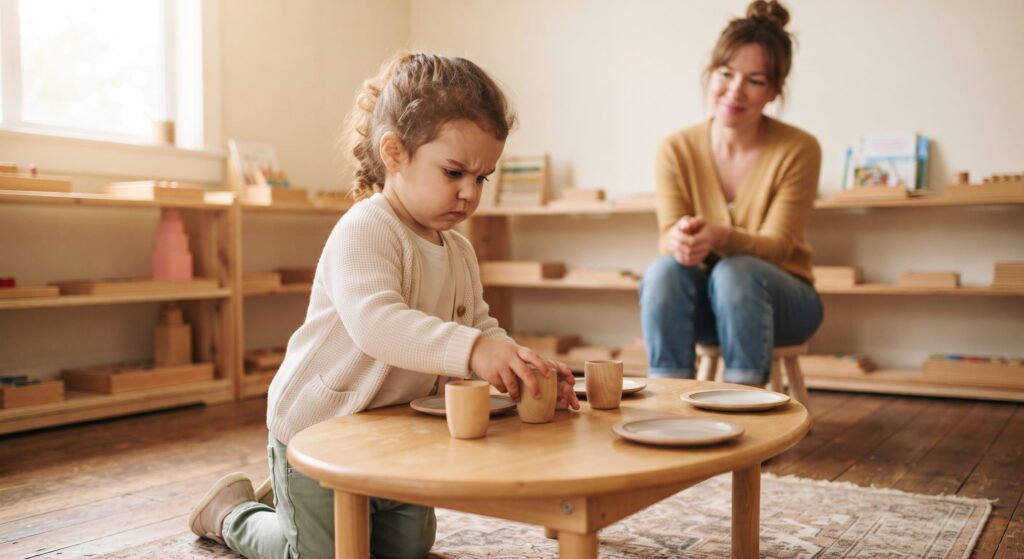
A child places one cup beside every plate, decides that a block tower is taller than yesterday’s, and changes a repeating bead pattern when something looks wrong. These are mathematical acts. They involve one-to-one correspondence, comparison, spatial reasoning and pattern detection even when nobody has announced a maths activity.
Te Whāriki Online describes early maths as including spatial thinking, number and quantity, and patterns that children explore and use purposefully. The word purposefully matters. Children develop stronger ideas when mathematics helps them solve a problem, organise play or explain something they care about.
Number words are only one part of number sense
Reciting a counting sequence can be enjoyable, but it does not automatically mean a child understands quantity. Number sense grows when children match one object to one person, notice that a group has changed, compare more and fewer, or count to answer a real question. Adults can touch or move each item as they count and discuss the total without turning every set of objects into a test.
Sorting reveals which features matter
Buttons may be sorted by colour, size, holes, material or a rule invented by the child. The mathematical thinking lies in identifying a property and using it consistently. When a child places one object differently, an adult can ask about the rule rather than assuming an error. The child may be attending to a feature the adult missed.
Language that makes comparison visible
- more, fewer, enough and equal
- longer, shorter, wider, narrower, heavier and lighter
- inside, beside, behind, under, through and between
- same, different, repeat, before and after
- near, far, first, next and last
Precise language helps children describe relationships they can see and feel. Home languages and te reo Māori can carry mathematical ideas too. Teachers should work with whānau and reliable resources rather than presenting English vocabulary as the mathematics itself.
Construction develops spatial thinking
Blocks, puzzles, ramps, containers and loose parts invite rotation, balance, enclosure, symmetry, distance and position. A child who turns a puzzle piece or chooses a wider base is reasoning in space. Adults can preserve the challenge while describing orientation and asking the child to explain a plan. Photographs or drawings can help children compare structures across time.
Patterns support prediction
Patterns appear in music, movement, stories, weaving, nature and daily routines as well as arranged objects. Children can copy, continue, vary and invent sequences. The adult might pause a familiar rhythm or ask what comes next, but should allow several forms of participation. Cultural patterns need respectful context; they should not be copied as decoration without understanding or permission.
Measurement begins before standard units
Children compare directly by placing objects together, filling containers or pacing a distance. Later they may use repeated informal units such as blocks or scoops. Standard tools can be introduced when useful, but early measurement is about relationships, consistency and purpose. A tape measure means more when the group is checking whether a planned table will fit than when children are asked to read numbers without context.
A play-based maths trail
- Pose or notice a real problem in the child’s play.
- Identify the quantity, pattern, shape, position or measurement involved.
- Offer language or a tool that helps the child investigate.
- Invite prediction and allow the child to test it.
- Revisit the result through conversation, drawing, movement or another attempt.
Maths is social and cultural
Families use mathematics while cooking, travelling, shopping, organising, gardening, making and celebrating. Sharing these practices helps a centre avoid presenting maths as context-free facts. Children may use different words, gestures or methods to reach a result. Teachers can invite explanation and comparison without treating one method as the only intelligent route.
Avoid turning every moment into a quiz
Constant questions such as ‘How many?’ can narrow attention and make the adult’s answer the goal. Description and genuine wondering may produce richer thinking: ‘You made two rows, but this one reaches farther.’ Teachers can also wait. Children need uninterrupted time to notice relationships and revise ideas.
Observe the environment during a visit
Look for varied construction materials, sorting possibilities, patterns, maps, containers, puzzles and measuring tools available within play. Ask teachers for a recent example of mathematical thinking that grew from a child’s interest. The current examples at Mt Roskill and Kingsland may differ, so speak with the relevant team rather than assuming a standard programme.
Share maths from home without assigning homework
Tell kaiako about interests such as buses, baking, collecting shells, building or arranging figures. At home, use natural mathematical language and invite children into genuine shared tasks. There is no need to reproduce school exercises. Confidence grows when children experience themselves as people whose noticing, estimating and problem-solving already have value.
Early maths through play: FAQs
Is counting to a high number the best sign of maths ability?
No. It is one capability. Quantity, pattern, spatial thinking, comparison, measurement and reasoning are also important parts of early mathematics.
Do children need maths worksheets before school?
Play and everyday routines offer meaningful foundations. Worksheets are not required to explore number, pattern, shape, measurement or mathematical language.
Can infants experience maths?
Yes. From early on, children notice space, sequence, movement, quantity and pattern through relationships and sensory experience.
What if a child gives an unexpected sorting answer?
Ask about the rule. The child may be using a valid feature that is not obvious to the adult, creating a valuable opportunity for explanation.
Contact Childsplay Unlimited
See how mathematical thinking appears in everyday play at Childsplay Unlimited. Call Mt Roskill on 09 627 9041 or Kingsland on 09 846 8908 to arrange a visit and ask the relevant centre for current examples of sorting, pattern, building, quantity and measurement.