
Early literacy is meaningful communication before formal reading
Early literacy grows as children enjoy books, hear and create stories, sing, talk, notice symbols, experiment with marks and see reading and writing used for real purposes. It includes first and additional languages and many ways of making meaning. Play-based literacy builds interest, identity and understanding without turning childcare into worksheet practice.
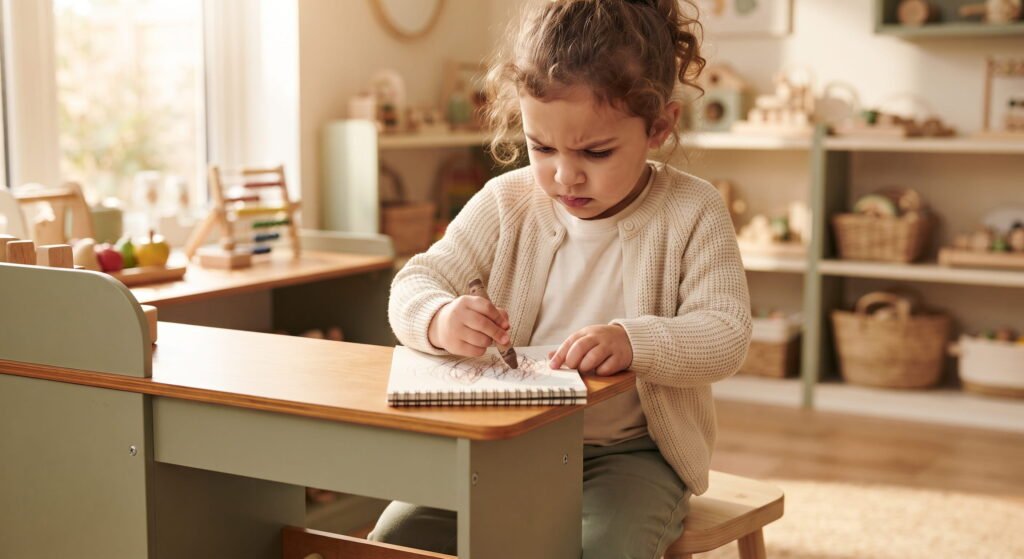
A child draws a series of loops and says it is an order for the cafe. Another recognises a familiar logo, joins the repeated line of a story and asks an adult to write a message. These experiences may not look like conventional reading and writing, but they show children discovering that marks, sounds, symbols and stories carry meaning.
Early literacy is sometimes described as preparation for school. That is true, but incomplete. Literacy is already useful in early childhood: it helps children connect, imagine, record, organise play and communicate across time. The strongest foundation combines enjoyment with meaningful use.
Start with identity, language and culture
Official Te Whāriki literacy guidance connects emergent literacy with children’s identity, language and culture. Books, songs, names, stories and symbols should help children recognise their own worlds and encounter others respectfully. Home languages and te reo Māori belong within a rich literacy environment. A child should not have to set aside one language identity in order to be seen as a capable literacy learner.
Books are social experiences
Reading together involves far more than finishing the text. Children study pictures, predict, repeat, question and connect events with their lives. An adult can follow attention rather than insisting on every page. Familiar books support participation because children know what is coming, while new books widen vocabulary, ideas and perspectives. Independent browsing also matters, so books need to be accessible and cared for without becoming untouchable display objects.
Ways to revisit a favourite story
- Retell it with puppets, blocks, movement or dramatic play.
- Draw a map, character, setting or alternative ending.
- Compare the story with a related event, object or family experience.
- Invite children to tell parts in a home language or communication method.
- Notice repeated sound, rhythm or phrasing without testing recall.
Songs strengthen pattern and participation
Songs and rhymes make sound patterns memorable and create repeated opportunities to join. Movement, instruments and visual cues can widen access. The purpose is not to drill children on isolated sounds. Joyful repetition builds familiarity with rhythm, sequence and language while strengthening group connection. Families can contribute songs with accurate words and context.
Mark-making becomes powerful when it does something
Children are more likely to experiment with writing when marks serve the play: a sign keeps people out of a construction, a list records ingredients, a ticket admits someone to a show and a map guides a journey. Adults can write in front of children, take dictation and provide varied tools. They should value the child’s current representation rather than copying over it to make the product look adult-correct.
A day filled with genuine literacy purposes
- Recognise a name or symbol during arrival.
- Choose a song and join a familiar phrase.
- Use a list, recipe, plan or sign during play.
- Tell, act, draw or dictate an experience.
- Revisit a learning story with a peer or family member.
Meaning can move between modes
A child may first act a story, then draw part of it and later dictate words to an adult. These are connected literacy decisions. Allowing ideas to move between speech, gesture, image, movement and print can reveal understanding that one required format would hide.
Oral language and literacy develop together
Conversation provides vocabulary, story structure and the experience of being understood. Children need partners who listen and extend meaning, not adults who dominate the exchange. Gesture, New Zealand Sign Language and augmentative and alternative communication may also support storytelling and participation. Literacy should remain accessible to children who do not communicate primarily through speech.
Print-rich should not mean print-covered
Labels and displays are most useful when children understand their purpose and can engage with them. Too much visual information may become background clutter or create sensory load. A thoughtful environment includes readable, relevant print alongside images, objects and communication supports. Teachers can change materials as the group’s interests and languages change.
Worksheets are not the measure of readiness
Tracing sheets can produce a tidy page without showing that the child understands why writing matters. Fine-motor development, symbol knowledge and letter interest can be supported through drawing, construction, clay, tools, songs, names and meaningful print. If a child chooses a defined paper activity, it can be one option; it should not replace a broad, playful literacy environment or become a compulsory performance.
Families can create continuity without homework
Share stories, library books, songs, family messages, recipes and everyday lists. Tell kaiako what the child enjoys and which languages or communication methods are important. Respond to Storypark documentation with related experiences or words from home. The goal is a connected literacy life, not an extra programme that turns evenings into lessons.
Questions for a centre tour
Ask how the current programme supports storytelling, home languages, te reo Māori, books and meaningful mark-making. Look for children using literacy within play rather than only adult-made displays. Mt Roskill and Kingsland may have different community languages, books and current projects, so ask the location-specific team for examples.
Early literacy questions from families
Should preschool children be taught to read with worksheets?
Early literacy is broader than worksheet practice. Rich conversation, books, songs, storytelling, play and meaningful mark-making build important foundations.
Is scribbling part of literacy?
Yes. Children’s marks can carry intention and meaning before they resemble conventional writing. Ask what the child says the marks do.
Does rereading the same book still help?
Yes. Familiarity supports anticipation, participation, deeper noticing and confidence. New books can be added without removing valued favourites.
Do home languages delay literacy?
Home languages are part of children’s identity and meaning-making. Continue rich communication and discuss any individual concern with qualified people who consider all languages and contexts.
Contact Childsplay Unlimited
Discover how literacy lives inside play at Childsplay Unlimited. Contact Mt Roskill on 09 627 9041 or Kingsland on 09 846 8908 to arrange a visit and ask about the relevant centre’s current books, stories, songs, languages and mark-making opportunities.