

Problem-solving grows when children can test and revise ideas
Play creates real problems that children care about solving: balancing a tower, moving water, joining a game or making a costume stay together. Kaiako can protect time for investigation, offer open-ended materials, model useful language and provide a prompt without supplying every answer. The goal is flexible thinking and persistence, not one correct product.
A cardboard ramp is too steep and every car flies off the end. To an adult, the solution may be obvious. To a child, the situation contains a rich sequence: notice the pattern, form an idea, alter the ramp, test again and decide what the result means. The learning sits in that sequence, not only in the successful final run.
Problem-solving in early childhood is practical, social, creative and emotional. Children solve how objects work, how to represent an idea and how to continue when people want different things. Play gives the problem a purpose that belongs to the child.
Follow the thinking inside a wobbly tower
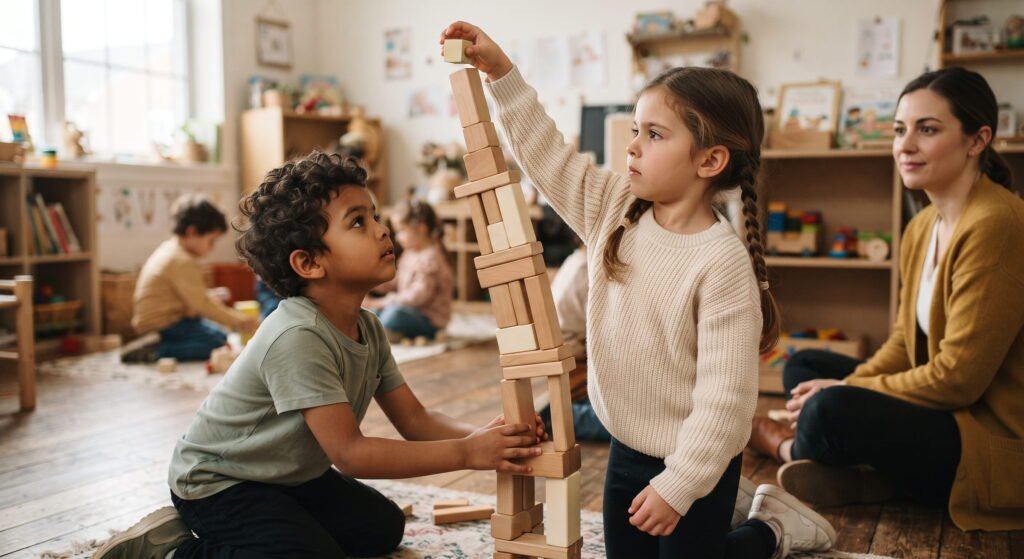
Imagine two children building above shoulder height. The tower leans. One adds another block to the top; the other holds the base. A teacher could rebuild it quickly, but that would remove the central question. Instead, the teacher might describe what is happening, make space around the structure and ask what the children notice. Their next move provides information about balance, shape, cooperation and their current working theories.
A four-part investigation cycle
- Notice: What is happening, and what matters to the child?
- Predict: What does the child think might happen next?
- Test: Which change can be tried safely?
- Revisit: What changed, and what new possibility appeared?
Children may move backwards and forwards rather than follow the sequence neatly. A failed attempt is still evidence. It can narrow possibilities, reveal a new property or encourage a different representation.
Open-ended materials keep answers open
Blocks, fabric, loose parts, sand, water, clay, drawing tools and reused construction materials can be combined in many ways. Because the material does not dictate one result, children must make decisions. A puzzle also offers valuable problem-solving, but its pieces usually lead toward a fixed solution. A balanced environment can provide both defined challenges and materials that invite children to invent the problem itself.
Language can extend thinking without taking ownership
Useful adult language may describe, compare or wonder: ‘That side is sinking into the sand’; ‘These two pieces have different edges’; ‘What could keep the roof from sliding?’ Questions should be genuine and used selectively. A stream of questions can interrupt concentration or make the child search for the answer in the adult’s face. Sometimes quiet observation is the most intentional response.
Social problems require different tools
When two children want the same resource, the problem cannot always be solved by declaring a winner or demanding immediate sharing. Kaiako can help each child communicate, identify the underlying need and consider workable options. Perhaps they need a timer, a related role, another material or a shared plan. The adult still protects safety and fairness while allowing children to contribute to the solution.
What persistence can look like
- Returning after a pause rather than continuing while overwhelmed
- Changing a material, tool, position or partner
- Asking for information or practical help
- Explaining why an earlier idea did not work
- Using a drawing, model or gesture to plan the next attempt
Adults can calibrate challenge
A problem that is too easy may not hold attention; one that feels impossible can close the investigation. Teachers can alter the number of materials, stabilise one part, connect a peer or remind the child of an earlier strategy. They should also recognise when tiredness, hunger, sensory load or strong emotion changes what is manageable. Pausing is not the opposite of learning.
Documentation can return the problem to children
A photograph of the first bridge, a child’s plan or a short transcript can make previous thinking available again. Children may notice a detail, disagree with the adult’s interpretation or decide to rebuild. Families can add related experiences from home. Documentation becomes part of the investigation when it invites revision, rather than merely celebrating a finished product.
Try a problem-solving lens during your visit
Look for sustained play, accessible materials and adults who can explain when they intervene. Ask for a recent example in which an idea developed across more than one attempt. Because the current interests and environments at Mt Roskill and Kingsland may differ, request an example from the location your child would attend.
Notice who gets to define the problem
Adult suggestions can be useful, but children also need chances to identify what is not working and decide what success would mean. Their goal may differ from the polished result an adult imagined. Listening for that goal over time protects agency and makes the investigation genuinely meaningful.
Protect curiosity from the perfect-result trap
Adult-made models can be useful, but if every construction must look polished or every art experience has a predetermined result, children have fewer decisions to make. A learning-rich environment values the reasoning in a crooked bridge, an unfinished plan and a surprising theory. Product quality is not a reliable measure of the complexity of a child’s thinking.
Problem-solving through play: FAQs
Should teachers always ask questions during problem-solving?
No. Questions can help, but description, a new material, a demonstration or quiet observation may be more useful depending on the moment.
Is frustration necessary for learning?
A manageable challenge can support persistence, but children do not need to be left distressed. Adults should protect safety, co-regulate and adjust support.
Do puzzles build problem-solving?
Yes. They can involve visual comparison, planning and persistence. Open-ended play adds problems with multiple possible solutions.
How can families extend an investigation?
Share related experiences or materials and ask the child to show what they tried. Avoid turning the conversation into a test of whether they remember an adult-defined fact.
Contact Childsplay Unlimited
See how children investigate ideas at Childsplay Unlimited. Contact Mt Roskill on 09 627 9041 or Kingsland on 09 846 8908 to arrange a visit and ask the relevant team for current examples of problem-solving, persistence and open-ended play.