


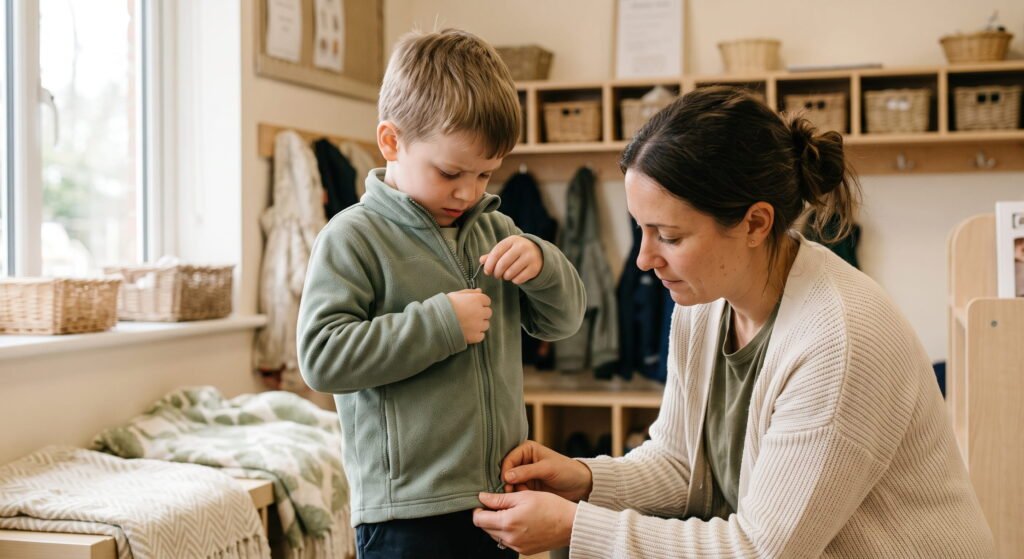
Independence develops through supported participation
Supporting independence does not mean leaving children to manage alone or expecting skills before they are ready. It means involving them in meaningful routines, offering suitable choices, breaking tasks into manageable parts and reducing help gradually. Children may become more independent at different rates and in different settings, so patient coordination between whānau and kaiako matters.
Adults often notice independence through visible milestones: putting on shoes, washing hands, packing away or opening a lunch container. Yet independence also includes choosing, communicating a need, remembering part of a routine and deciding when help is necessary. These capabilities develop within relationships, not outside them.
The phrase ‘Do it yourself’ can either invite agency or create pressure. The difference lies in timing, the size of the task and whether support remains available. Early learning can create many low-pressure opportunities to practise while respecting each child’s age, culture, temperament, ability and current circumstances.
Replace the all-or-nothing test
A child does not need to complete every step unaided for the experience to build independence. They might place clothes in reach while an adult manages a difficult fastening, carry a cup with two hands, or choose the book while a teacher turns delicate pages. Shared participation allows the child to experience competence now and take ownership of additional steps over time.
Use a simple support ladder
First: arrange the environment
Place everyday materials where children can see and reach them safely. Use consistent locations, manageable containers and visual cues where useful. An environment that always requires adult permission or physical access can make children appear less independent than they are.
Next: wait and observe
Before helping, notice what the child already understands. A pause may reveal that they can begin, change their grip or seek a tool. Waiting should not become a test of endurance. If frustration rises or safety is involved, the adult can respond while still preserving a meaningful part for the child.
Then: give the smallest useful assistance
A short prompt, a demonstration, holding one side steady or completing the hardest step may be enough. When the child no longer needs that help, reduce it. This gradual adjustment is more responsive than either doing the entire task or refusing assistance in the name of independence.
Routines provide repeatable practice
Arrival, handwashing, meals, rest, toileting, dressing and tidying recur often enough for children to recognise a sequence. Repetition reduces the thinking required to work out what happens next. Teachers can use clear language and allow time for participation. Care routines should remain respectful and responsive; independence must never come at the cost of hygiene, comfort, dignity or supervision.
Choice is an independence skill
Choosing between suitable options helps children consider preference and consequence. They may select a material, decide where to begin or choose whether to join now or after watching. Adults should avoid offering a choice when only one answer is acceptable. A clear statement is kinder than a false question, while boundaries can still include agency: ‘It is time to wash hands. Would you like this tap or that one?’
Help-seeking belongs inside independence
Independent learners know that people and tools are resources. A child who says ‘Can you start the zip?’ is identifying the difficult step and recruiting support. Adults can respond without taking over: ‘I’ll connect the bottom; you can pull the tab.’ This frames interdependence as capable participation rather than dependence as a weakness.
Everyday signs of growing independence
- Recognising where belongings or resources belong
- Starting part of a familiar routine without a reminder
- Making a choice and communicating it
- Persisting briefly, then asking for specific help
- Taking responsibility for a shared space or group task
Avoid turning speed into success
Group schedules can tempt adults to hurry. A child who needs more time may lose the chance to practise because an adult routinely finishes the job. Where possible, build time into transitions, offer an earlier start or simplify the step. Equally, a child should not be shamed for needing support. Efficient care and patient learning need to be balanced thoughtfully.
Coordinate without demanding identical behaviour
A child may manage a task at the centre but want help at home, or the reverse. The settings carry different relationships, equipment and emotional demands. Families and kaiako can share what the child currently does, which prompts help and whether a new expectation is appropriate. The goal is a coherent direction, not proof that the child performs identically everywhere.
Review the next step, not a final standard
Choose one useful step that is close to the child’s current capability, then notice whether the support still fits. As strength, coordination, language or confidence changes, the task can change too. This keeps independence thoughtfully responsive instead of turning it into a fixed checklist.
Ask what independence looks like at each centre
During a visit, observe whether children can access materials, contribute to routines and request assistance. Ask how teachers adjust expectations for infants, toddlers, older children and those with individual support needs. Mt Roskill and Kingsland should each describe their current environment and practice; do not assume the same room layout or routines apply to both.
Supporting independence: common questions
Does helping make a child less independent?
No. Well-judged help can make participation possible. The adult can provide the smallest useful support and reduce it as capability grows.
Should a child be able to dress completely before school?
Skills develop at different rates. Focus on gradual participation, communication and help-seeking, and discuss individual expectations with educators rather than using one rigid checklist.
What if practising makes mornings too slow?
Choose lower-pressure times for new practice and preserve one manageable step during busy routines. Independence grows through repetition, not through one rushed attempt.
Can visual routines help?
They can help some children recognise sequences and anticipate what comes next. Any support should be understandable, current and matched to the individual child.
Contact Childsplay Unlimited
Ask Childsplay Unlimited how everyday routines support agency and self-help skills without rushing children. Call Mt Roskill on 09 627 9041 or Kingsland on 09 846 8908 to arrange a visit and discuss your child’s current capabilities, routines and support needs.