

Exploration turns curiosity into working knowledge
Mana aotūroa | Exploration supports children to learn through active investigation of natural, social, physical, spiritual and human-made environments. They move, observe, ask, predict, test, compare and revise ideas. Kaiako provide time, adaptable resources, language and safe challenge while resisting the urge to solve every problem or prescribe one correct result.
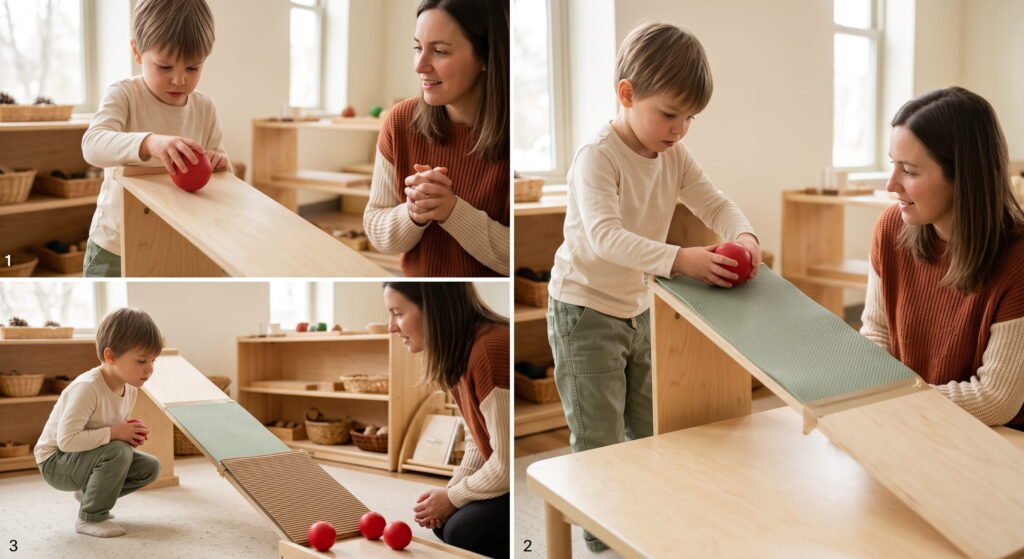
A child rolls the same object down three surfaces. Another watches where rainwater gathers. A group changes the roof of a shelter after the first design sags. In each case, knowledge develops through a cycle of action, result and reconsideration.
Exploration is sometimes mistaken for keeping children busy with novelty. Mana aotūroa offers a deeper picture: children build confidence as learners by making sense of a world that includes people, materials, places, ideas and relationships.
Working theories are ideas in motion
Children form provisional explanations about how things work: heavy objects sink, plants need water, a friend will accept a particular invitation. They test these theories through play and daily life. An unexpected result is valuable because it creates a reason to revise. Adults can ask what the child noticed rather than rushing to replace the theory with a fact.
The environment is broader than equipment
Official guidance describes exploration across natural, social, physical, spiritual and human-made dimensions. A ramp provides physical information, a group plan creates social questions, a local place holds cultural meaning and a digital photograph can help compare change. Centres should not reduce exploration to a science table or a set of sensory bins.
A cycle of inquiry children can revisit
- Notice a pattern, difference, problem or possibility.
- Act on an idea using movement, materials, language or collaboration.
- Observe what happens without treating surprise as failure.
- Represent or discuss the result through words, images, construction or gesture.
- Change the plan and test a new possibility.
The adult can be a co-investigator
Wondering honestly alongside a child models curiosity without pretending that every inquiry has one immediate answer.
Time is an essential learning resource
An activity rotated away just as children begin to understand it may create variety but little depth. Long periods and opportunities to return allow designs, questions and relationships to become more complex. Teachers make practical decisions about shared space and routines, yet photographs, saved components or conversation can help an idea continue even when materials must be packed away.
Good questions open possibilities
Questions such as ‘What changed?’ or ‘How could we find out?’ invite observation. A sequence of questions whose answers the adult already knows can turn inquiry into a quiz. Sometimes a comment, new tool or silent presence is more useful. The teacher watches whether intervention increases the child’s thinking or transfers ownership to the adult.
Documentation can return evidence to the child
A photograph, sketch, model or short transcript can help children remember what they tried and compare it with a later attempt. Teachers can invite the child to select what matters, explain a change or challenge the adult’s interpretation. This makes documentation part of inquiry rather than a report produced after learning has finished. Digital sharing may also invite family knowledge, but consent, privacy and the child’s dignity remain important. Not every failed structure or private conversation needs to become content for an online audience.
Movement produces knowledge
Children learn about distance, balance, force, speed, position and their own capabilities by moving. Suitable physical challenge supports judgement and confidence. Adults maintain safe conditions and active supervision while allowing time for children to assess and attempt. Individual mobility, sensory and health needs may require adaptation, so participation should never be defined by one physical route.
Trial and error needs emotional safety
A structure falling can be funny, disappointing or both. Children are more likely to persist when mistakes are treated as information and help is available without embarrassment. Teachers can name effort, break down a problem or protect the work from interruption. Praising every result automatically is less useful than noticing the strategy or change.
Signs of a thoughtful exploration environment
- Materials can be combined, moved and used in more than one way.
- Children have places for energetic investigation and sustained concentration.
- Kaiako can explain why and when they intervene.
- Children’s questions and changing theories are documented across time.
- The local natural and cultural environment is approached with care and respect.
Exploration includes responsibility
Making sense of the environment also means noticing impact. Children can help care for materials, living things and shared places, with adults holding the real responsibility. Kaitiakitanga should be connected with ongoing relationships, local knowledge and respectful practice rather than used as a decorative word for a one-off tidy-up.
Family knowledge can change the investigation
A parent may recognise the machine a child is building, know the home-language name for a plant or explain a family practice connected with the weather. That contribution can give the inquiry cultural and personal depth. Teachers should seek permission before sharing private stories and distinguish family knowledge from assumptions about an entire cultural group.
Ask for an example that developed over time
On a tour, attractive materials show possibilities but not necessarily curriculum quality. Ask the centre to describe an investigation that children revisited, how teachers responded and what changed. Because programmes evolve, Mt Roskill and Kingsland may provide different current examples; treat each as its own local setting.
Mana aotūroa and exploration: FAQs
Is exploration mainly outdoor science?
No. It includes natural, social, physical, spiritual and human-made environments and can occur through construction, movement, relationships, technology, stories and daily routines.
Should adults answer children’s questions?
Sometimes. They can also help children observe, test and find information so the question remains an active inquiry.
Why do children repeat the same experiment?
Repetition can improve control, reveal variation and allow a working theory to become more detailed.
How is risk managed?
Kaiako distinguish suitable challenge from hazards, supervise actively and adapt experiences to children’s ages, capabilities and current conditions.
Contact Childsplay Unlimited
See how curiosity develops at Childsplay Unlimited. Call Mt Roskill on 09 627 9041 or Kingsland on 09 846 8908 to arrange a visit and ask the relevant centre for current examples of children investigating, revisiting and extending ideas.