

Fair participation values difference rather than erasing it
Mana tangata | Contribution supports equitable opportunities for children to learn with and alongside others, draw on their strengths and have their ideas valued. Equity is not giving every child an identical role. It means noticing barriers, adapting environments and relationships, challenging bias, and ensuring different ways of communicating and participating can influence the group.
A group activity can appear open to everyone while one child always watches, another carries out adult instructions and the same confident voices make every decision. Presence is not the same as participation, and participation is not the same as contribution.
Te Whāriki’s Mana tangata strand asks early learning communities to value what each child brings and create equitable opportunities. This gives parents a more useful question than whether everyone received the same turn.
Contribution begins with a strengths-based view
Children arrive with knowledge, relationships, interests, languages and capabilities. A strengths-based teacher looks for what helps the child engage and what the group can learn from them. This does not ignore support needs. It avoids defining a child only by what is difficult and uses existing competence as a bridge toward fuller participation.
Equity and equality are not identical
Giving every child the same verbal instruction may look equal, but it can exclude someone who needs a visual cue, more processing time, a home-language explanation or a different position in the room. Equity adapts access so children can participate meaningfully. The desired contribution may also differ: speaking to the whole group is not the only valuable form.
Barriers adults can investigate
- Materials are out of reach or usable in only one way.
- The pace leaves no time for observation, translation or response.
- Popular children repeatedly control roles, tools or topics.
- Noise, space or sensory demands overwhelm participation.
- Adult assumptions about age, gender, language or ability limit expectations.
Peer relationships are learned with support
Children learn to enter play, share perspectives, ask for help, offer help and repair disagreements through interaction. Telling a child simply to share may not provide the language or strategy needed. Kaiako can interpret cues, model a phrase, protect an unfinished idea, suggest compatible roles or help the group understand another viewpoint.
A contribution should be able to change something
If adults invite ideas but always keep the original plan, children learn that consultation is ceremonial. Genuine contribution may alter the story, resource arrangement, question or sequence. Adults still set safety and care boundaries, yet within those limits children can see that their thinking has consequences for the learning community.
Fairness includes challenging bias
Children notice messages about who can lead, which families are normal and whose language sounds valuable. Teachers should respond when play excludes someone through stereotypes or discriminatory ideas. The response can be calm and educational: protect the affected child, make the bias visible in age-appropriate language and offer more accurate possibilities rather than ignoring harm as imagination.
Contribution can be quiet, physical or creative
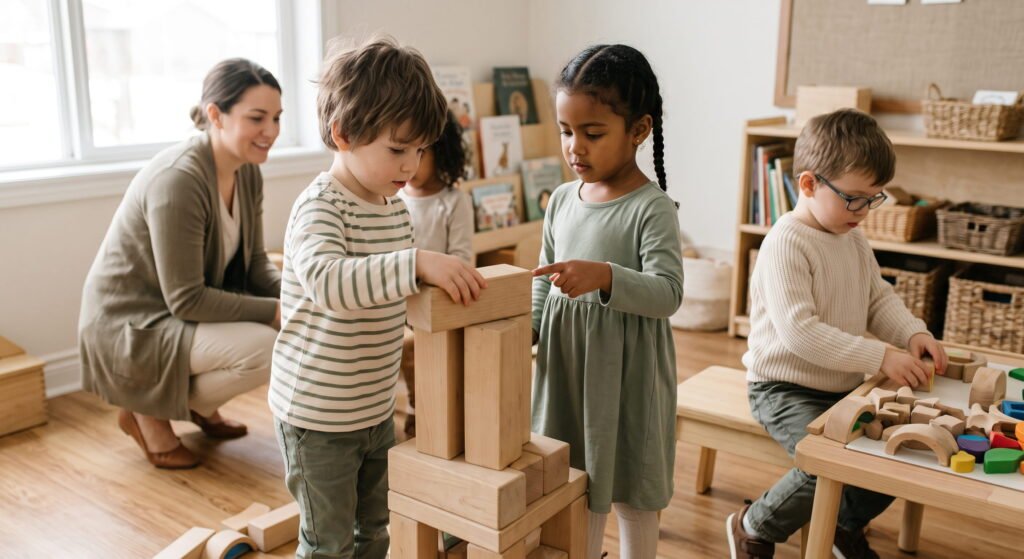
One child proposes the story; another watches carefully and places the piece that stabilises the structure. A child may communicate through signs, movement, drawing, an assistive system or a home language. Teachers need multiple ways to notice authorship and influence. Rewarding only quick speech can create a narrow picture of competence.
Review whose contributions become part of assessment
Documentation can unintentionally favour dramatic projects, fluent speech and products that photograph well. Teams can compare whose ideas appear in learning stories and whose participation is recorded mainly as attendance or compliance. A brief gesture, patient observation or home-language explanation may reveal important capability when interpreted with family knowledge. This review should improve opportunities, not create a quota or force children into public visibility. Parents can help by responding with context while protecting information they prefer to keep private.
A simple observation exercise for parents
- Choose one shared area and notice who can enter it.
- Watch whose ideas adults and peers take up.
- Look for adaptations that support different bodies and communication styles.
- Notice how disagreement, exclusion or stereotypes are addressed.
- Ask how teachers review participation patterns across time, not just during tours.
Family insight can reveal unseen strengths
A child who speaks little at the centre may tell complex stories at home. Another may carry significant responsibilities within an extended family or use specialist knowledge adults have not recognised. Share these capabilities with kaiako and ask how they can enter assessment and planning without putting the child on display.
Leadership should move between children
Leadership can mean inviting a peer, explaining a method, caring for materials or changing course after listening. Teachers can create conditions in which different children lead from their strengths rather than always assigning the most verbal child. Rotating a formal helper badge is less meaningful if real decisions remain concentrated elsewhere.
Ask each centre about its current inclusion practice
Groups, spaces and support arrangements can change. Families considering Mt Roskill or Kingsland should discuss the child’s strengths, language, accessibility and support needs with that centre. Ask for current examples and collaborative planning. This article provides a curriculum lens, not a promise that every adaptation is available without discussion.
Mana tangata and participation: FAQs
Does fair participation mean every child takes the same turn?
No. Equity focuses on meaningful access and valued contribution, which may require different support, time, roles or communication methods.
What if my child prefers observing?
Observation can be purposeful. Teachers can protect that entry point while offering low-pressure ways to join when the child is ready.
How should a centre respond to exclusionary play?
Kaiako should protect wellbeing, help children understand impact, challenge biased assumptions and support fairer ways to continue.
Should I tell the centre about strengths seen only at home?
Yes. Family observations can broaden assessment and help teachers create relevant opportunities without defining the child by centre behaviour alone.
Contact Childsplay Unlimited
Ask how every child can contribute at Childsplay Unlimited. Call Mt Roskill on 09 627 9041 or Kingsland on 09 846 8908 to arrange a visit and discuss your child’s strengths, communication and participation with the relevant centre.