
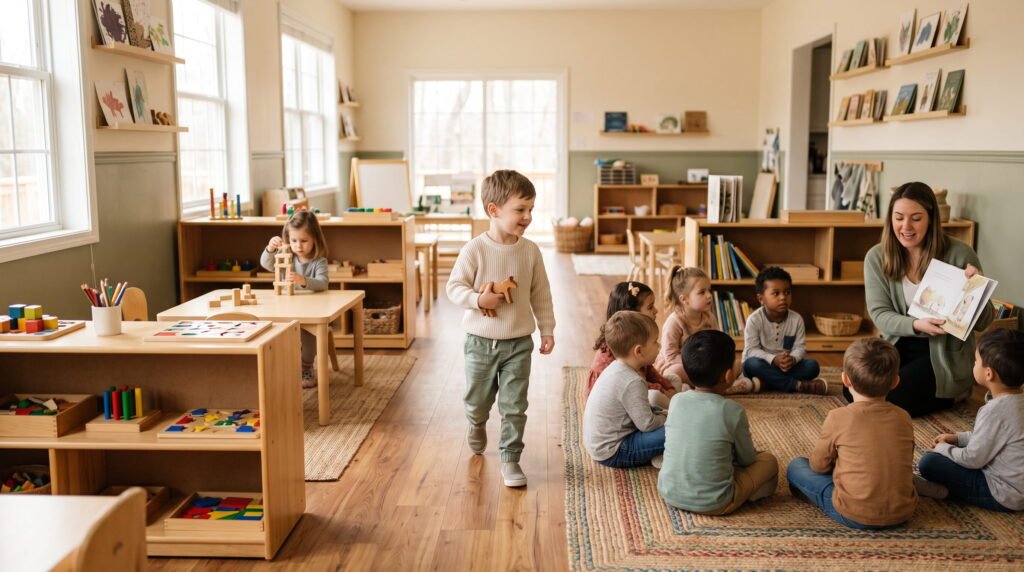
Te Whāriki is a framework that centres the whole child
Te Whāriki is Aotearoa New Zealand’s early childhood curriculum. It weaves four principles with five learning strands, then allows each service to create a local curriculum shaped by its children, whānau, community and place. Parents should expect intentional teaching and assessment, but not an identical timetable or programme at every centre.
Choosing early learning can introduce families to unfamiliar language. Te Whāriki may appear in a centre philosophy, learning story or conversation with a teacher, yet the name alone does not explain what a child’s day will feel like. The simplest starting point is its image: a whāriki is a woven mat, and the curriculum treats learning as something woven from connected principles, experiences and relationships.
This guide translates the framework for parents without reducing it to a checklist. It also explains why two centres can work from the same national curriculum and still make different, locally responsive decisions.
Why the woven-mat metaphor matters
A woven mat gains strength through strands crossing and supporting one another. In the same way, early learning is not divided neatly into isolated subjects. A child building a shelter may be communicating, cooperating, testing physical ideas, drawing on family knowledge and developing confidence at once. Te Whāriki gives kaiako a way to notice those connections and plan for learning without turning childhood into a sequence of lessons.
Four principles guide curriculum decisions
The framework is underpinned by Whakamana | Empowerment, Kotahitanga | Holistic development, Whānau tangata | Family and community, and Ngā hononga | Relationships. These are not four activities to complete. They are lenses for decisions: does the experience enhance the child’s mana, recognise development as interconnected, include the wider world of family and community, and build responsive relationships with people, places and things?
What parents may notice when the principles are lived
- Children have meaningful choices and their ideas influence what happens next.
- Care, emotion, movement, language, culture and thinking are considered together.
- Whānau knowledge and aspirations contribute to planning and assessment.
- Kaiako respond warmly, listen closely and help children develop relationships with others and their environment.
Five strands describe broad areas of learning
The five strands are Mana atua | Wellbeing, Mana whenua | Belonging, Mana tangata | Contribution, Mana reo | Communication, and Mana aotūroa | Exploration. Each contains goals for the learning environment and broad outcomes that children develop over time. The Māori and English names are presented together, but their cultural meanings should not be treated as simple word-for-word equivalents.
Learning outcomes are broad on purpose
Te Whāriki does not expect every child to produce the same answer on the same day. Outcomes describe valued capabilities such as making connections, expressing ideas, including others, caring for wellbeing and exploring with confidence. Kaiako observe how these capabilities emerge in play, routines and relationships. They can then offer resources, language, time or interaction that makes further learning possible.
Every service weaves a local curriculum
The Ministry of Education explains that local curriculum reflects the place, history, people, languages, cultures, identities, aspirations and interests connected with a service. This flexibility is not permission to ignore Te Whāriki. It is the mechanism that makes the national framework meaningful for real children. Families should ask how local priorities were chosen and how their voices can influence them.
The same framework does not mean identical centres
Childsplay Unlimited promotes both Mt Roskill and Kingsland, but parents should not assume their rooms, resources, routines or current projects are interchangeable. Visit the centre relevant to your family. Ask teachers to show how its local curriculum reflects the children, whānau and neighbourhood currently present, and confirm operational details directly.
Assessment makes the learning pathway visible
Early childhood assessment often uses observations and learning stories rather than tests. A useful story does more than describe an enjoyable activity: it interprets what learning may be developing, connects with previous knowledge or whānau insight and suggests possible next steps. Childsplay Unlimited uses Storypark, so parents can ask how online stories, face-to-face conversations and their own observations work together.
Te Whāriki includes care and routine moments
Arrival, meals, rest, nappy changing, toileting, transitions and farewells are part of the curriculum because relationships, independence, communication and wellbeing are being built there. A parent evaluating a centre should therefore watch how adults respond during ordinary moments, not only inspect planned activities. Respectful care can show the principles as clearly as an elaborate project.
A practical five-question tour lens
- How do children’s interests and family aspirations shape planning?
- Can you show an example of learning that developed across time?
- How are te reo Māori, tikanga Māori and the bicultural foundation woven into everyday practice?
- How does the programme include children with different languages, strengths and support needs?
- What is distinctive about this centre’s local curriculum and community connections?
Use the framework to start a conversation
Parents do not need to become curriculum specialists before enrolling. A strong centre should be able to explain Te Whāriki in clear language and connect it to a child’s experience. Ask for examples, listen for thoughtful reasoning and share what matters to your whānau. The curriculum becomes most useful when it supports a continuing partnership rather than appearing only in policy documents.
Te Whāriki questions parents often ask
Is Te Whāriki used by every early learning service?
It is New Zealand’s early childhood curriculum framework. Services weave it into a local curriculum suited to their setting and community.
Does Te Whāriki prepare children for school?
It supports broad capabilities for confident lifelong learning, including communication, relationships, wellbeing, contribution and exploration. Early literacy and mathematics can grow through meaningful play and routines.
Why does my child’s programme look different from another centre?
Local curriculum is intentionally shaped by each service’s children, whānau, place and priorities, while remaining grounded in the national framework.
How can whānau contribute?
Share aspirations, culture, language, interests and observations from home, and ask how these can be reflected respectfully in planning and assessment.
Contact Childsplay Unlimited
Talk with Childsplay Unlimited about how Te Whāriki is expressed at each centre. Call Mt Roskill on 09 627 9041 or Kingsland on 09 846 8908 to arrange a visit, see the current learning environment and ask how your whānau can contribute to the local curriculum.