
Building and puzzles turn ideas into visible problems
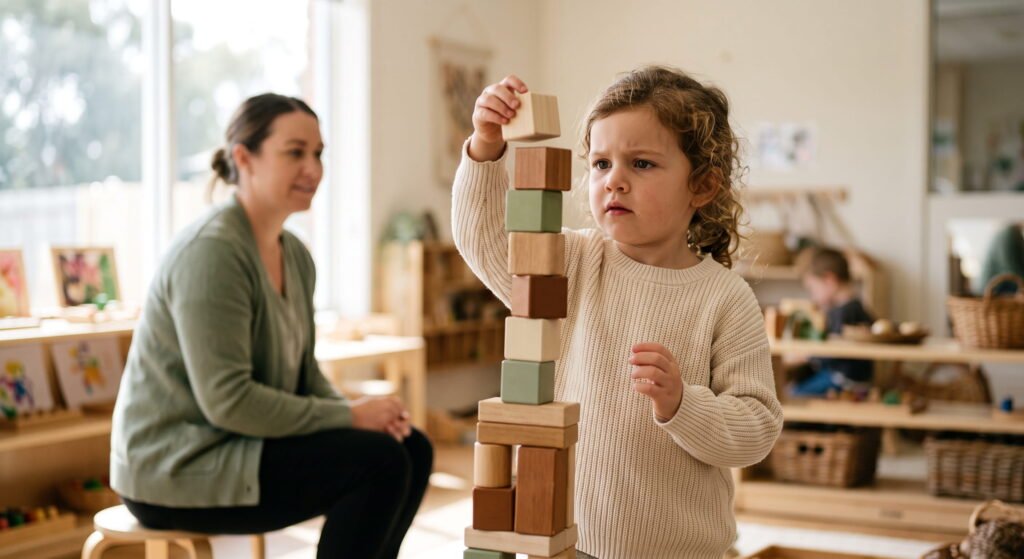
Blocks, construction materials and puzzles invite children to plan, compare, rotate, balance, connect and revise. These experiences can support spatial thinking, early mathematics, language, persistence and cooperation. The most valuable learning often happens before completion, when a child tests why something failed and chooses what to try next.
A tower that falls is not failed learning. It provides immediate information about balance, base width, weight and the effect of movement nearby. A puzzle piece that will not fit invites rotation, comparison and attention to detail.
Construction experiences vary from stacking a few large blocks to designing complex shared worlds. Teachers support different ages by selecting suitable materials, protecting concentration and helping children explain or revise their strategies.
Spatial thinking develops through action
Children learn about position, orientation, distance and shape as they move pieces in real space. A block may fit when turned; a road must pass under or around a structure; a puzzle requires matching both edge and image. Words such as beside, between, vertical and curved become meaningful when attached to the child’s plan.
Early mathematics appears without a worksheet
Construction encourages comparison, pattern, quantity and measurement. Children may count pieces because they need enough, compare heights because a bridge must clear a vehicle or create a repeating fence. Kaiako can introduce useful mathematical language and tools while keeping the numbers connected to a genuine problem.
The thinking cycle inside a build
- Imagine or agree on a purpose.
- Select materials and begin a structure.
- Observe what happens under real conditions.
- Change the plan, connection or material.
- Explain, revisit or use the result in further play.
Puzzles teach strategy as well as matching
A child may search for corners, group colours, rotate a piece or use the picture as a guide. Adults can name the strategy rather than placing pieces for the child. When the challenge is too high, reducing the available pieces or completing a small section together can preserve ownership.
Persistence needs emotional support
Frustration is common when a carefully built structure collapses or a plan exceeds current skill. Teachers acknowledge the feeling, protect the work from unnecessary disruption and help the child identify a next step. Praise is most useful when it refers to strategy and effort rather than labelling the child as clever.
Shared construction creates social problems
A group must decide whose idea leads, where a structure belongs and what happens when resources are scarce. Teachers can help children state intentions, listen and negotiate. Cooperation does not require every child to work on the same part. Parallel roles—designer, builder, material collector or storyteller—can support participation.
Open-ended materials change with the imagination
A block can become a phone, ingredient, animal or piece of a city. Loose parts such as tubes, fabric and natural materials expand combinations when they are safe and age appropriate. A highly specific toy can also be useful, but adaptable materials create more opportunities for children to assign meaning and transform a plan.
Safety and challenge must be considered together
Materials need suitable size, condition and storage for the children using them. Tall or heavy constructions require thoughtful placement and supervision. Adults can set boundaries around throwing, unstable towers or blocked pathways while still allowing manageable experimentation. Younger children may need a separate scale of materials from older builders.
Photographs can preserve an idea, not just a product
A temporary build may need to be dismantled for space or safety. A photograph, sketch or child explanation can help the idea continue later. Documentation is especially valuable when it records the problem and strategy, not merely the finished structure. Children can compare versions and recognise how their thinking changed.
Teachers extend by adjusting one variable
- Add weight and ask how the bridge responds
- Offer a different connector or surface
- Introduce a plan, map or measuring tool
- Connect the build with dramatic play or storytelling
- Invite children to explain a strategy to a peer
What parents can observe
Look for children selecting materials, sustaining attention and making real decisions. Notice whether adults solve problems too quickly or support children to test possibilities. Ask how constructions are protected or revisited, how different ages access challenge and how family or community experiences enter the play.
Completion is only one possible ending
A child may finish, transform, abandon or dismantle a project. Each ending can offer information. Teachers can ask what the child wants to remember and whether the materials should become available for a new idea. The purpose is not a permanent display; it is increasingly capable thinking.
Construction can reveal knowledge from home and community
Children may reproduce roads, marae, apartments or repair work they have observed. Families can explain the place or process and contribute accurate vocabulary. Asking the child and whānau prevents adult guesses from replacing genuine connections with occupations, histories and local environments.
Respect decisions about keeping or dismantling
Space and safety mean a construction cannot always remain. Give warning, photograph it if the child wishes and explain when materials must return. This treats the child’s work seriously while recognising shared-centre realities. Children can then decide what element to rebuild, remember or change next time.
Blocks, construction and puzzle FAQs
Why does my child keep knocking towers down?
They may be exploring cause and effect, sound, force or repetition. Adults can provide a safe place and help protect other children’s work.
Should adults help complete puzzles?
Offer a strategy or reduce the challenge before placing pieces automatically, so the child can retain ownership and experience progress.
Do blocks support school readiness?
They can support language, spatial thinking, mathematics, planning, persistence and cooperation—useful foundations developed through meaningful play.
What if my child prefers building alone?
Independent concentration can be valuable. Teachers can respect it while creating gentle opportunities for communication and shared projects.
Contact Childsplay Unlimited
See how children plan, build and solve problems at Childsplay Unlimited. Call Mt Roskill on 09 627 9041 or Kingsland on 09 846 8908 to arrange a visit and explore the current learning environments.