
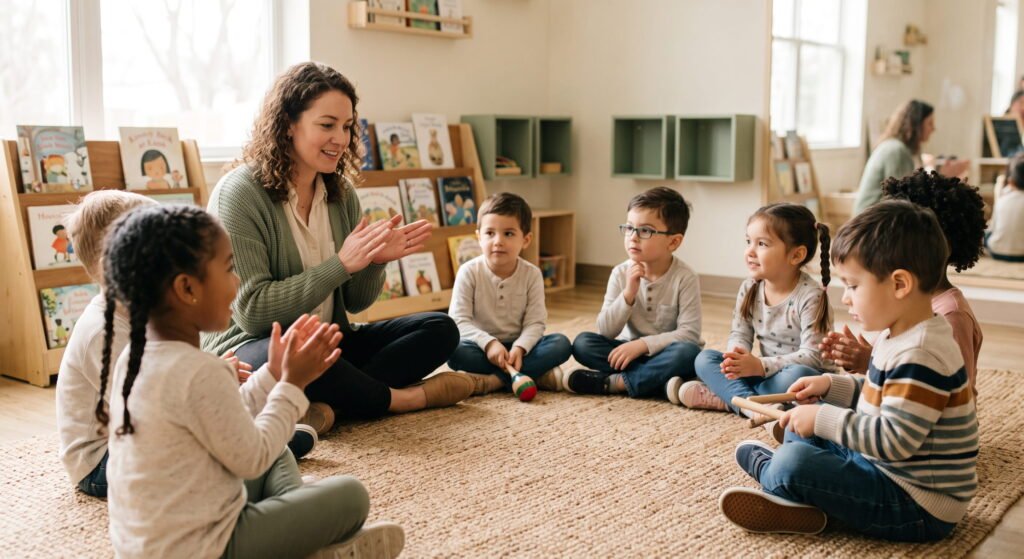
Music and movement bring body, language and relationship together
Songs, rhythm, dance and movement can support coordination, listening, memory, expression, language and social connection. Strong early childhood experiences do not depend on polished performance. They offer many ways to participate—moving, watching, keeping a beat, choosing a song, using an instrument or joining a familiar phrase—while respecting culture and sensory needs.
A tidy music session is not necessarily the most educational one. Children may change the tempo, invent a verse, repeat one movement or turn a scarf into part of a story. Those variations show agency and developing understanding.
Music and movement can happen in planned group experiences, spontaneous play and daily routines. The value comes from regular, responsive participation rather than saving music only for performances or special events.
Rhythm helps children anticipate
A repeated beat or song pattern gives children something to predict. They may pause before a familiar word, copy a clap or change movement when the tempo shifts. Prediction supports attention and memory. Familiar songs can also signal a routine, although cues should remain gentle and should not be used to rush children through necessary care.
Movement develops more than fitness
Turning, reaching, balancing, stopping and crossing the midline require coordination and body awareness. Children learn how much space they need and how their movement affects others. Adults can offer varied pace, level and direction rather than expecting everyone to reproduce the same dance.
Different ways a child might participate
- Watch closely before attempting a movement
- Keep a beat with hands, feet or an instrument
- Sing a repeated word or use gesture
- Choose music or invent a sound pattern
- Move independently, beside others or with a partner
Songs carry language naturally
Repetition, rhyme and melody make sound patterns memorable. Children hear vocabulary in context and can join before they are ready to produce a whole sentence. Teachers can slow a verse, leave space for a child’s contribution or connect a song to books and dramatic play. Music should complement conversation, not replace responsive talk.
Home languages deserve more than translation
A waiata, lullaby or action song can carry identity, history and relationship. Families can share pronunciation, meaning and when a song is appropriately used. Teachers should avoid treating languages as interchangeable sound effects. Accurate, repeated inclusion helps children see their family knowledge valued within ordinary centre life.
Instruments support cause-and-effect learning
Children discover that striking, shaking, scraping and blowing create different sounds. They can compare loud and soft, fast and slow, steady and irregular. Kaiako may model safe use and listening, then allow experimentation. Homemade sound-makers also require attention to secure construction, suitable materials and choking risks.
Volume and group size affect inclusion
Music that energises one child may overwhelm another. Centres can offer smaller groups, quieter instruments, distance from speakers or the option to observe. Adults should watch for distress and avoid demanding participation. Inclusion means finding a meaningful entry point, not requiring identical enthusiasm.
Performance is optional; expression is central
Families may enjoy concerts, but rehearsing for an adult audience should not dominate the curriculum or turn children’s participation into pressure. Daily music can be playful, imperfect and responsive. If a performance is planned, parents can ask how consent, confidence and alternative roles are supported.
Music can organise shared attention
When a group echoes a pattern or moves together, children practise listening and adjusting to others. They can lead and follow, negotiate turns and notice when a peer changes the pattern. Teachers can keep the experience brief enough for the ages involved and allow children to reshape it.
Outdoor and indoor movement offer different possibilities
Indoors may suit finger plays, singing, small instruments and focused listening. Outdoors allows larger travel, louder sound and movement with wind, slopes or open space. Ideas can cross between environments: children may collect natural rhythms outside and represent them with instruments later.
Questions to ask about the programme
- Is music available beyond formal group time?
- How are children’s home languages and cultural knowledge included?
- What choices exist for children who prefer less noise?
- How are instruments selected, maintained and used safely?
- Can children invent, lead and change musical experiences?
Families can continue the conversation at home
You do not need specialist equipment. Tap patterns on a table, sing a familiar routine, move to contrasting tempos or listen for sounds on a walk. Share the child’s favourite songs with the centre and ask what they return to there. The connection becomes especially valuable when a home song carries language or family history.
Music can support transitions without controlling emotion
A familiar melody may help a group anticipate packing away or gathering, but it should not be used to silence distress or demand instant compliance. Children still need explanation, enough time and individual help. Teachers can adjust tempo, volume and expectations when a transition is difficult. When the cue remains dependable and adults respond warmly, music contributes to the routine without becoming background pressure.
Children can compose before they can write music
Inventing a rhythm, choosing the order of sounds or creating a movement sequence are forms of composition. Kaiako can repeat the pattern back, record it or invite the child to develop a visual symbol for it. The emphasis is authorship and variation, not formal notation. Peers may add a response, turning one child’s idea into a shared musical conversation.
Music and movement questions for families
Does my child have to sing in group time?
Ask how the centre supports different forms of participation. Watching, moving or joining one repeated part can all be meaningful.
Can music help language development?
It can support listening, sound patterns, vocabulary and confident participation, especially when combined with responsive conversation.
What if my child is sensitive to noise?
Share this early and ask about volume, group size, quieter spaces and ways the child can participate without overwhelm.
Can we share songs from home?
Yes. Provide words, pronunciation, meaning and any cultural guidance so the centre can use them respectfully.
Contact Childsplay Unlimited
Discover how music and movement are woven into learning at Childsplay Unlimited. Contact Mt Roskill on 09 627 9041 or Kingsland on 09 846 8908 to arrange a visit and discuss your child’s interests and sensory needs.