

Creative arts value the child’s decisions
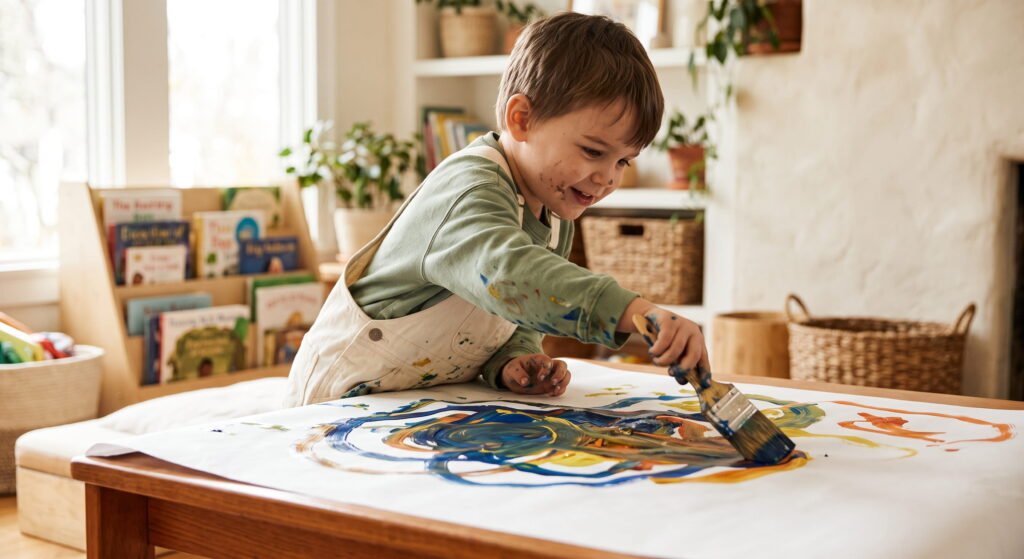
Creative arts in early learning are about exploration, expression and meaning-making, not producing identical items for adults. When children can choose, combine, revisit and discuss materials, they practise coordination, planning, communication and confidence. The process may result in a picture, movement, sculpture or story, but a take-home product is not the measure of learning.
A row of matching crafts can look organised, yet reveal little about what each child imagined or decided. By contrast, a table of paint, clay, collage pieces or drawing tools can lead to very different investigations.
Creative experiences become richer when children have time, safe access to suitable materials and adults who are curious about their ideas. They do not need an adult model to copy before their work is treated as worthwhile.
Process art begins without one required result
Teachers may introduce a technique or material, but children decide how to use it within reasonable boundaries. The focus shifts from ‘Did it look like the sample?’ to ‘What did the child explore, select, represent or revise?’ This allows children at different developmental stages to participate meaningfully rather than being compared against one adult-made standard.
Materials invite sensory and technical discovery
Clay responds differently from paper; charcoal makes a different mark from a brush; fabric folds, stretches and layers. Children learn the possibilities and limits of media by handling them. Teachers help with safe use, introduce vocabulary and make tools accessible while allowing enough experimentation for genuine familiarity.
Learning that may be present in one art session
- Grip, pressure, hand-eye coordination and bilateral movement
- Choice, planning and changing a decision
- Representing an event, feeling, place or imagined idea
- Comparing texture, colour, line, shape and space
- Sharing resources and responding to another person’s work
Not every artwork needs an adult interpretation
Asking ‘What is it?’ can imply that a recognisable object is required. A comment such as ‘You used long lines across the whole page’ may invite the child to explain—or simply continue. Children sometimes explore movement and material without intending to represent anything. That experience is still valid.
Creative work can communicate beyond speech
Drawing, movement, construction and dramatic expression can help children share experiences that are hard to put into words. Adults should avoid diagnosing feelings from an image or pressing for private disclosure. Instead, they can listen if the child chooses to explain and use family knowledge carefully and respectfully.
Time changes the quality of the process
A child may need several encounters before understanding what a tool can do. Longer projects allow planning, drying, rebuilding and collaboration. Teachers can photograph or safely store unfinished work. A creative programme should include quick playful experimentation and opportunities to revisit a more sustained idea.
Display should respect authorship
Children can contribute to decisions about what is displayed and what a label says. Work should not be altered to look more polished without consent. Some children want to take a creation home immediately; others may dismantle it or reuse the materials. Documentation can capture the process when no permanent product remains.
Culture belongs in everyday creative practice
Songs, patterns, materials and art forms carry cultural meaning. Teachers need more than a one-off themed craft: they can work with whānau, use accurate knowledge and make space for children’s languages and identities throughout the programme. Sacred or significant forms should not be copied casually without understanding.
Mess needs planning, not elimination
Paint, water, clay and collage can be managed with suitable clothing, surfaces, handwashing and storage. Families should follow the centre’s advice about named spare clothes. An environment that never permits mess may close valuable possibilities, while an unmanaged setup can exclude children who need clearer sensory choices or predictable boundaries.
Adults can extend without redesigning the child’s work
- Offer a new tool or a larger scale.
- Help the child recall a previous technique.
- Introduce language connected to what is happening.
- Invite collaboration without requiring it.
- Ask whether the child wants to preserve, display or transform the work.
What parents can notice on a visit
Look for variety rather than identical products, and listen to how adults speak about children’s choices. Ask whether materials are available regularly, how younger children are supported and how the centre handles clothing and allergies or sensitivities. A beautiful display is encouraging when it represents authentic child thinking rather than adult correction.
The absence of a product is not the absence of learning
A child may mix colours until the page tears, perform a dance that cannot be carried home or spend the session arranging rather than gluing. The learning may be visible in control, prediction, persistence or expression. Parents can ask what the child was trying, not only what they made.
Digital tools should serve the creative purpose
Photography, audio recording or simple digital drawing can expand creative expression when used intentionally. A child might record a temporary sculpture, layer sounds or revisit movement on video. The device should not replace rich physical materials automatically, and privacy or sharing must follow centre procedures. Ask what the tool enables that would otherwise be difficult, and whether the child remains an active maker rather than a passive viewer.
Creative arts in childcare: parent questions
Why does my child not bring home artwork every day?
The child may have chosen other play, worked on something unfinished or explored a temporary process such as movement, music or arranging materials.
Should teachers show children exactly what to make?
Demonstrating a tool can help, but requiring one copied product can reduce decision-making and individual expression.
What should children wear for art?
Follow the centre’s current guidance and provide named spare clothing where requested; washable materials can still leave marks.
How can families contribute cultural knowledge?
Share accurate stories, language, materials or contacts and discuss how they can be included respectfully rather than as a token activity.
Contact Childsplay Unlimited
Explore creative learning at Childsplay Unlimited. Call Mt Roskill on 09 627 9041 or Kingsland on 09 846 8908 to arrange a visit and ask how children use art, materials and imagination within the current programme.