

A good question creates space for thinking
Open-ended questions invite children to describe, predict, compare, imagine or evaluate rather than recall one expected answer. Their value depends on timing, tone and genuine interest. Kaiako also use comments, listening and pauses, because a conversation crowded with questions can feel like a test and interrupt the very thinking adults hope to support.
‘What colour is that?’ may check a fact. ‘What do you notice about the colours when they meet?’ invites observation. Both questions can have a place, but they do different work.
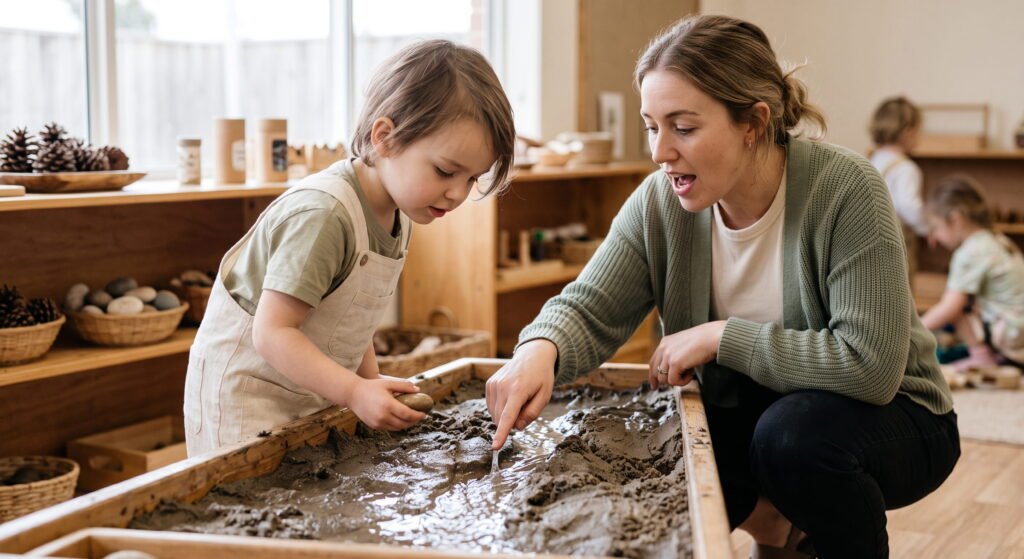
Open-ended questioning is most useful when it grows from an experience children already care about. The adult does not need to know the answer, and the child can respond with words, gesture, action, drawing or another communication method.
Open-ended does not simply mean a longer answer
Some broad questions are still designed to lead children toward the adult’s preferred response. A genuine open question allows more than one defensible idea and gives the child influence over the conversation. ‘How could we make it steadier?’ creates different possibilities from ‘Should you put the big block underneath?’
Timing matters as much as wording
A child who is concentrating on threading, climbing or negotiating may not benefit from immediate questioning. Kaiako can observe, wait for eye contact or comment on what they see. A question offered after the child reaches a natural pause is more likely to extend thought than one inserted to prove that teaching is happening.
Question families that invite different thinking
- Observation: What changed when the water reached the sand?
- Prediction: What do you think might happen if we lift this end?
- Explanation: How did you decide where that piece belonged?
- Possibility: What else could this fabric become?
- Perspective: What might your friend be trying to tell us?
- Evaluation: Which idea worked best for your plan, and why?
Comments can keep conversation natural
Adults can share an observation or a small piece of relevant knowledge before asking anything. ‘That wheel is turning more slowly on the grass’ gives the child something to consider. Ministry oral-language guidance encourages a balance between commenting and questioning so interaction remains reciprocal rather than becoming an interview.
Wait time shows that the answer matters
Children may need several seconds to organise language, translate between languages, recall an event or respond through action. Adults often fill silence too quickly or repeat the question in a new form. A calm pause, attentive expression and protection from interruption communicate that the child’s contribution is worth waiting for.
Questions can support working theories
Children build explanations about how the world works. A teacher can invite them to make the theory visible, test it and compare results. The aim is not to correct every imperfect idea immediately. When children predict and observe, they gain experience changing an explanation in response to evidence.
Conversation can deepen social understanding
Questions about feelings and perspectives should be used carefully, especially during conflict. ‘What happened from your point of view?’ may help after everyone is calm. In the heat of distress, children may first need safety, co-regulation and simple language. Reflection works best when it is not used as a forced apology script.
Include children who communicate differently
An open question should not privilege only fluent speakers. Children may point, demonstrate, select an image or use home language. Teachers can reduce verbal load, offer visual possibilities and notice embodied answers. Families can share useful words and communication strategies so the child’s thinking is not underestimated.
Too many questions can narrow play
If every action attracts adult questioning, children may begin looking for approval instead of testing their own ideas. They may also leave the experience. Strong teaching includes restraint. One carefully chosen prompt, followed by time, can produce more thought than a rapid series about colour, number, shape and purpose.
Parents can use the same approach at home
- Begin with what the child is already attending to.
- Offer a comment before a question.
- Ask one question and allow time for the response.
- Accept surprising ideas and ask for the child’s reasoning.
- Stop questioning when the child returns to concentrated play.
Look for dialogue, not performance
During a centre visit, notice whether adults listen and adapt their next contribution. A strong conversation has turns, uncertainty and genuine connection. The goal is not a child displaying facts for visitors. It is a child experiencing their ideas as meaningful enough to investigate and share.
Questions should not hide an adult correction
Adults sometimes ask, ‘Are you sure?’ when they already intend to reject the answer. Children quickly learn to search the teacher’s face rather than examine their own evidence. When safety requires a correction, it is clearer to give it directly and respectfully. When the idea can be tested, invite a real investigation: ‘How could we find out?’ Honesty about the purpose preserves trust and helps children distinguish between an open inquiry, a request for information and a necessary instruction.
Document the child’s reasoning, not only the adult’s prompt
A learning story becomes more useful when it captures what the child noticed, predicted or changed. Families can then respond to the idea rather than seeing a list of questions asked by the teacher. The child may also revisit their own words, photograph or drawing and decide whether the explanation still fits.
Open-ended question FAQs
Are closed questions always unhelpful?
No. They can clarify facts or routines. The concern is relying on them when the goal is explanation, imagination or problem-solving.
What if a child says ‘I don’t know’?
Pause, comment, simplify the context or let the child respond through action. The question may be mistimed, unclear or too demanding.
How many questions should an adult ask?
There is no fixed number. Follow the quality of the exchange and protect sustained concentration from unnecessary interruption.
Can questions support home languages?
Yes. Families and kaiako can use familiar words, gesture and visual support, while accepting responses in the child’s strongest communication mode.
Contact Childsplay Unlimited
Experience the conversations that support learning at Childsplay Unlimited. Contact Mt Roskill on 09 627 9041 or Kingsland on 09 846 8908 to arrange a visit and ask how kaiako encourage children to explain, predict and wonder.