
Communication begins long before fluent speech
Babies and toddlers communicate through gaze, facial expression, body movement, gesture, sound, rhythm, signs and emerging words. Adults support communication by noticing these attempts, responding as if they matter, using clear language, repeating songs and stories, and leaving time for another turn. Home languages and family meanings belong in this process.
A child does not need a large spoken vocabulary to be an active communicator. Looking toward a desired object, pushing something away, copying a sound or bringing an adult a shoe can carry intention. When adults respond thoughtfully, children learn that communication connects them with people and can influence what happens.
Early learning adds a social setting with multiple adults and children. This creates rich opportunities for listening, gesture, imitation and shared attention, provided teachers do not value spoken words so highly that quieter forms of communication are missed.
First notice what already counts as a message
A baby may widen their eyes, still their body, vocalise or reach. A toddler may point, take an adult’s hand, use one word with several meanings or act out an idea. Teachers combine the signal with context and check their interpretation. Saying ‘You’re looking at the gate; do you want to go outside?’ gives language while leaving room for correction.
Shared attention creates a place for words
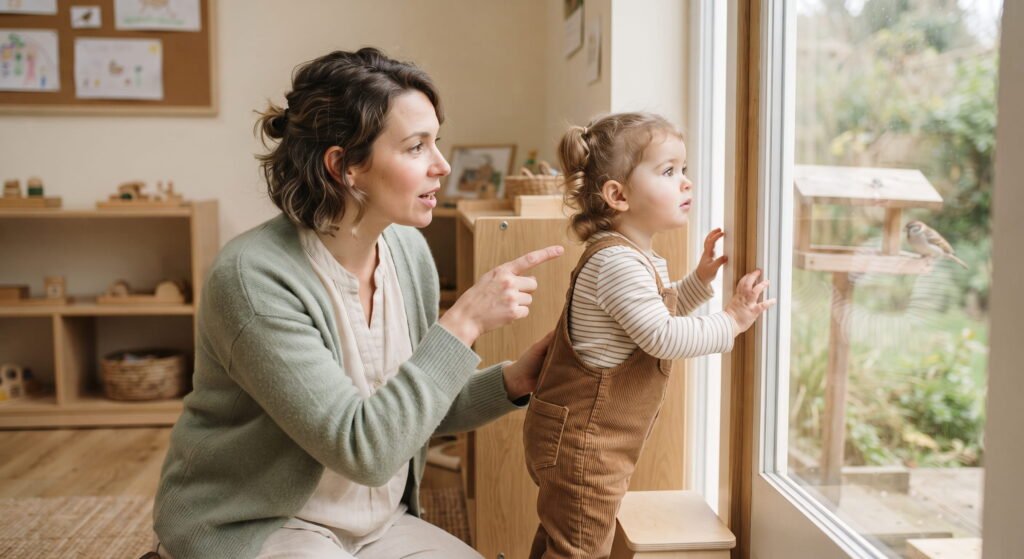
Communication becomes more meaningful when adult and child attend to the same event. Rather than redirecting a child to a planned flashcard, a teacher can name the bird the child is watching, the wheel they are spinning or the splash they made. The word is attached to a real focus. Repeated experiences allow the child to hear and use it in different ways.
Ways a young child may take a turn
- Looking from an adult to an object
- Repeating or changing a sound
- Offering, pointing, reaching or moving away
- Using a home-language word, sign or partial word
- Waiting expectantly for the adult to continue a game
Wait time makes the exchange real
Adults often fill silence quickly. A baby or toddler may need several seconds to process a question, organise a gesture or decide whether to respond. A teacher who pauses with an interested expression gives space for the child’s turn. If no response comes, the adult can continue without framing the silence as failure.
Songs and repeated books build participation
Familiar songs, rhymes and stories offer patterns children can anticipate. A baby may move at a repeated sound; a toddler may supply an action, page turn or final word. The same book can remain valuable through many readings because the child’s participation changes. Teachers can slow down, point, imitate and follow interest rather than rushing to finish the text.
Care routines provide highly relevant language
During a bottle, meal, nappy change or dressing, language can describe the sequence and the child’s action. Words such as more, finished, arm, warm, wipe and lift have immediate meaning. The adult can pair words with gestures and watch the child’s response. These one-to-one exchanges often offer more genuine turn-taking than a large-group question.
Avoid constant testing
Repeatedly asking ‘What is this?’ can make interaction feel like an exam. Comments, expansions and genuine questions provide richer language. If a toddler says ‘truck’, an adult might respond, ‘The red truck is rolling down the ramp,’ then wait to see where the child takes the exchange.
Home languages strengthen identity and meaning
Families should share names, greetings, comfort words, songs and pronunciation from home. Using more than one language does not make a child’s communication less valid. Teachers can learn key words accurately, invite whānau contributions and reflect the child’s language in stories and routines. Ask how the centre supports languages it is still learning to use.
Peers communicate before they can negotiate fully
Babies watch one another, exchange objects and copy sounds. Toddlers may use gesture, movement and short phrases to join play, then need adult help when intentions collide. A teacher can interpret without speaking over the children: name what each appears to want, protect safety and offer language for another turn. Conflict can become communication support rather than a demand to say sorry automatically.
Create a useful home-centre language bridge
- List the child’s current words, signs and consistent gestures.
- Explain any sounds or shortened words that carry a particular meaning.
- Share favourite songs, books and family names with correct pronunciation.
- Ask teachers what new attempts they notice in the group setting.
- Update the list without turning vocabulary growth into a competition.
Know when general advice is not enough
Children develop communication in varied ways, and bilingual or multilingual development should be understood in context. If parents or teachers have a persistent concern about hearing, understanding, interaction or speech, discuss observations and seek advice from an appropriate health or developmental professional. An article can suggest supportive interaction, but it cannot assess an individual child.
Document meaning, not only new words
A learning story can capture how a child initiated an exchange, persisted, understood a phrase or communicated with a peer, even if no new spoken word appeared. This broader record helps families see progress that vocabulary lists miss. Parents can add what the gesture or sound means at home, and teachers can describe the context in which it appeared. Together, those perspectives build a more accurate picture of communication across people, places and languages.
Early communication questions
Does pointing count as communication?
Yes. Gesture, gaze, movement and sound can all express attention, choice, refusal, interest or a request.
Should adults correct every early word?
Usually a natural model is more helpful. Respond with the clear word in a meaningful phrase without making the child repeat it.
Can we share songs in our home language?
Yes. Provide lyrics, pronunciation or a recording where appropriate and ask how the centre can include familiar language respectfully.
What if we are concerned about communication?
Compare specific observations and contact an appropriate health or developmental professional for individual advice.
Contact Childsplay Unlimited
Ask how communication is supported throughout the under-two day at Childsplay Unlimited. Contact Mt Roskill on 09 627 9041 or Kingsland on 09 846 8908 to arrange a visit and share your child’s words, gestures and home languages.