

Movement grows through safe freedom and repetition
Babies and toddlers develop physical confidence by moving often in ways that match their current capabilities: reaching, rolling, sitting, crawling, pulling up, walking, carrying, climbing and balancing. Adults prepare safe spaces, stay close, observe and offer appropriate challenge. Development is variable, so experiences should support the individual child rather than compare milestones competitively.
Movement is not a break from learning for children under two. It is one of the main ways they discover their bodies, distances, surfaces, objects and other people. A small shift in reach or balance can represent sustained effort and problem-solving.
A useful childcare environment does more than contain movement. It gives children repeated opportunities to initiate it, with adults who protect safety without taking over every challenge.
Start from what the child can do today
A teacher can observe how a baby gets into and out of positions, which side they favour, what attracts their movement and when they tire. For a toddler, attention may turn to speed, stopping, stepping over obstacles, carrying or climbing. The next experience should grow from current capability. Placing children into positions they cannot reach or leave independently may remove the problem-solving that builds confidence.
The floor is an important learning space
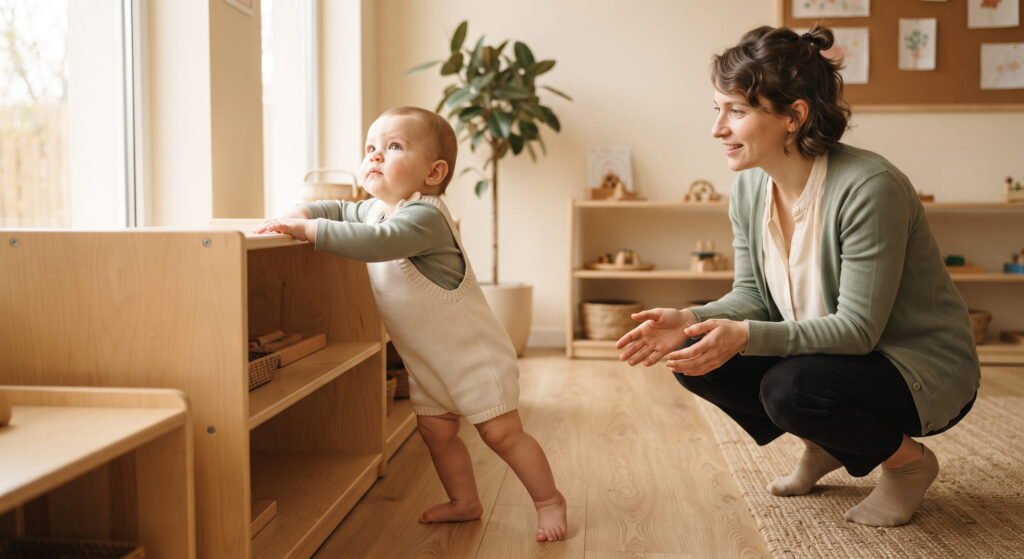
Clear floor time allows babies to turn, reach, roll and shift weight. Interesting objects can be placed within achievable but not automatic reach. Adults can stay nearby without continuously repositioning the child. A clean, safe surface and attentive supervision matter more than a large collection of specialised equipment.
Movement opportunities across stages
- Reaching and turning toward people or objects
- Rolling, pivoting, creeping or crawling across open space
- Pulling to stand at stable low furniture
- Walking while carrying, pushing or changing direction
- Climbing low structures and practising safe descent
Challenge should be possible, not guaranteed
If every task is completed for the child, there is little room to test effort or recover from a wobble. If the challenge is too difficult or unsafe, frustration and risk overwhelm the learning. Teachers calibrate distance, height, stability and support. They may move close, offer a hand without pulling, or show where a foot could go while allowing the child to complete the action.
Outdoor environments change the equation
Grass, slopes, uneven ground, wind and space create physical questions that indoor floors cannot. Toddlers can push, dig, run and transport; babies can experience safe surfaces and watch movement around them. Clothing and weather planning affect access. Ask how the centre offers outdoor movement to under-twos and how more mobile children share space with those still moving close to the ground.
Words can support body knowledge
Simple narration connects movement with language: up, down, through, stop, under, strong push, one foot and turn around. Adults can also name effort and strategy rather than praise only success. ‘You held the rail and moved your foot down’ gives the child information. Too much commentary can interrupt concentration, so teachers watch for when words help and when quiet presence is better.
Confidence is not the absence of caution
A child who pauses at an edge may be judging distance. Allowing time can support safer decision-making. Adults remain responsible for hazards, but they do not need to celebrate impulsiveness or hurry a cautious child. Both confidence and care can grow through supported practice.
Fine and large movements work together
Picking up a lid, turning a page, placing an object into a container and feeding oneself involve coordination alongside the larger movements of posture and balance. A varied day provides both. Care routines also create opportunities: reaching an arm into a sleeve, holding a cup or helping pull a sock can support participation without turning the task into an exercise session.
Families can share useful movement knowledge
Tell teachers what the child is practising, what surfaces are familiar, any professional guidance and any recent change that affects movement. Avoid presenting a milestone date as a deadline. Teachers can share observations from the centre, where peer movement and different equipment may reveal new strategies. Seek qualified health advice if development or movement causes concern.
How to evaluate a movement environment
- Look for clear floor space as well as equipment.
- Check that challenges vary in height, surface and purpose.
- Observe whether adults stay close without automatically doing the movement for children.
- Ask how outdoor access works for babies and young toddlers.
- Notice whether children can rest after active effort.
Physical development is a continuing story
A learning record may show the first visible success, but the deeper story includes weeks of reaching, falling safely, trying another route and watching others. Parents and teachers can celebrate progress while respecting variability. The aim is not to make every child move sooner; it is to give each child safe conditions to become capable and confident in their own body.
Rest and recovery complete the movement cycle
Active exploration uses physical and emotional energy. A responsive programme also makes room for a child to sit close to a teacher, examine a book, drink, eat or sleep according to need. Adults can notice when enthusiasm has become fatigue and reduce the challenge before safety deteriorates. This rhythm teaches that bodies give useful information. Parents comparing centres can ask not only how much movement is offered but also how children move between energetic play, care, nourishment and rest.
Baby and toddler movement questions
Do babies need special exercise equipment?
Usually the essentials are safe floor space, appropriate objects, varied positions reached naturally and attentive adults. Ask about individual needs.
How should adults help with climbing?
Stay close, manage hazards and offer the minimum useful support so the child can participate in solving the movement.
What if my child is developing at a different pace?
Variation is common. Share observations with teachers and consult an appropriate health professional if you are concerned.
Does outdoor play matter for babies?
Yes. Safe outdoor experiences can offer new surfaces, sounds, air, movement and perspectives suited to the child’s stage.
Contact Childsplay Unlimited
See how Childsplay Unlimited supports movement through everyday play. Call Mt Roskill on 09 627 9041 or Kingsland on 09 846 8908 to arrange a visit and discuss your child’s current stage and care needs.