


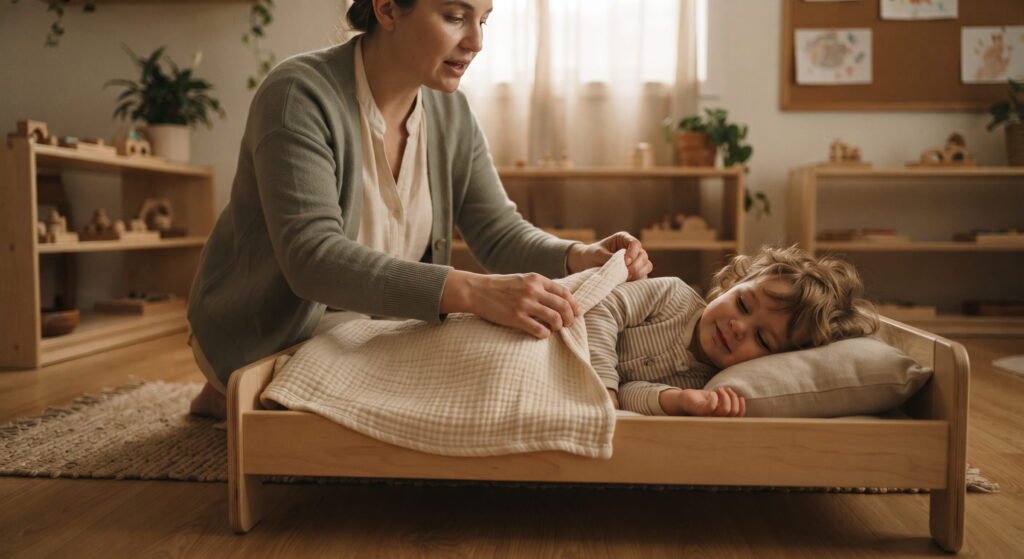
Why one sleep timetable cannot fit every child
Individual sleep routines matter because babies and toddlers differ in sleep frequency, duration, settling cues and changing developmental needs. A centre still needs safe procedures and reliable monitoring, but responsive care uses current family information and careful observation to support rest rather than assuming every child of the same age should sleep at exactly the same time.
Sleep is one of the first topics parents raise when considering care for a baby or toddler. They may worry that a centre schedule will undo a home routine, that their child will not settle in a different space, or that one difficult nap will affect the evening.
These are useful concerns to discuss, not reasons to demand an exact guarantee. Sleep changes with age, health, stimulation and family life. The goal is a safe, communicative partnership in which the centre understands the child’s current pattern and parents understand how rest is supported and recorded.
Start with a sleep profile, not a label
Words such as ‘good sleeper’ or ‘poor sleeper’ hide the information teachers need. Describe approximate nap times, recent changes, tired cues, settling cues, sleep duration and what usually happens after waking. Mention health advice, breathing concerns or anything unusual. State what is essential and what is simply a preference. This gives the team a practical starting point without treating yesterday’s pattern as a permanent schedule.
Tired cues can appear before crying
A baby may look away, become quieter, rub their eyes, lose interest or seek closer contact. A toddler may become unsteady, frustrated or unusually active. Signals vary, and the same behaviour can have another cause. Teachers build knowledge through repeated observation and family dialogue. When adults notice early cues, the transition to rest may feel calmer than waiting until the child is overwhelmed.
Information worth updating
- Wake time and sleep quality from the previous night
- Recent changes to nap number or usual duration
- A new settling cue, comfort strategy or health concern
- Whether teething, illness or travel may affect the day
Predictability can exist without rigid clock times
A familiar pre-sleep sequence can tell a child what is coming: quieter interaction, a repeated phrase, preparation of clothing and a calm transfer to the sleep space. The precise time may move while the sequence remains recognisable. This distinction helps families assess practice. Individualised care does not mean improvising without records; it means using a dependable process responsively.
Safe sleep requirements set non-negotiable boundaries
Licensed early learning centres must provide appropriate sleep arrangements and follow monitoring requirements. Ministry guidance says services must record each sleeping child’s sleep and wake times and when checks occur. Parents should ask to hear the centre’s current sleep procedure, how the environment is supervised, how bedding is managed and what happens if a child is unwell. A home preference cannot override a safe centre procedure.
Questions are more useful than assumptions
Ask where children under two sleep, who can see or access the area, how checks are documented and how the team responds if a child does not settle. Avoid judging safety from decorative appearance alone. A clear explanation of procedure, supervision and records provides more meaningful evidence.
What if the child sleeps differently at childcare?
It is common for context to influence sleep. The sounds, activity, relationships and timing of a centre day are different from home. A child may initially sleep for a shorter period, need another form of reassurance or gradually develop a new pattern. Families and teachers can compare observations over several days. The question is whether the child remains safe and supported, not whether every nap exactly reproduces home.
A changing routine needs a clear feedback loop
- Share the current home pattern and any professional advice.
- Agree on safe settling information the centre can use.
- Review recorded sleep times and the child’s wellbeing after care.
- Notice patterns across several attendances rather than one isolated day.
- Tell the centre promptly when the home routine changes again.
Protect the evening without blaming the nap
If bedtime becomes difficult, record what happened across the whole day: wake time, travel, illness, activity, food, sleep and emotional load. Ask the centre what it observed. A collaborative review is more productive than assuming the nap was too early, too late or too long. Where sleep problems are persistent or concerning, families should seek advice from an appropriate health professional rather than relying on a childcare article.
How to compare two centres on sleep practice
Use the same questions at both visits. Compare the clarity of the process, the team’s interest in your child’s cues, the sleep environment, monitoring explanation and communication plan. Do not assume Mt Roskill and Kingsland use identical room arrangements or procedures. Ask each centre directly and have any child-specific agreement recorded during enrolment and orientation.
The real sign of individual care
Individual care is visible when adults know the child, explain why they responded in a particular way and remain open to new family information. It is not a promise that a baby can sleep anywhere, at any time, by any method. The centre must balance the child’s rhythm with safety, licensing, staffing and the needs of others. Good partnership makes those boundaries understandable.
Individual sleep routine questions
Can a centre follow our home routine exactly?
It can use home information, but safe-sleep procedures, the group environment and the child’s actual cues may mean the routine is not identical.
Are sleep checks recorded?
Current Ministry licensing guidance requires records of sleep and wake times and adult checks. Ask the centre to explain its procedure.
What if my toddler no longer naps every day?
Tell the centre what you observe at home and ask how rest, quiet time and signs of tiredness are handled for that child.
When should we seek health advice?
Contact an appropriate health professional if sleep, breathing, illness or development causes concern. This article is general information, not medical advice.
Contact Childsplay Unlimited
Discuss your child’s current sleep pattern with the Childsplay Unlimited centre you are considering. Call Mt Roskill on 09 627 9041 or Kingsland on 09 846 8908 and ask about sleep spaces, monitoring, records, settling and family communication.