


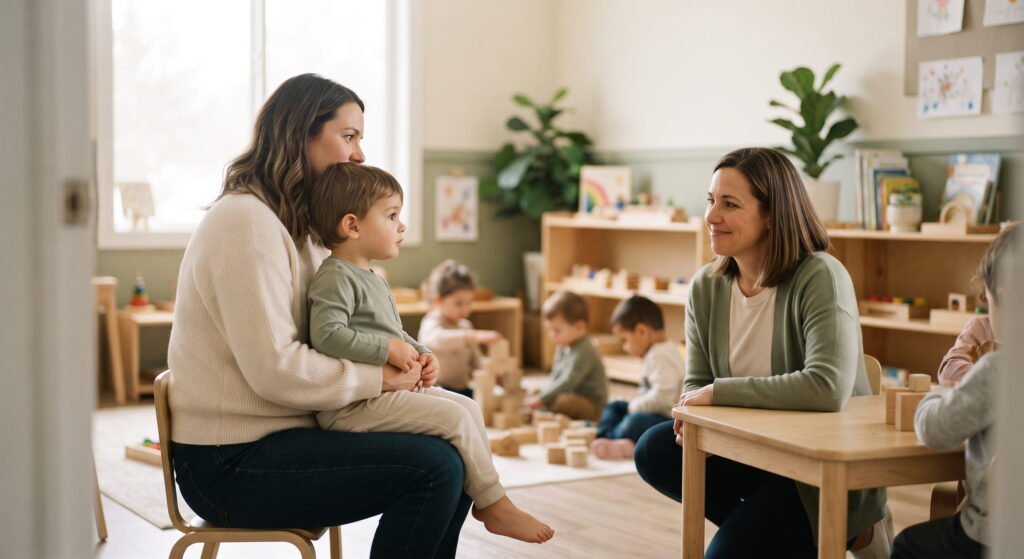
What orientation visits are for
Childcare orientation visits help a child and family meet teachers, explore the environment, learn practical routines and share information before the official start. Visits often begin briefly and may increase in length, but the exact plan should be agreed with the centre. Orientation introduces the relationship; it is not a test a child must pass.
A centre can look very different when children are playing than it does during a quiet tour. Orientation lets the family experience part of the real day while still having time to notice, ask and reconnect. It also gives teachers information they cannot learn from a form alone.
There is no single number of visits that suits every child. Age, temperament, previous care, family availability and the centre’s process all influence the plan. The useful question is what each visit is meant to achieve.
Before the first visit: remove practical uncertainty
Confirm the centre address, arrival time, visit length, parking or access instructions and who will meet you. Ask what the child should bring and whether siblings can attend. Complete urgent health or safety information before the visit. When adults are not searching for the entrance or filling forms at the last minute, they can focus on the child’s experience.
Visit one: meet without demanding participation
The child may watch from a parent’s lap, move immediately into play or alternate between both. None of these reactions is a pass or fail. Follow the teacher’s lead, notice where the child pauses and allow exploration without repeated prompting. Share the child’s name, preferred words, interests and ways of seeking comfort. A calm first visit can be valuable even if it remains short.
Visit two: follow a meaningful part of the routine
Choose a period the child will commonly experience, such as morning play, an outdoor transition or a meal, subject to the centre’s advice. This reveals practical details: where belongings go, how handwashing happens, how teachers gather children and where a child can retreat from busy activity. Parents can see how information moves between adults rather than judging only the room’s appearance.
Questions to answer through observation
- Who notices when the child seeks help?
- How are arrivals and departures handled?
- Where can a child find quieter play?
- How do teachers support transitions without rushing?
- What information does the family need to share each day?
A later visit: practise a short separation if appropriate
When the centre and parent agree, the adult may step away for a short, clearly explained period. Say goodbye rather than disappearing. Tell the child who will stay and when the adult will return in language they can understand. The teacher can then observe what support helps. The purpose is to gather information and build trust, not to prove the child can cope alone for a predetermined time.
Use orientation to transfer care knowledge
- Describe the child’s usual sleep and feeding pattern.
- Explain allergies, medication and health plans.
- Share words, gestures and comfort cues used at home.
- Identify current interests, fears and recent family changes.
- Confirm authorised collectors and emergency contacts.
What to notice after each visit
The child may show excitement, tiredness, clinginess or little visible reaction. Record what drew their attention, which adult they approached and what seemed overwhelming. Ask the teacher what they noticed too. Use the observations to plan the next visit or first day. Avoid repeatedly asking the child whether they ‘liked daycare’; younger children often communicate more clearly through play and behaviour.
Keep orientation centre-specific
Mt Roskill and Kingsland have separate teams, environments and operating hours. An orientation at one does not familiarise a child with the other. Book visits directly with the centre the child will attend and verify current visit processes, session availability, meals, supplies and first-day expectations. Do not apply Mt Roskill operational information automatically to Kingsland.
Move from visiting to belonging
On the official start day, repeat the useful elements from orientation: the same entrance, greeting, goodbye phrase and place for belongings. Share any change in sleep, health or collection plans. Orientation cannot eliminate every emotion, but it gives the child familiar anchors and gives teachers a stronger starting point for responsive care.
Orientation is useful for parents too
Use visits to practise what the adult will do, not only to observe the child. Learn where to sign in, who receives medication, how urgent messages are sent and which questions belong in a longer conversation. Notice your own uncertainty and ask for clarification before the first busy morning. A confident handover comes from knowing the process, not from hiding every emotion.
Finish with a shared first-day plan
Before the last visit ends, agree on the arrival time, receiving teacher or team, goodbye approach, packing requirements, expected communication and authorised collector. Decide what the centre should do if the child remains very distressed. Write the plan down. The first day can still be emotional, but adults will not need to negotiate the basics in front of the child. Ask when the plan will be reviewed and who the family should contact if an important detail changes before the start date. Bring the written summary to the final visit and correct misunderstandings together.
Orientation visit questions
How many visits will my child need?
There is no universal number. Agree on a plan with the centre based on the child, family and service process.
Should a parent leave during orientation?
A short separation may be useful when the centre and parent agree the child is ready. Always use a clear goodbye.
What if my child only watches?
Watching is a valid way to gather information. Avoid forcing participation and discuss what the teacher observed.
Do visits guarantee the selected place?
No. Confirm enrolment, availability and the booked start date separately with the centre.
Contact Childsplay Unlimited
To arrange orientation, contact the Childsplay Unlimited centre your child will attend. Call Mt Roskill on 09 627 9041 or Kingsland on 09 846 8908 and confirm the current visit process, enrolment status and proposed start date.